

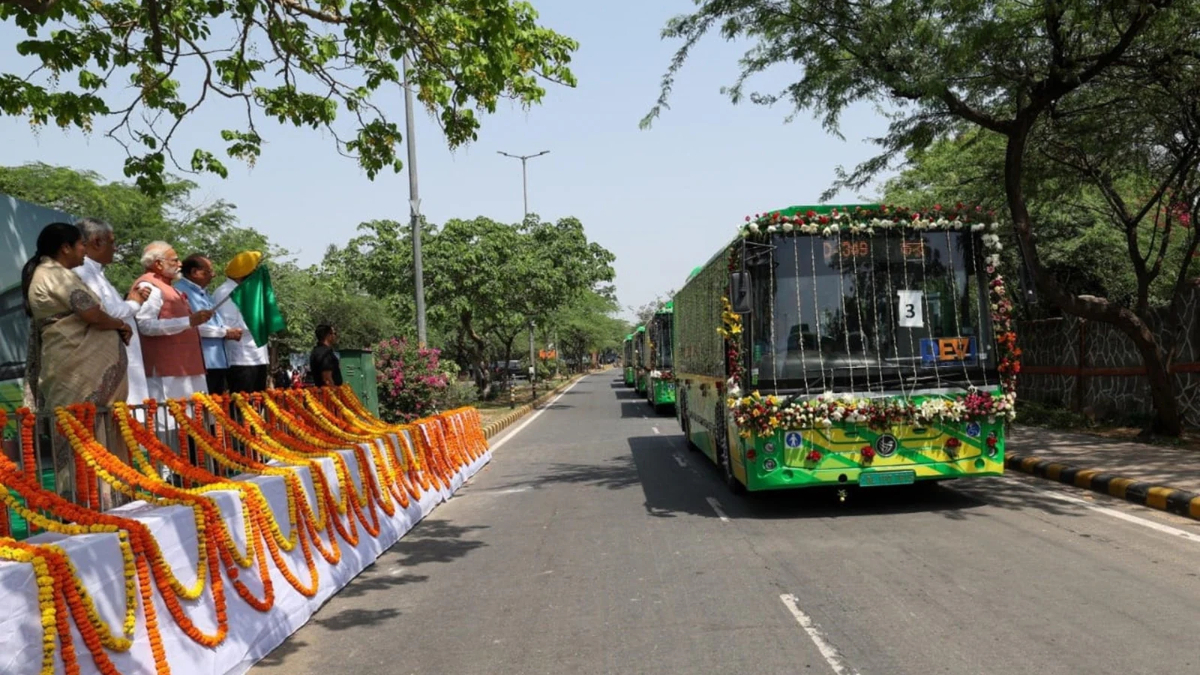
New Delhi, June 12, 2026 — The Uttar Pradesh government has kicked off a massive, state-wide celebration to mark the completion of 12 years of the Narendra Modi-led Central Government. Championed by Chief Minister Yogi Adityanath, the milestone is being integrated into public-awareness campaigns across the state. The crown jewel of today’s celebrations is a major upgrade to the National Capital Region’s (NCR) public transit network: the official flagging off of a brand-new fleet of air-conditioned electric buses destined for Noida, Greater Noida, and the Yamuna Expressway Industrial Development Authority (YEIDA) zones.
Connecting milestones of governance with green infrastructure development, the dual-purpose initiative targets two major objectives: highlighting more than a decade of welfare and infrastructure programs, while directly addressing local transit demands. Crucially, the launch is timed right before commercial flight operations begin at the highly anticipated Noida International Airport in Jewar on June 15, 2026.
A Mass Movement in Lucknow and Varanasi
Chief Minister Yogi Adityanath explicitly directed state machinery to transform these political milestones into active public movements. Rather than keeping the celebrations restricted to formal government buildings, the state has scheduled block-level health fairs, night chaupals (rural public grievance forums), and massive sanitation drives.
The Chief Minister began the morning in Lucknow at Lok Bhavan, addressing the media regarding the Union Government’s track record of public service. Accompanied by leaders from National Democratic Alliance (NDA) alliance partners—including Apna Dal (S), the Suheldev Bharatiya Samaj Party (SBSP), the Rashtriya Lok Dal (RLD), and the Nishad Party—Yogi Adityanath inaugurated a comprehensive developmental exhibition highlighting shifts in poverty alleviation, economic growth, and regional infrastructure over the last 12 years.
Later in the evening, the Chief Minister will travel to Varanasi, Prime Minister Modi’s parliamentary constituency. At the Girija Devi Cultural Complex in Chaukaghat, he will honor local beneficiaries of the Urban Livelihood Mission and the Industries Department. The venue features dedicated promotional zones highlighting regional heritage, such as the “One District-One Dish” campaign alongside local handicraft stalls.
Green Transit Takes the Wheel in Noida
The most visible, immediate upgrade for everyday citizens took place via a remote link from the Chief Minister’s official residence in Lucknow. Collaborating via video conferencing across three simultaneous local venues—Shilp Haat in Noida, the Dadri bus depot in Greater Noida, and the Medical Devices Park in the YEIDA area—the state launched the initial phase of its eco-friendly public transit push.
In this first rollout phase, 45 electric buses completed their dry runs on Thursday and are officially hitting the streets today. The operational split deploys 11 buses each to the Noida, Greater Noida, and Yamuna Expressway zones, with an extra 12 stationed for local transit duties in Lucknow. By June 15, the operational fleet will scale rapidly to 110 total e-buses under the management of the Uttar Pradesh State Road Transport Corporation (UPSRTC), with viability gap funding financed by the Noida Authority.
Connecting the New Noida International Airport
The routing architecture of the newly introduced e-buses reveals a hyper-focus on seamless multi-modal connectivity, intentionally anchored around the opening of the Jewar Airport. Commuters can expect buses to run at intervals of 30 to 60 minutes.
Beyond local commuter routes, the network links directly to external regional transit hubs. Routes extending to Sarai Kale Khan, Anand Vihar, Ghaziabad, and various Inter-State Bus Terminals (ISBT) ensure that travelers coming out of Delhi or deeper parts of UP can transition easily to the airport. To complement the state-run network, regional officials have confirmed parallel transport partnerships. UPSRTC will operate long-distance connecting routes from Agra, Aligarh, Hathras, and Mathura straight to the Jewar terminal, while neighboring Haryana Roadways and the DTC will run dedicated lines from cities like Faridabad, Gurugram, and Chandigarh.
Pricing and State EV Goals
To keep the service universally accessible, the state has rolled out a highly affordable, structured fare map. During the initial introductory period, short commutes will feature low base fares, capped at a maximum of Rs 30. Once the full multi-tier fare matrix settles into regular operations, ticketing will scale transparently across three flat price points based on travel distance.
This localized e-bus launch functions as part of Uttar Pradesh’s wider green mobility macro strategy. The state currently leads the country with approximately 15.5 lakh registered electric vehicles. To sustain this massive volume, the State Transformation Commission has accelerated investments in localized power infrastructure. With over 2,500 commercial charging stations currently operational, the state is actively on track to hit its target of 10,000 functional EV charging stations by 2030.
By combining political celebration with functional, forward-looking environmental infrastructure, the UP government is using this 12-year milestone to firmly position the Delhi-NCR expansion zone as a modern blueprint for sustainable urban transport.
