

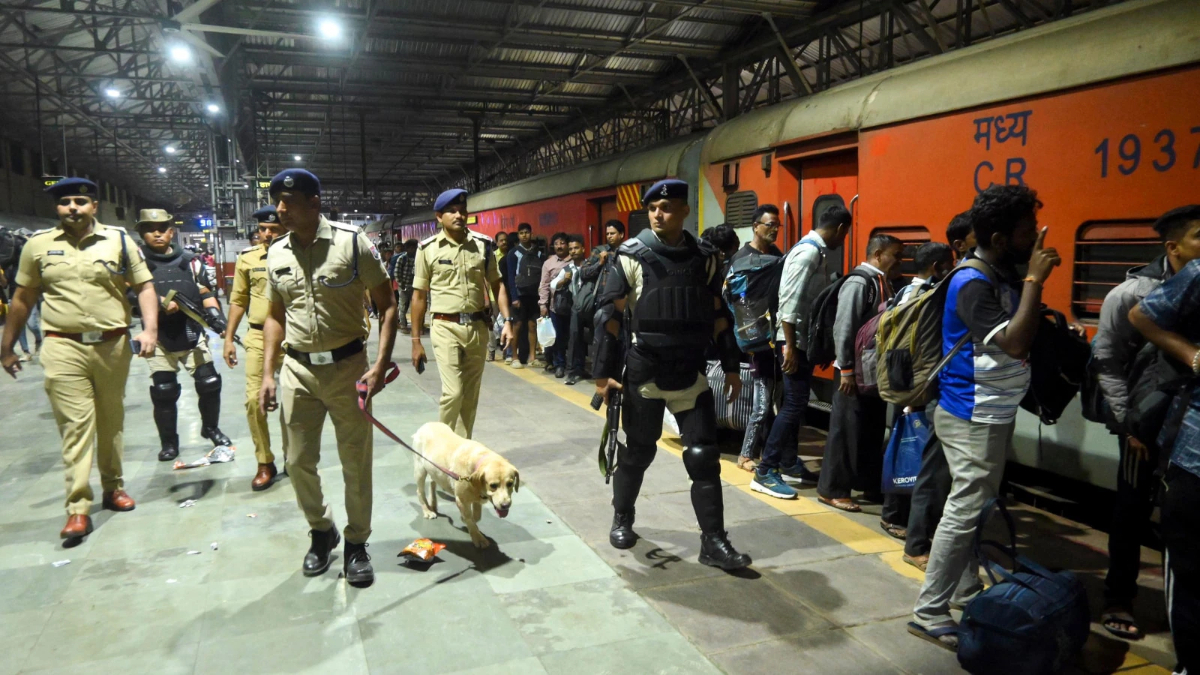
New Delhi, June 15, 2026: A devastating and deeply tragic accident unfolded near Hetampur railway station in the Morena district of Madhya Pradesh on Sunday afternoon, June 14, 2026. A chaotic series of events triggered by a completely false rumor of a fire aboard one train led to a mass panic, causing passengers to leap onto adjacent tracks. Tragically, four people—including three women and a young child—were run over and killed instantly by a high-speed express train traveling in the opposite direction.
The incident has sent shockwaves through the region, casting a spotlight on the deadly power of misinformation and public panic in crowded transport spaces.
The Origin of the Chaos
The disaster began at approximately 4:15 PM inside a general coach of the Khajuraho-Udaipur Intercity Express (Train 19665). According to eyewitness accounts and local law enforcement, the train was carrying a large number of families, many of whom were returning from a pilgrimage to the revered Bageshwar Dham.
The spark that ignited the stampede-like situation was remarkably minor. Inside one of the unreserved coaches, a sudden confusion arose near the mobile charging sockets. Some passengers reported hearing a popping noise or seeing sparks, leading to a localized fear that a phone battery had exploded. Amidst the tight, crowded space of the general bogey, someone suddenly panicked and screamed that the entire coach was catching fire.
The word “fire” acted like a wildfire itself. Within seconds, sheer terror gripped the 100 to 120 passengers packed inside the coach. Unable to verify the truth and desperate for safety, passengers rushed toward the emergency exits. A woman pulled the Alarm Chain Pulling (ACP) mechanism, causing the brakes to lock and forcing the heavy train to screech to a sudden halt on a section of the track between Hetampur and Dholpur, within the Jhansi Railway Division.
A Fateful Leap Onto the Tracks
Even before the Khajuraho-Udaipur Intercity Express had fully stopped, terrified passengers began throwing open the doors and jumping out onto the gravel embankments. In their frantic bid to distance themselves from what they believed was a burning train car, dozens of passengers climbed over the adjacent tracks to the opposite side.
Unbeknownst to them, the train had stopped along a sharp, 1.8-degree curved section of the railway line. This specific geography proved fatal. The curve drastically limited the visibility of both the people standing on the ground and the operators of oncoming traffic.
Moments after the passengers alighted, the Firozpur-Seoni Patalkot Express (Train 20424) came barreling down the adjacent line from Agra, moving at a high speed. Because of the curved tracks, the passengers standing directly on the line failed to see or hear the approaching locomotive until it was too late.
The Fatal Collision and Victim Profiles
The locomotive pilot of the Patalkot Express spotted the crowd on the tracks at the last second and immediately engaged the emergency braking system. However, given the immense momentum of a fast-moving passenger train, it was impossible to bring the heavy engine to a sudden stop. The train slammed into the helpless group of people.
The impact killed four individuals on the spot. Local authorities and railway officials later identified the deceased as:
- Afreen, aged 35
- Ashad, aged 4
- Shakuntala, aged 60
- Veerma Devi, aged 58
According to Morena Collector Lokesh Kumar Jangid, the tragedy tore families apart across state lines; two of the women and the child hailed from Uttar Pradesh, while the third woman was from Rajasthan.
The raw heartbreak of the incident was captured in the gut-wrenching testimony of a surviving male passenger. He recounted to news agencies how he and his family had jumped from the Intercity Express following the fire shouts. While he stepped back into the carriage to retrieve one of his children left behind in the rush, his wife stood on the tracks outside holding their other child. In that split second, the Patalkot Express rushed past, killing both his wife and child instantly before his eyes.
Immediate Response and Investigation
The gruesome accident triggered immediate alarm across the railway network. Teams from the Railway Protection Force (RPF), Government Railway Police (GRP), and Morena district administration rushed to the rural site alongside local police units led by Morena Superintendent of Police Dharmaraj Meena.
Ambulances were deployed to transport several injured individuals to nearby civil hospitals in Morena, while rescue workers meticulously recovered the bodies from the tracks for post-mortem examinations.
The catastrophic incident severely disrupted rail traffic along the vital trunk line for several hours. Both trains were temporarily detained as safety inspectors combed the tracks and ensured that no further civilians were in danger. After emergency clear-outs were finished and the tracks were officially declared safe, both the Intercity Express and the Patalkot Express were permitted to resume their journeys toward their respective destinations.
No Fire Found: Railways Confirm False Alarm
A thorough, immediate inspection of the Khajuraho-Udaipur Intercity Express by railway mechanics and technicians confirmed the worst irony of the disaster: there was absolutely no fire on board.
Anirudh Kumar, the Divisional Railway Manager (DRM) for the Jhansi Railway Division, issued a formal statement clarifying the situation. “Following the emergency chain-pulling, our teams checked the bogeys thoroughly. There was no fire, no smoke, and no evidence of a mobile phone blast. It was entirely a false rumor that caused mass panic,” Kumar explained.
The Indian Railways and local police have since launched a comprehensive joint investigation to track down the exact origin of the rumor. Authorities are reviewing whether the panic was a result of a tragic, honest misunderstanding among passengers over an electrical spark, or if malicious mischief played a role. Furthermore, safety experts are reviewing the incident to see if any additional protocols can prevent crowd surges and rash detrainments during emergency chain-pulling scenarios in the future.
This horror in Morena serves as a grim and sobering reminder of how panic can easily outrun logic, turning a completely harmless situation into an unforgettable mass tragedy in a matter of seconds.