

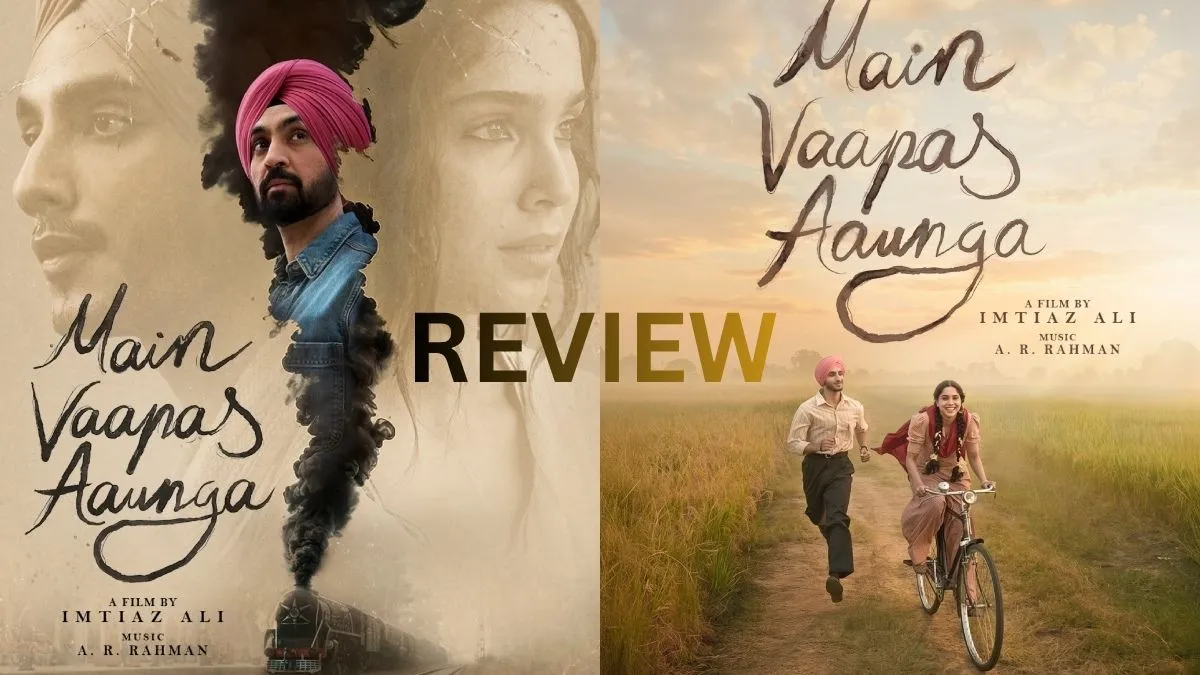
New Delhi, June 15, 2026: Every once in a while, a piece of cinema arrives that reminds us why we tell stories. Director Imtiaz Ali’s period romance drama, Main Vaapas Aaunga, which arrived in theatres on June 12, 2026, tries to do exactly that. The movie tackles a massive, painful subject: the 1947 Partition of India.
While the film itself has faced mixed reactions from critics for being a bit muddled, long, and uneven, there is one thing everyone agrees on: Naseeruddin Shah is absolutely brilliant. Plagued by sluggish initial box office numbers, the movie is currently leaning entirely on the legendary actor’s performance to pull audiences into theatres. Shah takes a complicated, messy script and elevates it into a deeply moving human tragedy.
A Mind Trapped in the Past
The story of Main Vaapas Aaunga jumps between two different times. In the present day, we meet Ishar Grewal (played by Naseeruddin Shah), a 95-year-old Sikh patriarch who is severely ill and living out his final days. Ishar has dementia and has suffered a major stroke. To his adult sons, his constant talking sounds like complete nonsense. He speaks in slurred, broken words, rambling about “Martians” with blue skin who spread hatred, and comparing them to figures like Adolf Hitler.
However, his grandson, Nirvair (played by a restrained and soulful Diljit Dosanjh), refuses to ignore these outbursts. Nirvair, who is dealing with his own feelings of isolation as a migrant in London, starts listening closely. He realizes his grandfather’s mind isn’t just failing; it is traveling backward in time.
Ishar is mentally trapped in 1947. He completely forgets the 78 years he lived in India after the border was drawn. Instead, his subconscious is stuck in Sargodha (now in Pakistan), remembering the short 17 years of his youth.
Through these memories, the movie flashes back to a vibrant, undivided Punjab. A younger Ishar, known affectionately as Keenu (played beautifully by Vedang Raina), falls deeply in love with a young woman named Jiya or Afsana (played by Sharvari Wagh). Their sweet, old-school romance is filled with secret glances, playful chats, and bad Urdu poetry. But their happiness is violently cut short by the Partition. Forced to flee to India, young Keenu leaves behind a desperate, heartfelt promise to his first love: “Main vaapas aaunga” (I will return).
Where the Film Fumbles
This is where the movie gets complicated, and where some critics feel Imtiaz Ali lost his way. Main Vaapas Aaunga tries to do too many things at once. At times, it wants to be an epic, heartbreaking historical film about the Partition. At other times, it shifts into a family drama about generational trauma. And in some chapters, it feels like a spiritual successor to Ali’s older films like Love Aaj Kal, contrasting a modern young man’s confusion about commitment with an old man’s eternal love.
Because the movie tries to wear so many different hats, the pacing slows down significantly. Running at nearly 167 minutes, the script occasionally drops the ball. It introduces heavy political commentary and social themes that don’t always connect smoothly with the central love story. Some subplots feel like screenplay chores that do not lead to a satisfying payoff.
Furthermore, the film tries very hard to remain strictly neutral and avoid taking political sides. Ironically, this cautious approach makes some of the social commentary feel detached from the real, brutal history of 1947. If you take away the historic backdrop, the core plot is a familiar story about a young couple from different religions who are separated by circumstance.
Elevating the Chaos
Despite these flaws in the script, Naseeruddin Shah turns the film into a must-watch experience. Playing a dying man who is mostly bedridden and speaking a language that is not his native tongue could have easily become a caricature. Instead, Shah is pitch-perfect.
He communicates a lifetime of regret, longing, and unresolved grief with just a single look or a heavy silence. When his character tries to drive a car all the way to Pakistan, only to be stopped at the border because he genuinely does not understand why a line separates him from his home, it breaks your heart.
Shah’s performance bridges the gap between the film’s messy writing and its emotional core. He takes the “gibberish” his character speaks and gives it an eerie, poetic weight. His rants about “Martians” become a powerful metaphor for how normal people can suddenly turn into violent mobs when blinded by hatred. Through Shah’s eyes, the Partition isn’t a political event found in a history book; it is a sudden, terrifying natural disaster that permanently shattered human hearts.
The Supporting Cast and Soulful Music
The rest of the cast does a commendable job supporting Shah’s powerhouse performance. Diljit Dosanjh delivers a grounded, quiet performance as the caring grandson. He serves as the perfect guide for the audience, helping us translate and understand the old man’s pain.
In the flashback sequences, Vedang Raina is incredibly charming as the youthful version of Shah’s character, wearing a traditional turban and capturing the naive innocence of young love. Sharvari Wagh is equally radiant on screen, using her eyes to express the deep grace, hope, and eventual honesty of a romance cut short by history.
Adding to the emotional depth of the movie is the musical score by the legendary A.R. Rahman, with lyrics by Irshad Kamil. While some viewers noted that the soundtrack lacks the immediate, radio-friendly pop hits of typical Bollywood films, the background music functions beautifully as a “balm of tenderness.” Tracks like Kya Kamaal Hai and Maskara blend smoothly into the background, capturing the bittersweet ache of a love story that never got the chance to grow old.
While the film may struggle to make a major mark at the box office due to its slow pace and scattered focus, it remains a valuable piece of artistic cinema. It is a restless, ambitious project that reminds us of the immense human cost behind political borders. If you are willing to look past a muddled screenplay, go see it for Naseeruddin Shah. He takes a flawed film and transforms it into a timeless, haunting poem about memory, love, and the universal longing for home.