

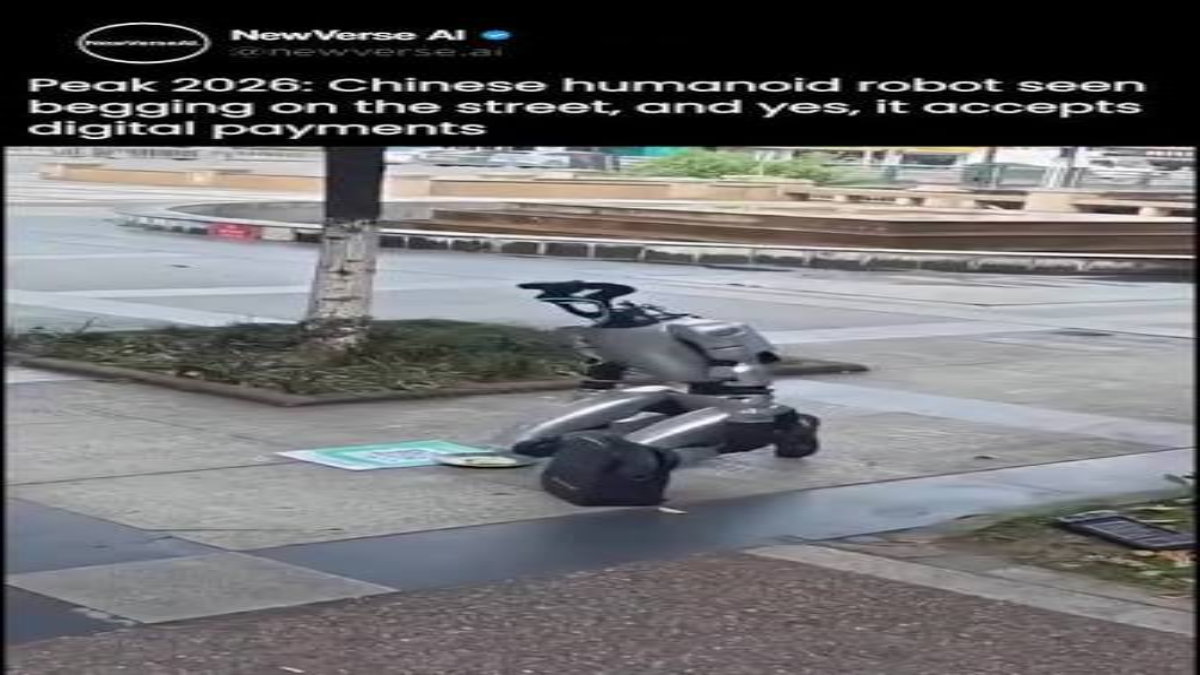
New Delhi, June 16, 2026: A bizarre and deeply futuristic scene has taken social media by storm, sparking a massive global conversation about the rapid evolution of artificial intelligence and robotics. An 11-second viral video capturing a sleek, metallic humanoid robot kneeling on a public plaza sidewalk in China has gone viral. Dressed with a backpack on its shoulders, a collection bowl in front of it, and a large, prominent digital payment QR code lying flat on the ground, the machine was seen actively soliciting financial help from startled passersby.
As pedestrians approached the scene, the android didn’t just sit statically. It utilized dynamic hand gestures and an integrated voice module to actively plea for assistance. The robot repeated heartbreakingly automated phrases like, “My battery is running low, please help!” In the footage, a curious citizen can be seen walking up to the kneeling machine and placing a small item into its bowl, while others stand back, documenting the surreal, dystopian sight on their smartphones.
Staged Spectacle or the Future of Panhandling?
The video immediately split opinions across tech forums, Reddit, and global media outlets. Many viewers quickly pointed to the obvious humorous elements of the presentation. The narrative that a multi-million dollar piece of high-tech hardware was forced onto the streets because it lacked the pocket change to “buy electricity” for a battery recharge is highly comical.
Technology experts and local analysts suggest that the incident was almost certainly a staged marketing stunt or a controlled performance art piece rather than a rogue, autonomous robot down on its luck. Chinese tech companies frequently test the boundaries of their newly developed androids in public spaces to observe human-robot interaction or to draw massive crowds. Whether it was an independent content creator pulling a futuristic prank, a corporate promotional campaign, or an artistic critique of modern society, the display effectively weaponized two things China is globally famous for: cutting-edge humanoid robotics and a virtually cashless, QR-code-driven economy.
The Reality Behind China’s Humanoid Boom
While the video may be an orchestrated stunt, the underlying technology is very real—and expanding at a breakneck pace. The sight of a robot on a public sidewalk is becoming increasingly common in China due to a massive, state-backed industrial push. The government has unleashed an “AI+” industrial strategy with intense targets to deeply integrate artificial intelligence and embodied AI (robots with physical forms that interact with the environment) into everyday infrastructure.
Major Chinese robotics firms and newcomers are racing to mass-produce these machines, triggering what industry insiders call an “involution”—a period of extreme, hyper-competitive price wars. Because barriers to entry for entertainment-focused, semi-humanoid, and customer-service robots are dropping quickly, developers are finding wild and creative ways to showcase their products in the real world. From performing complex choreographed dances at the annual Spring Festival Gala to operating in specialized smart factories, humanoids are stepping out of heavily guarded research labs and into public view.
A Cashless Dystopia
What makes this video uniquely representative of modern Chinese society is the presence of the QR code. In major Chinese cities, physical paper currency is rapidly becoming a relic of the past. From high-end luxury boutiques to elderly street vendors selling vegetables, almost all local commerce is conducted digitally via platforms like WeChat Pay and Alipay.
Even traditional, human street performers and beggars in urban centers have transitioned to using printed QR codes pasted on boards or bowls, allowing pedestrians to transfer micro-donations instantly with a swipe of their smartphones. By giving the humanoid robot its own payment code, the creators of this video perfectly mirrored the existing economic landscape, wrapping a highly advanced piece of machinery in a familiar societal habit.
The Ethical and Social Questions Left Behind
Even if this specific 11-second clip is proven to be an intentional publicity stunt, it has opened up a fascinating psychological and ethical conversation regarding how humanity will coexist with independent machines.
- The Empathy Factor: Why do humans feel a sudden urge to “help” a piece of metal when it mimics a position of vulnerability? The fact that a passerby felt compelled to drop an object into the robot’s bowl shows how easily human empathy can be triggered by behavioral design.
- Public Space Regulation: As semi-autonomous robots become cheaper to build, cities will soon have to face complex regulatory questions. If a company can set up a robot to beg, advertise, or perform on a sidewalk, how will municipal authorities manage public space, pedestrian flow, and digital safety?
- Digital Scams and Security: A rogue QR code placed in a public area can easily be swapped by malicious actors to redirect funds or phish data from unsuspecting citizens. The “cute” or “novel” factor of a begging robot could easily be exploited for digital theft.
The image of a gleaming metallic android kneeling on a concrete sidewalk, holding its hand out for digital currency, serves as a vivid symbol of our current technological crossroads. As the boundaries between science fiction and daily life continue to blur, the viral robot of China reminds us that the future is no longer arriving—it is already kneeling on the sidewalk, asking for a quick charge.