

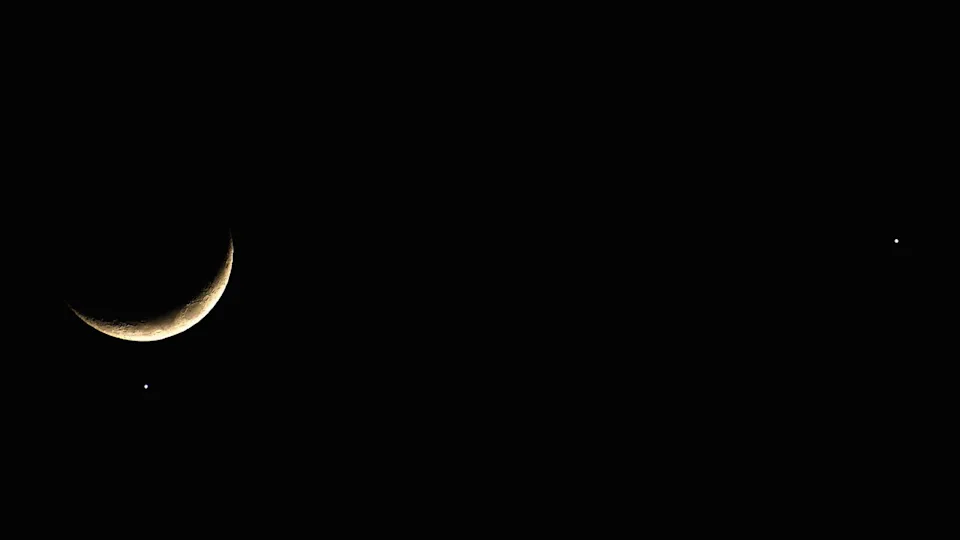
June 16, 2026 — If you step outside shortly after sunset tonight, you will be treated to one of the most delicate and beautiful celestial displays of the year. Following the dark, moonless nights of the recent New Moon on June 14, a slender sliver of silver light is returning to the evening sky. Tonight, June 16, the Moon enters its Waxing Crescent phase, offering skywatchers a breathtaking visual treat, especially as it aligns with some of our solar system’s brightest planets.
Whether you are a seasoned astronomer or just someone who enjoys looking up at the night sky on a clear evening, tonight’s lunar display is an event you won’t want to miss.
What the Moon Looks Like Tonight
Tonight, the Moon is just under two days old in its current 29.5-day lunar cycle. Because it has only recently moved away from its position between the Earth and the Sun, only a tiny fraction of its visible surface will be illuminated.
Depending on your precise global location, the Moon’s illumination will sit between 2.2% and 6%. To the naked eye, this appears as an incredibly thin, razor-sharp crescent of light hanging low on the western horizon.
Understanding the Waxing Crescent Phase
The word “waxing” means growing, indicating that the amount of illuminated surface area is increasing each night as the Moon journeys toward its next major milestone: the First Quarter Moon on June 21, followed by the Full Moon on June 29.
Spotting the “Da Vinci Glow”
Because the crescent itself is so thin tonight, the sky will remain relatively dark. This creates the perfect opportunity to witness a spectacular phenomenon known as Earthshine, or the Da Vinci Glow.
Earthshine occurs when sunlight reflects off the Earth’s oceans and clouds, throwing a faint, ghostly light back onto the dark, unlit portion of the Moon. Instead of seeing just a bright floating crescent, you will likely be able to see the dim, eerie outline of the entire lunar ball floating in the twilight.
The Main Event: A Cosmic Triangle in the Night Sky
While a Waxing Crescent is beautiful on its own, tonight’s sky offers something truly extraordinary. As darkness falls, the Moon will team up with two major planets—Mercury and Jupiter—to form a striking, elongated celestial triangle low in the western sky.
Just 24 hours ago, Mercury reached its greatest eastern elongation, meaning it is currently at its farthest point from the sun from our point of view and exceptionally easy to spot. Tonight, the Moon sits just above Mercury and Jupiter.
- When to Look: The best time to catch this alignment is roughly 30 to 60 minutes after sunset. Half an hour after the sun dips below the horizon, the trio will sit about 10° high. By an hour after sunset, they will drop to about 8°, so you will need a clear view of the western horizon, free of tall buildings or trees.
- Surrounding Stars: Just to the upper right of the Moon, the twin stars of Gemini—Pollux (the brighter of the two) and Castor—will begin to pierce through the fading twilight.
- The Venus Factor: If you look further to the upper left of Jupiter, the dazzlingly bright planet Venus will be shining brilliantly in the constellation Cancer. Astronomers note that the Moon is rapidly tracking toward Venus, setting up a rare daytime occultation (where the Moon passes directly in front of Venus) tomorrow afternoon.
Tips for Observing and Photographing Tonight’s Moon
Because tonight’s Moon is incredibly low and thin, you do not need expensive equipment to enjoy it, but a little bit of planning goes a long way.
Because the planets and the Moon are bright, modern smartphone cameras utilizing a “Night Mode” should easily be able to capture this planetary parade. Hold your phone steady, or prop it against a solid surface, to capture the brilliant colors of the post-sunset twilight alongside the celestial trio.
Looking Ahead in the June Lunar Cycle
Tonight’s Waxing Crescent is just the beginning of an exciting couple of weeks for lunar observation. As the Moon continues its counterclockwise orbit around the Earth, it will grow noticeably wider and climb higher into the night sky with each passing evening.
Over the next few days, it will leave Mercury and Jupiter behind, sweeping past Venus and moving steadily through the zodiac constellations. If you miss tonight’s sky show, keep your eyes trained upward over the coming days as the light steadily reclaims the lunar face, building toward a brilliant summer Full Moon at the end of June.