

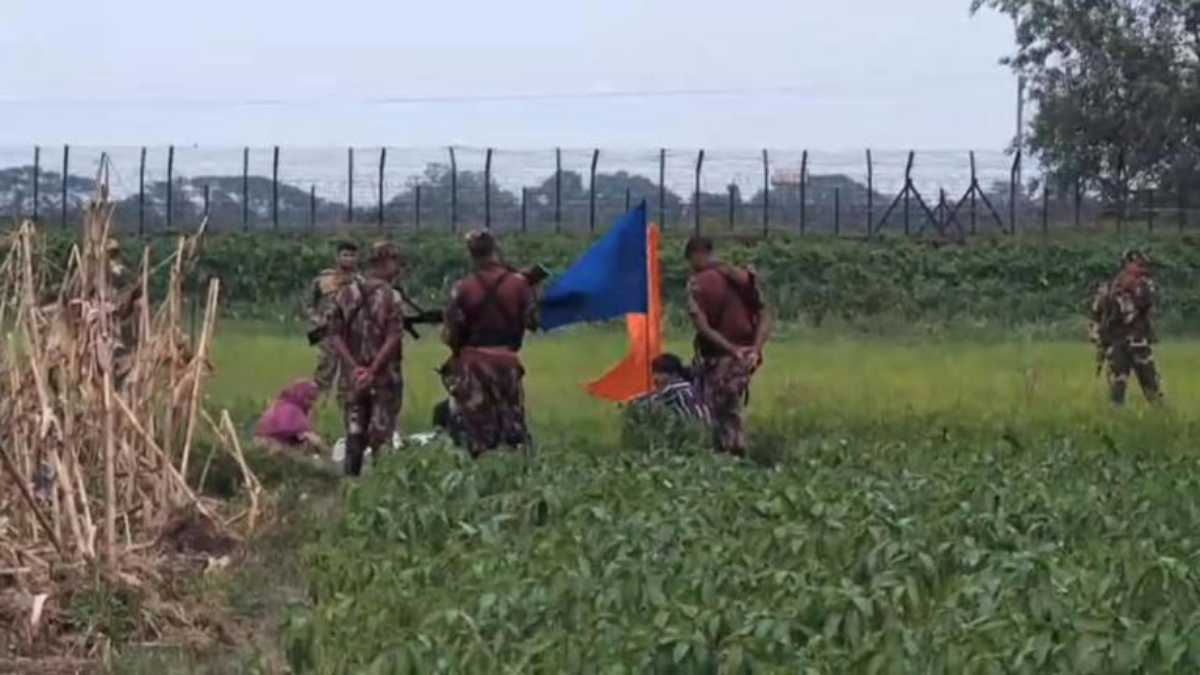
New Delhi, June 17, 2026: High-level diplomatic intervention and swift tactical coordination between border security forces successfully defused a volatile situation on Tuesday night. This followed the cross-border abduction of an elderly Indian farmer from the “Zero Line” along the India-Bangladesh border in Assam’s Cachar district.
The victim, identified as Ranjit Das (aged between 65 and 77 according to varying official records), a resident of Chandinagar Part-II village, was forcibly taken by a group of suspected Bangladeshi miscreants on Tuesday morning. Following intense high-level deliberations and a flag meeting between the Border Security Force (BSF) and the Border Guard Bangladesh (BGB), Das was safely returned to Indian authorities at around 10:00 PM the same night.
While his safe return has brought immense relief to his family and the frontier village community, the incident has reignited serious concerns regarding the safety and security of Indian agrarian workers who cultivate land outside the international border fencing.
The Abduction on the Zero Line
The alarming incident unfolded around 11:00 AM on Tuesday in the Kinnorkhal border area, which falls under the Katigorah assembly constituency in Cachar district. As part of a routine and heavily regulated security protocol, the BSF opens the border gates daily at around 7:00 AM. This measure allows local Indian farmers access to agricultural land that lies beyond the barbed-wire fence but remains strictly within Indian sovereign territory, close to the Surma River.
On Tuesday morning, a group of approximately 16 to 17 local farmers, including Ranjit Das and his younger brother, Kalimohan Das, crossed the fence to plow fields and harvest grass for cattle fodder. According to eyewitnesses and family members, the farmers had completed their morning work and were preparing to head back inside the fence when the crisis began.
Kalimohan Das recounted that their plow experienced a mechanical glitch, delaying their exit from the patch of land near the Zero Line—the immediate geographical strip where the distinct borders meet. In those few unsupervised moments, a group of seven to eight unidentified men crossed over from the Bangladeshi side.
“They suddenly rushed in and grabbed hold of him,” Kalimohan alleged. “Before we could fully comprehend what was happening, they threatened him and began dragging him forcibly across the border line.”
Eyewitness accounts indicated that the miscreants acted with immense speed, capitalizing on the temporary distance between the farmers and the nearest BSF outpost. By the time an alarm could be raised, Das had been ferried across the unfenced international line into Bangladeshi territory.
Retaliation Rumors and Diplomatic Backchannels
As news of the brazen daylight abduction spread, panic and anger gripped the frontier villages of Cachar district. Hundreds of tense local residents gathered near the border fence, prompting additional BSF deployments to prevent any spontaneous law-and-order escalations.
Top regional administrative and political figures quickly descended on Kinnorkhal to assess the brewing crisis. Silchar Member of Parliament (MP) Parimal Suklabaidya, Katigorah MLA Kamalakshya Dey Purkayastha, and Cachar Superintendent of Police (SP) Sanjib Kumar Saikia met with the local population and the victim’s distraught family to guarantee an immediate response.
While security agencies initiated backchannel communication, Ranjit Das’s family claimed they received an anonymous phone call from an individual in Bangladesh. The caller alleged that the abduction was not a random criminal act, but rather a targeted retaliation for a previous border incident involving the death of a Bangladeshi national. Though senior Indian defense officials refrained from validating these claims, the underlying geopolitical friction added massive urgency to the rescue efforts.
Recognizing the potential for severe escalation, the BSF’s 170 Battalion immediately formally lodged a strong protest with their counterparts, the Border Guard Bangladesh (BGB). Command-level operations swung into action, demanding an urgent flag meeting and the immediate tracking of the missing Indian citizen.
The Safe Release and Medical Care
Following hours of intense, high-level diplomatic discussions, the BGB confirmed they had located Das and taken him into custody from the local miscreants. Before handing him over, Bangladeshi authorities conducted a routine medical examination on Das to log his health status.
Late Tuesday night, at roughly 10:00 PM, a formal border flag meeting concluded at the Bhanga Border Outpost (BOP). BGB officials safely handed Ranjit Das back to a joint team of the BSF and Cachar police, effectively ending his ten-hour ordeal.
Although early statements from certain BSF officials indicated that Das was returned in stable health, subsequent medical reviews revealed a more complex situation. Upon his transfer back into India, officials discovered that the elderly farmer had sustained visible physical injuries, including head trauma and severe bruising across multiple parts of his body.
Das was rushed by emergency transport to the Katigorah Model Hospital, where he was admitted for comprehensive treatment and monitoring. While he explicitly expressed gratitude to the Indian government and security forces for saving his life, he has remained visibly shaken and has not yet given a detailed statement regarding the precise nature of the treatment he received while in captivity. SP Sanjib Kumar Saikia noted that a formal investigation is underway and more clarity will emerge once the elderly man recovers sufficiently from the psychological and physical shock.
Fencing Gaps and Farmer Safety
The dramatic abduction has brought critical focus back to the structural vulnerabilities along the 32-kilometer international border that Cachar district shares with Bangladesh. While India has systematically constructed heavy barbed-wire fencing along its frontier segments, vast stretches on the immediate Bangladeshi side remain completely unfenced, leaving the zero-point agricultural lands exposed to cross-border incursions.
Speaking directly from the border village, Silchar MP Parimal Suklabaidya highlighted the unique security risks that local agrarian communities face.
“Many of our Indian citizens have legally held and cultivated portions of agricultural land situated on the Indian side of the zero line for decades,” Suklabaidya stated. “This incident forces us to completely re-evaluate our field security infrastructure. I will formally request the Union Home Ministry to implement significantly tighter patrolling and reinforce security arrangements during the designated farming hours so that our citizens do not have to risk their lives to earn a livelihood.”
Local village councils have also called for static BSF pickets near active farming clusters along the Surma River to ensure that rapid-response units are within arm’s reach if external miscreants attempt future incursions. For now, a fragile peace has returned to Kinnorkhal, but the underlying anxiety felt by those who till the edges of the nation remains palpable.