

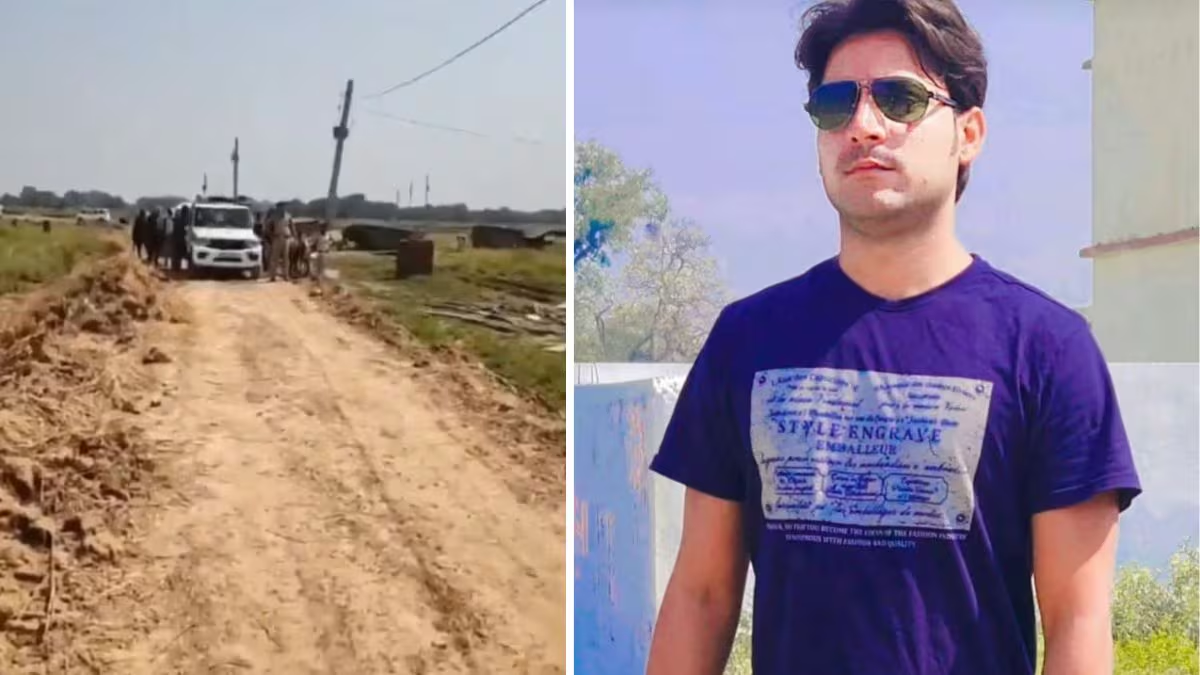
New Delhi, June 25, 2026: The fatal shooting of 28-year-old local activist and social media commentator Bharat Bhushan Tiwari in a police operation on June 17, 2026, has ignited a major political and public controversy across Bihar. The incident occurred in Bilauti village, located under the Shahpur police station limits in Bihar’s Bhojpur district. Following intense public protests and escalating political tension, a Public Interest Litigation (PIL) was filed in the Supreme Court of India seeking an independent, court-monitored investigation into what critics and the deceased’s family allege was a premeditated extra-judicial killing.
Who Was Bharat Tiwari?
Bharat Bhushan Tiwari was a well-known local resident of Bilauti village in Bhojpur district. To his 1.6 lakh Facebook followers, he was a vocal digital activist who frequently used social media platforms to broadcast live updates and commentary regarding local civic grievances. He actively campaigned for administrative transparency, raised public awareness about bureaucratic corruption, and fiercely advocated for the rehabilitation and compensation of local families displaced by severe regional flooding and river erosion.
While local residents and community members described him as a spirited social worker dedicated to highlighting the hardships of marginalized rural populations, local administrative authorities maintained a different perspective. Following a series of critical social media posts directed at the local administration, the Bhojpur police issued an official statement on June 16, 2026—just one day before the fatal encounter—characterizing Tiwari as “mentally unstable.” The police asserted that they had initiated a process to take him into safe custody in order to transport him to a mental health facility for medical treatment.
The Fatal Encounter and Conflicting Versions
The controversy stems from the stark contradictions between the official police account and visual evidence captured during the final moments of Tiwari’s life.
According to the official statement released by the Bihar Police and the Special Task Force (STF), a joint security team arrived in Bilauti village on the morning of June 17 after receiving reports that Tiwari was brandishing an illegal weapon and firing into the air. Law enforcement officials claimed that despite repeated instructions to surrender, Tiwari opened fire on the approaching personnel, discharging eight to ten rounds. The police maintained that security forces were forced to retaliate in self-defense, during which Tiwari sustained non-fatal bullet wounds to his lower body. Authorities reported that he succumbed to his injuries while being transferred to the Patna Medical College and Hospital (PMCH).
However, this version has been strongly disputed by Tiwari’s family and local eyewitnesses, who point to a Facebook Live video recorded by Tiwari just minutes before his death. The footage shows Tiwari standing on a rural road between open fields, addressing his digital audience while surrounded by heavily armed STF personnel wearing bulletproof vests. In the video, Tiwari states that he has been assured his administrative demands regarding flood victims will be met and declares his willingness to surrender. He is then seen firing a final shot into the air before tossing his pistol away toward the police officers to signal his complete surrender.
Tiwari’s family contends that despite being completely unarmed and surrendering peacefully, he was shot multiple times at close range. His mother, Asha Devi, and younger brother, Chandan, have publically accused the local police of executing a calculated, cold-blooded murder to silence his ongoing criticism of local governance.
Public Outrage and Political Repercussions
The news of the encounter immediately triggered massive demonstrations across the Bhojpur region. Aggrieved family members and hundreds of local villagers placed Tiwari’s body on the Ara-Buxar four-lane highway, completely blocking traffic for hours as they demanded justice and the immediate arrest of the involved police officers.
The incident quickly escalated into a full-scale political crisis for the ruling state government. Senior political figures across party lines, including opposition leaders and members of the ruling alliance, expressed deep concern over the operational methodology of the state police. Prominent political leaders, including independent MP Pappu Yadav, former Union Minister Ashwini Choubey, and regional political figures, visited the grieving family to offer condolences and openly question the legitimacy of the encounter. Critics argued that the incident reflects an alarming rise in an “encounter culture” and the emulation of aggressive, extra-judicial policing models.
In response to the mounting political fallout and public demonstrations, Bihar Chief Minister Samrat Choudhary announced a high-level judicial inquiry on June 20, 2026. The investigation will be spearheaded by a retired High Court judge to ensure transparency and uncover the exact sequence of events. Furthermore, the state administration took immediate disciplinary action by suspending six police personnel, including the local Station House Officer (SHO), pending the outcome of the comprehensive inquiry.
Case Reaches the Supreme Court
Seeking to move the investigation outside of state control, Advocate Vishal Tiwari filed a Public Interest Litigation (PIL) under Article 32 of the Constitution in the Supreme Court of India. The petition explicitly seeks the establishment of an independent expert committee, led by a retired Supreme Court judge, alongside a central probe by the Central Bureau of Investigation (CBI).
The legal plea argues that the circumstances surrounding Tiwari’s death represent a profound breakdown of the constitutional framework and a direct threat to the rule of law. It highlights that the police assume an illegal role as judge, jury, and executioner when resorting to extra-judicial killings rather than utilizing the established judicial process. The petition emphasizes that Tiwari had no prior criminal antecedents or pending chargesheets, and details the specific timeline of the police declaring him “mentally unsound” less than 24 hours before utilizing lethal force against him.
During an initial presentation of the matter, a Supreme Court bench headed by Justice B.V. Nagarathna declined an immediate urgent hearing, directing the petitioner to formally mention the plea before the Registrar first to follow standard listing protocols. Despite the lack of immediate interim intervention from the apex court, the legal challenge has put immense pressure on the state apparatus to conduct an uncompromised, objective investigation into the operational conduct of the Bhojpur police force.