

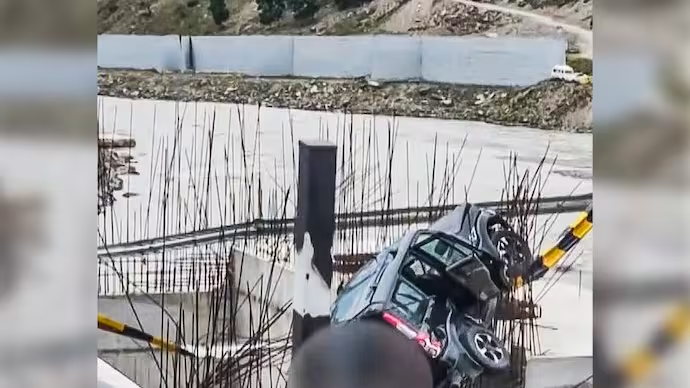
New Delhi, July 2, 2026: A late-night drive turned into a horrific tragedy for a group of young vacationers when a Mahindra Scorpio SUV careened out of control just after exiting the north portal of the iconic Atal Tunnel. The vehicle violently crashed through roadside safety barriers, plunging several feet down onto an under-construction concrete bridge over the Chandra River.
The freak accident, which occurred on Tuesday night around 9:00 PM, claimed the life of a 34-year-old tourist from Rajasthan and left three others severely injured. The impact of the crash was exceptionally brutal; the SUV plummeted onto a section of the unfinished bridge where exposed structural framework—including sharp, thick iron reinforcement bars (rebars)—pierced through the vehicle’s body, trapping the occupants in a mangled cage of steel.
The Tragic Sequence of Events
The group of four friends was traveling from the popular resort town of Manali toward the scenic Lahaul Valley. Driving through the 9.02-kilometer-long Atal Tunnel—the world’s longest highway tunnel above 10,000 feet—the journey had been smooth. However, the situation changed dramatically the moment the vehicle crossed into the north portal near Sissu.
According to preliminary investigations by the local police, the Scorpio was traveling at a very high speed. As the vehicle exited the brightly lit, straight lanes of the tunnel into the darkness of the mountain road, the driver was suddenly confronted with a sharp turn. Unable to negotiate the curve due to the excessive velocity, the driver lost complete control of the heavy SUV. The vehicle veered off the tarmac, shattered the perimeter barricades, and went airborne before crashing onto the concrete piers and unfinished deck of the adjacent bridge under construction.
A Challenging Rescue Operation
The sound of the violent crash echoed through the valley, immediately alerting nearby workers, local residents, and the tunnel’s security staff. Emergency calls quickly mobilized teams from the regional police department, the fire brigade, and local administrative rescue units, who rushed to the accident site.
When the first responders arrived, they were met with a grim and technically challenging scene. The Scorpio was crushed and wedged tightly into the unfinished masonry. Because multiple steel rebars protruding from the bridge structure had impaled the vehicle, standard extraction methods were impossible.
Using specialized cutting tools, hydraulic equipment, and sheer physical force, firefighters and police personnel meticulously worked through the night to cut through the reinforced iron and twisted sheet metal. The complex rescue operation took considerable effort before the emergency teams could safely extricate the victims from the wreckage and rush them to the nearest hospital.
Casualties and Victim Identification
Tragically, one passenger succumbed to massive trauma sustained during the impact and died on the spot. Local authorities have identified the deceased as Kailash Kumar (34), a resident of Mandota village in the Sikar district of Rajasthan.
The remaining three occupants survived the drop but sustained severe injuries. They were stabilized at a local medical facility and continue to undergo treatment. The injured individuals have been identified as:
- Rajendra, a resident of Mandla village in the Sikar district, Rajasthan.
- Siddharth Singh Shekhawat, the driver of the vehicle, from Khatu Shyam in Sikar, Rajasthan.
- Aditya, a resident of the Lakhimpur Kheri district in Uttar Pradesh.
The body of the deceased was shifted to the local mortuary for a post-mortem examination. Law enforcement officials confirmed that Kailash’s family has been formally notified of the tragedy, and his remains will be handed over once family members arrive in Himachal Pradesh.
Police Investigation and Safety Warnings
While speeding has been noted as the primary catalyst behind the crash, the Kullu and Lahaul-Spiti police have registered a formal case and are investigating the incident from all possible angles. Investigators are checking whether mechanical failure, sudden low visibility upon exiting the tunnel, or driver fatigue played a role in the fatal turn.
Mukesh Rathour, the Station House Officer (SHO) of the Sissu Police Station, addressed the press regarding the ongoing hazards on high-altitude highways. He noted that the influx of tourist vehicles passing through the Atal Tunnel has grown exponentially, bringing drivers who are often completely unaccustomed to the unique dangers of mountain driving.
Local administrations have repeatedly issued strict advisories urging drivers to adhere to the rigid speed limits enforced inside and outside the tunnel. Regrettably, despite highly visible road signs, speed cameras, and frequent patrolling, accidents caused by reckless and negligent driving continue to plague this high-altitude corridor.