

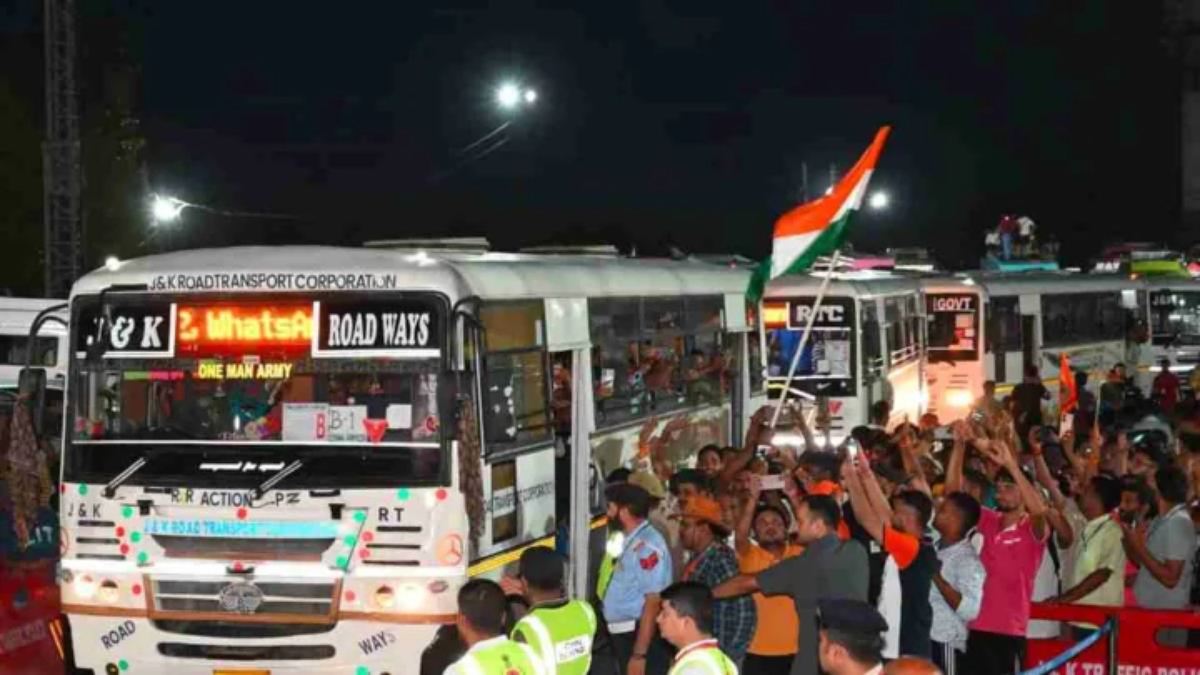
New Delhi, July 2, 2026 — The air at the Bhagwati Nagar Base Camp in Jammu reverberated with thunderous chants of “Bam Bam Bhole” and “Har Har Mahadev” early Thursday morning, July 2, 2026, as the first official batch of the annual Amarnath Yatra was officially flagged off. Marking the formal commencement of the 57-day-long spiritual pilgrimage, Jammu and Kashmir Lieutenant Governor Manoj Sinha sent off the eager devotees under an extensive, multi-layered security blanket. The atmosphere was a profound blend of high emotional fervor and intense vigilance, setting a hopeful tone for a safe and spiritually fulfilling journey.
High Spirits and Spiritual Awakening
The flag-off ceremony saw an enthusiastic turnout of over 4,800 pilgrims who embarked from the Yatri Niwas base camp in a heavily guarded convoy of 259 light and heavy vehicles. For these devotees, the journey across the rugged terrain of the South Kashmir Himalayas is the ultimate testament of faith. They travel to pay obeisance at the holy cave shrine of Shri Amarnath Ji, located at a daunting altitude of 3,888 meters (12,756 feet), where a natural ice stalactite—revered as the physical manifestation of Lord Shiva—forms every summer.
Speaking at the launch, Lieutenant Governor Manoj Sinha described the Amarnath Yatra as a deep path of spiritual awakening. He emphasized that every step taken toward the holy cave shrine reflects an unwavering surrender to divine forces. Wishing the pilgrims a blissful, safe, and comfortable journey, the LG prayed for prosperity and peace across the region. Prominent religious leaders, senior officers from the civil administration, police heads, and representatives from the Shri Amarnathji Shrine Board (SASB) joined the ceremony to boost the morale of the departing faithful.
Unprecedented Multi-Layered Security Matrix
Given the geopolitical sensitivity of the region, security has been amplified to an unprecedented level this year. Ground forces from the Jammu and Kashmir Police, the Central Reserve Police Force (CRPF), the Indian Army, and other paramilitary branches have woven a tightly integrated defensive grid along the entire pilgrimage route. Armed personnel are stationed heavily at crucial choke points, vulnerable mountain passes, and highway intersections.
A core element of this year’s security framework is the reliance on real-time technology. Every single registered pilgrim has been issued a personalized, mandatory Radio Frequency Identification (RFID) card. Equipped with built-in GPS capabilities, these chips allow centralized control rooms to monitor individual locations continuously, ensuring quick assistance during medical crises or sudden weather disruptions. Furthermore, bulletproof armored vehicles are actively escorting every moving convoy along the strategic Jammu-Srinagar National Highway.
Upgraded Highway Infrastructure and Transit Routes
The journey from Jammu to the Kashmir valley base camps has been significantly improved by major infrastructure milestones. Pilgrims traveling this year are benefiting from the recently opened 3.5-kilometer tunnel connecting Digdole and Panthyal, as well as the newly completed 810-meter viaduct near Ramsoo. These engineering feats bypass historically dangerous stretches of the Jammu-Srinagar National Highway that were prone to frequent landslides and shooting stones.
From the highway, the convoy splits toward the two traditional base camps in Kashmir. The pilgrimage officially opens to the cave from these base points on Friday, July 3:
- The Baltal Route: Winding through Ganderbal in central Kashmir, this is the sprint version—a steep, rigorous 14-kilometer climb that most fit pilgrims complete within two to three days.
- The Pahalgam Route: Originating in the Anantnag district of South Kashmir, this traditional 46-to-48-kilometer track offers a gentler slope spread out across four to five days, snaking through breathtaking meadows and high-altitude mountain streams.
Logistical Preparedness and Food Safety
Managing crowd logistics for an event of this magnitude requires seamless coordination among multiple government branches. The Indian Railways division in Jammu has implemented sweeping crowd-management protocols at the Jammu Tawi railway station. Special ticketing checks, reinforced Government Railway Police (GRP) personnel, and helpful youth volunteers like scouts and guides have been positioned to steer arriving pilgrims smoothly toward their designated transit buses.
Health and hygiene are also receiving high priority. Dedicated food safety teams from the Food and Drugs Administration are inspecting the dozens of community kitchens—known locally as langars—set up by non-governmental organizations along the routes. Officials are monitoring cooking hygiene, ingredient quality, and clean water supplies to prevent foodborne illnesses among the trekking devotees.
Health Restrictions and Medical Checks
Because the high altitude presents serious risks of acute mountain sickness (AMS) and cardiac stress, the SASB has enforced strict medical guardrails. No pilgrim between the ages of 13 and 70 is allowed onto the mountain trails without a certified Compulsory Health Certificate (CHC). For the 2026 season, these certificates must have been issued on or after April 8, 2026, by authorized state-vetted medical clinics. Pregnant women beyond six weeks are strictly prohibited from attempting the high-altitude trek.
For affluent or physically frail travelers, commercial helicopter services have been made operational up to the Panchtarni halt. However, officials remind pilgrims that no flights land at the cave itself; the final six kilometers from Panchtarni must be crossed on foot, by horseback, or using traditional palanquins (palkis).
A Horizon of Expectations
With the first batch safely en route to the valley, expectations are high for a landmark season. Political leaders across party lines, including the Leader of the Opposition in the J&K Assembly, Sunil Sharma, have expressed optimism that the 2026 yatra could break past participation records due to enhanced highway connectivity and superior tracking arrangements.
The 57-day event will draw to a formal close on August 28, 2026, coinciding with the auspicious festival of Raksha Bandhan. On that final day, the Chhari Mubarak—the holy saffron-cloaked mace of Lord Shiva—will be carried into the cave by custodians, concluding one of the most culturally profound and logistical feats in modern India.