
 has ordered the immediate removal)
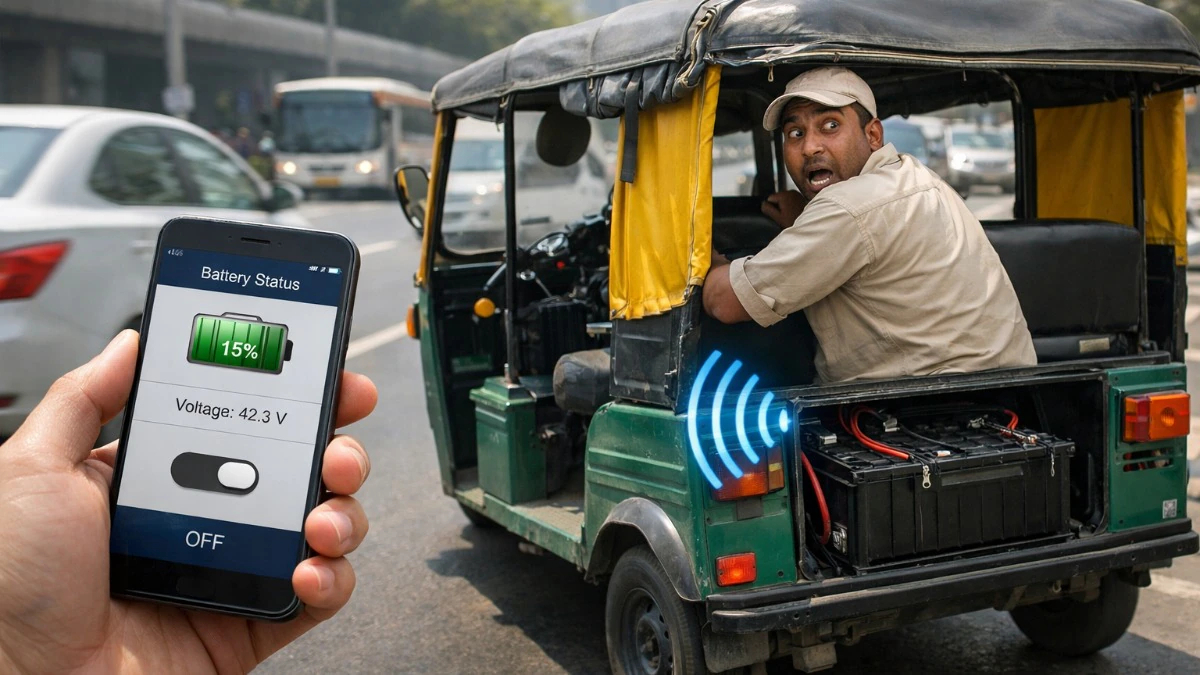
New Delhi, July 3, 2026 — In a swift regulatory crackdown, the Union Ministry of Electronics and Information Technology (MeitY) has ordered the immediate removal of two smartphone applications from major mobile app stores. The apps, BAT-BMS and Epoch Li-ion (alongside similar software like Lossigy), had recently evolved from legitimate battery-maintenance tools into tools for public mischief. Over the past week, Indian social media platforms were flooded with viral “prank” videos showing content creators remotely shutting down moving e-rickshaws, locally known as tirris, stranding confused drivers and paying passengers mid-journey to rack up millions of views online.
The Anatomy of a Bluetooth “Kill Switch”
At the heart of this controversy lies a glaring cybersecurity vulnerability in the booming low-cost electric vehicle sector. The banned applications were originally developed by Chinese technology firms—such as Shenzhen Grenergy Technology Co.—to act as companion utilities for Bluetooth-enabled lithium-ion batteries. In a normal use case, these apps allow vehicle owners to monitor real-time battery analytics, including voltage, temperature, current, and overall battery health.
However, many budget aftermarket lithium-ion battery packs widely sold across India are built with basic, unencrypted Battery Management Systems (BMS). Because these systems were manufactured without basic factory-level security protocols—such as password protection, PIN numbers, or standard user authentication—they broadcast an open Bluetooth signal to any device within a 10-to-15-meter radius.
Pranksters quickly realized that by downloading these free apps, they could easily pair their smartphones with any passing e-rickshaw’s battery pack without needing permission. Once paired, a single tap on the app’s master “discharge switch” cuts the electrical current instantly. The vehicle’s dashboard immediately goes dark, the motor dies, and the e-rickshaw grindingly halts in traffic. Adding to the drivers’ nightmare, this digital lockout completely bypasses the vehicle’s mechanical ignition key; once a battery is disabled via the app, it can generally only be reactivated through the same software interface.
From Stunts to Extortion: The Human Cost
What began as an irritating social media trend quickly escalated into a predatory scheme targeting vulnerable, low-income gig workers. While some influencers merely filmed the drivers’ confusion for views, police investigations have revealed a far darker development. Exploiting the drivers’ lack of technical literacy, some miscreants began posing as “technical experts.” After covertly shutting down a vehicle from a few meters away, the perpetrators would approach the stranded driver, pretend to diagnose the mysterious breakdown, and charge fees ranging from ₹200 to ₹300 to “fix” the problem by quietly flipping the toggle back on in the app.
For e-rickshaw operators, many of whom rent their vehicles daily for roughly ₹400 to ₹500, a single localized digital shutdown can erase an entire day’s livelihood. Incidents of drivers breaking down in tears after losing hours of fare revenue sparked widespread public outrage, prompting the Unorganised E-Rickshaw Drivers and Operators Association to lodge formal complaints. Law enforcement has since stepped in, with Delhi Police Crime Branch officials launching a targeted probe and arresting an 18-year-old suspect, Ritesh Bhanupa, on charges of tech-based extortion.
Legal experts emphasize that this behavior crosses the line from a harmless joke into serious criminal territory. Cyber law authorities have noted that remotely tampering with a vehicle’s computer systems without consent is a clear violation under Section 66, read alongside Section 43, of India’s Information Technology Act, which penalizes unauthorized access and damage to computer resources.
Government and Industry Response
Recognizing the escalating safety risks of vehicles shutting down unpredictably on crowded arterial roads, the central government intervened. MeitY Secretary S. Krishnan confirmed the digital takedown, stating that app stores must exercise strict due diligence to prevent potentially hazardous software from being distributed. The government has further pledged to work directly with Google and Apple to implement proactive filters so that identical third-party battery-override utilities cannot simply be re-uploaded under different names.
While the digital ban provides temporary relief to millions of commuters who rely on e-rickshaws for last-mile connectivity, safety analysts warn that a simple app store removal does not fix the underlying hardware flaw. The ban prevents new downloads, but users who already have the applications installed on their phones can still exploit unsecured vehicles. Furthermore, older e-rickshaws running on traditional lead-acid batteries remain completely safe due to their lack of wireless connectivity, and premium EV brands utilizing encrypted, proprietary software are unaffected.
Moving forward, the Delhi transport department and automotive experts are urging local battery manufacturers to push out firmware updates or establish mandatory password barriers on all newly manufactured lithium-ion units. Cyber security experts warn that this incident exposes a broader regulatory vacuum regarding the internet-of-things (IoT) consumer marketplace. They argue that as India rapidly transitions toward electric mobility, strict baseline cybersecurity standards must be enforced on imported or budget components to prevent everyday transport infrastructure from being held hostage by a smartphone screen.