

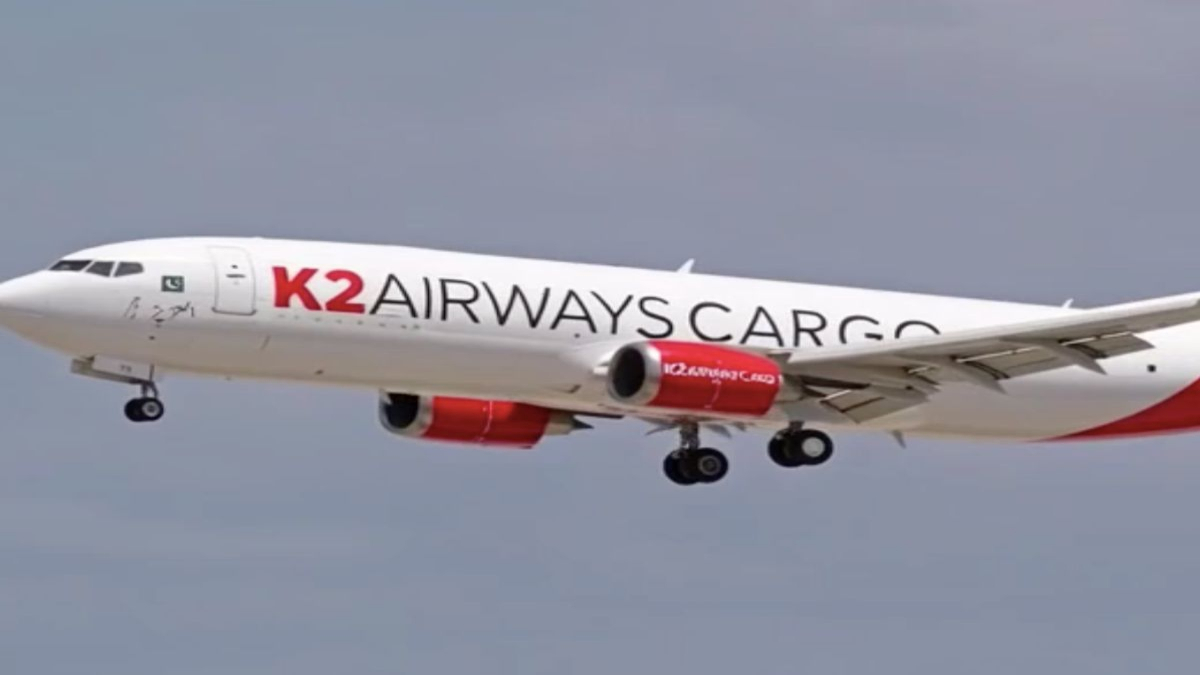
New Delhi, July 8, 2026 — A massive joint search and rescue operation is underway off Pakistan’s southern coast after a commercial cargo aircraft carrying five crew members vanished from radar on Tuesday night.
The aircraft, a Boeing 737-400 freighter operated by Karachi-based K2 Airways, was on a scheduled international flight from Sharjah, United Arab Emirates, to Karachi, Pakistan. According to the Pakistan Airports Authority (PAA), all communication and radar tracking were lost roughly 155 nautical miles (287 kilometers) west of Jinnah International Airport over the open waters of the Arabian Sea.
The Final Minutes: A Sudden Loss of Control
Flight KTA1732—operating under the call sign “City Link 1732″—was cruising normally toward its destination when the first signs of trouble emerged. Air traffic control logs indicate that at approximately 9:18 PM Pakistan Standard Time (PST), the flight crew contacted Karachi’s Area Control Centre (ACC) to report a critical malfunction with their onboard navigational systems.
Aviation officials confirmed that the plane had encountered severe Global Navigation Satellite System (GNSS) interference shortly after taking off from Sharjah, which had initially recovered but appeared to destabilize again as the plane approached Pakistani airspace.
Karachi air traffic controllers immediately provided navigational guidance and instructed the pilots to maintain their current heading. However, the situation deteriorated rapidly over the next three minutes. At 9:21 PM, regional radar screens showed the twin-engine jet performing highly erratic maneuvers, including an abrupt change in heading paired with a violent drop in altitude.
According to preliminary tracking data published by the flight-tracking service Flightradar24, the aircraft experienced a sudden loss of altitude from its 35,000-foot cruise level, briefly attempted a sharp climb, and then entered a second, catastrophic plunge.
The final telemetry packet received from the aircraft placed it just 1,100 feet above the ocean surface, falling at an extreme vertical speed of approximately -22,400 feet per minute. At that point, the aircraft’s forward speed had dropped to a critical 114 knots, a profile that senior accident investigators state is highly consistent with a stall-induced loss of control. Seconds later, the tracking signal went completely dark.
The Aircraft and Missing Crew
The missing airframe, registered as AP-BOI, is a 27-year-old Boeing 737-400 converted freighter. It holds a significant place in the country’s aviation landscape as it was the sole operational aircraft and the absolute backbone of K2 Airways’ cargo services.
First delivered to the Russian flag carrier Aeroflot as a passenger airliner in 1999, the aircraft went through a complete cargo conversion in 2012. It served multiple major logistics fleets globally, including TNT Airways and FedEx Express, before being leased by K2 Airways in October 2024.
Flight manifests confirmed that five specialized crew members were on board the flight:
- The Captain
- The First Officer
- A Load Master (responsible for calculating cargo weight and balance)
- Two traveling aircraft maintenance engineers
Because it was a dedicated logistics flight, no commercial passengers were on board. The status of the five crew members remains officially listed as missing, though defense and aviation authorities privately fear the worst given the violence of the plane’s final recorded descent.
Urgent Military and Civil Mobilization
Immediately following the loss of radar contact, the Pakistan Airports Authority activated the national Rescue Coordination Centre to deploy all available maritime and aerial resources to the coordinates of the last known signal.
The search grid is located in a deep-water sector of the northern Arabian Sea, making the operation logistically challenging. The response has drawn heavily on both military assets and commercial shipping networks:
- PNS Zulfiquar: The Pakistan Navy immediately diverted this primary guided-missile frigate to the crash zone to act as the on-scene command vessel.
- Saab 2000 Erieye: The Pakistan Air Force has scrambled an Airborne Early Warning and Control (AEW&C) aircraft to scan the ocean surface using high-resolution radar systems.
- Maritime Patrol Aircraft: A Navy ATR-72 aircraft was deployed from its base in Turbat to conduct low-altitude visual and radar sweeps.
- Commercial Support: The PNSC Lahore, a merchant vessel belonging to the Pakistan National Shipping Corporation, was rerouted to assist in scanning for floating debris or oil slicks.
Despite the rapid deployment, search teams face significant hurdles. The open ocean environment, coupled with the dark overnight hours when the disappearance occurred, has delayed the discovery of any confirmed debris field or emergency locator transmitter (ELT) signals.
Technical Questions and Expert Perspectives
The abrupt nature of the flight’s termination has left the aviation community searching for answers. Modern commercial aircraft are designed to glide for long distances even in the event of a total dual-engine failure. A sudden plunge of more than 20,000 feet per minute points to a massive mechanical failure, structural break-up, or a severe aerodynamic stall that left the flight crew entirely unable to recover.
Aviation expert Imran Aslam pointed out the highly unusual nature of the tragedy during a briefing. He emphasized that under normal emergency circumstances, a crew suffering a navigation or propulsion issue would maintain a controlled descent path. The data showing a momentary climb followed by a near-vertical dive strongly indicates that the pilots lost aerodynamic control of the airframe, possibly due to shifting cargo or faulty instrument readings misleading the flight computer.
The incident has brought renewed scrutiny to safety and maintenance oversight within the regional private cargo sector, especially following the loss of the airline’s singular asset. Aviation authorities have stated that a formal investigation will be spearheaded by the Air Accident Investigation Board (AAIB) as soon as the physical wreckage or the flight recorders (the “black boxes”) are located in the Arabian Sea.
For now, the focus remains entirely on the active search and rescue operation, with families of the five missing crew members waiting anxiously in Karachi for any concrete updates from maritime authorities.