

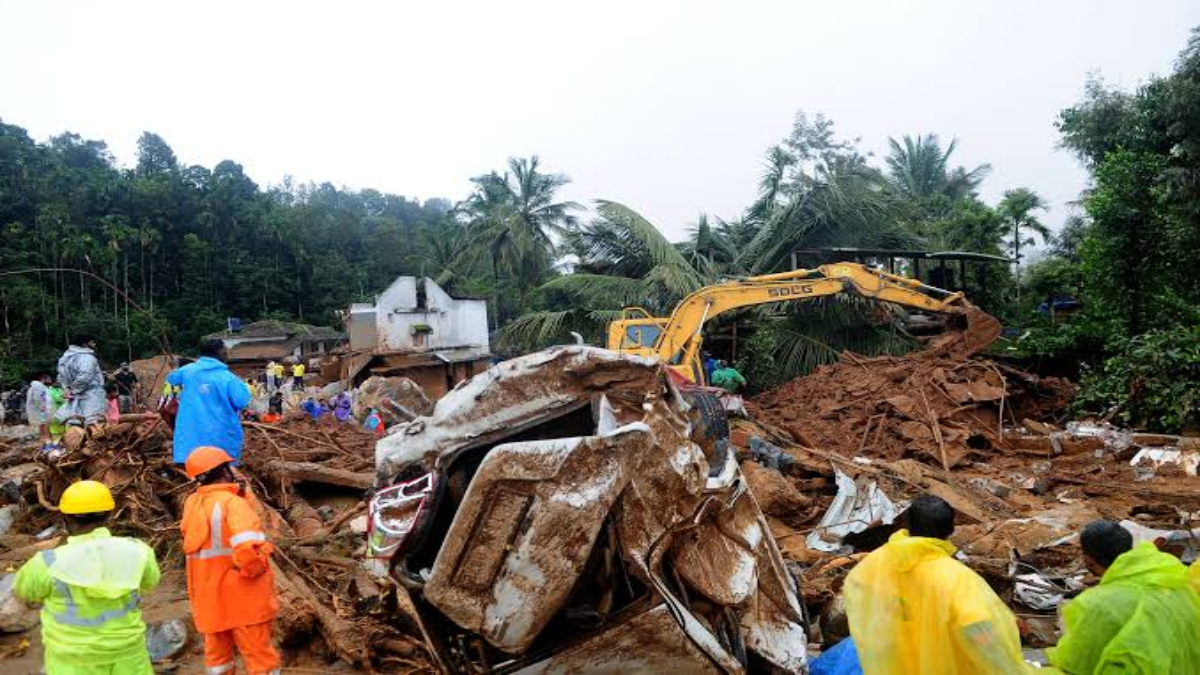
New Delhi, July 8, 2026: An extensive search and rescue operation is underway in the hilly terrain of Kalladi, near Meppadi, in Kerala’s Wayanad district, following a devastating debris slip at an under-construction twin tunnel project. The disaster, which struck between 11:00 AM and 11:30 AM on Tuesday, July 7, 2026, has claimed at least five lives, while five individuals remain missing under massive mounds of displaced earth, rock, and concrete.
As rescue teams enter their second day of consecutive operations, local authorities have intensified legal scrutiny. The Meppadi police have registered a case of unnatural death under Section 194 of the Bharatiya Nyaya Sanhita (BNS) to investigate whether negligence or a failure to comply with safety protocols contributed to the fatal accident.
The Incident and Immediate Impact
The catastrophe occurred near the Meenakshi Bridge along the proposed Kalladi–Anakkampoyil tunnel road project. Triggered by relentless, heavy monsoon rainfall—with the region recording between 226 mm and 265 mm of rain within a 24-hour window—a significant portion of the hillside above collapsed.
The resulting torrent of mud, stones, and a massive concrete retaining wall crashed down upon the construction site, blocking the vital Meppadi–Chooralmala Road. The landslide also swept away a local bus stop, damaged nearby residential structures, and destroyed a local church. Fortunately, the affected houses were vacant at the time, as several occupants had recently departed for a pilgrimage, preventing a significantly higher civilian casualty count.
At least 18 people were estimated to be caught in the immediate path of the debris slip. While active construction work had been officially suspended by district authorities due to the severe weather alerts, a group of engineers, supervisors, security personnel, and camp workers were present at the site when the hill gave way.
Casualties and Hospitalizations
Emergency response teams have recovered five bodies from the debris so far. Among the deceased were site personnel trapped under collapsed structural elements and heavy cables.
Nine individuals who were pulled alive from the mud sustained various degrees of physical trauma. They were quickly evacuated and admitted to the Meppadi WIMS Hospital, where they continue to receive emergency medical care. The injured individuals have been identified as:
- Hira Kumar (32)
- Dileep (19)
- Suraj Yadav (25)
- Sanjay Thakur (35)
- Rajneesh (27)
- Tanmay Ghosh (28)
- Koopamal (Jaya) (37)
- Kunju (39)
Additionally, Meppadi Sub-Inspector Santosh Kumar sustained injuries while actively leading the initial wave of the rescue operations and is currently undergoing treatment at the same medical facility.
Zonal Rescue Strategy Underway
To maximize the efficiency of the rescue operation, the affected disaster zone has been systematically divided into four distinct search sectors. Personnel from the National Disaster Response Force (NDRF), the Kerala Fire and Rescue Services, the Kerala Police, and local defense volunteers are working in tandem despite challenging weather conditions.
Kannur Range DIG Karthick K and Wayanad Superintendent of Police Devamanohar are overseeing the ground operations. To assist in locating individuals trapped deep beneath the heavy, compacted mud, the state has deployed specialized police sniffer dogs and cadaver teams.
While the road leading directly toward Chooralmala has been partially cleared to re-establish emergency logistics, complete debris removal at the primary impact site has been intentionally paused. Authorities note that operating heavy excavators indiscriminately could further endanger any survivors trapped in pockets beneath the mud.
Blame Game and Legal Probe
The tragedy has quickly sparked a sharp administrative dispute regarding accountability. The Kerala state government has categorized the incident as a “man-made disaster.” Officials allege that the construction firm executing the tunnel project had stacked massive quantities of excavated earth on the hillside. According to the district administration and Public Works Department Minister P K Basheer, the firm had received clear, prior directives to clear this loose mud, which they reportedly failed to execute.
Conversely, the general manager of the construction company has strongly rejected these allegations. The company claims that the landslide originated from a natural fracture point high up the mountain, well above their designated workspace. They argue that the mudslide did not occur on land allotted to the firm and that their internal debris management was not the catalyst for the hillside collapse.
Wayanad District Collector Meghashree D R has initiated a comprehensive administrative inquiry to cross-verify these conflicting claims. The police investigation under BNS Section 194 will run parallel to the magisterial probe, focusing on structural assessments, weather warning compliance, and land-use safety protocols.
Community Safety and Relief Measures
In response to the continuing threat of secondary landslides and a red weather alert issued by the India Meteorological Department (IMD), the district administration has executed proactive evacuations across vulnerable pockets of Wayanad.
Residents from high-risk zones—including Erattukundu, Attamala, Mammikkunnu, and the Ambedkar Colony—have been moved to safer ground. Temporary relief camps and shelters have been established at the Mundakkai Forest Station and the Chooralmala Church Hall to accommodate displaced families and individuals stranded by the road closures. Local educational institutions have also adjusted schedules to ensure student safety during the ongoing heavy spell of rain.