

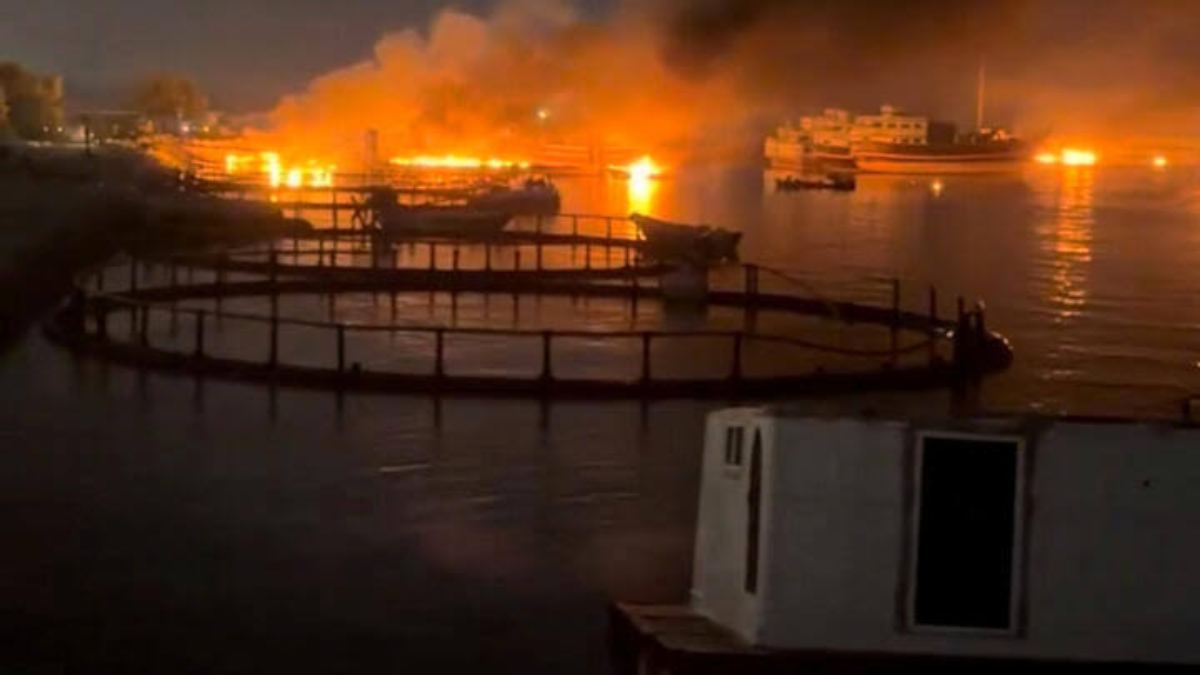
New Delhi, July 9, 2026 — The Middle East stands on the precipice of a wider regional war following a massive, multi-wave American military assault on Iranian strategic sites. In an unprecedented escalation, the United States has targeted Iran’s critical southeastern oceanic gateway, the port of Chabahar. The sudden bombardment represents a total collapse of a fragile ceasefire brokered in April 2026, and it has already triggered immediate retaliatory missile and drone strikes against U.S. military installations across the Persian Gulf.
The high-stakes military campaign unfolded late Tuesday and continued through Wednesday night after U.S. President Donald Trump declared the Pakistan-negotiated truce “over.” Taking to social media, Trump shared imagery of the operations, warning Tehran that any further disruptions to international maritime commerce would be met with an even heavier hand.
The Breaking of the Ceasefire and the Direct Assault
The conflict unraveled rapidly after Washington accused Iran of orchestrating repeated attacks against commercial vessels transiting the vital Strait of Hormuz over the past week. In response, the U.S. Central Command (CENTCOM) unleashed a coordinated, expansive air and sea blitz hitting roughly 90 military and maritime targets across Iran’s southern coast.
Unlike previous rounds of localized hostilities confined near the western bottleneck of the Gulf, the latest American campaign forcefully pushed eastward into the Gulf of Oman. Dramatic explosions lit up the night sky across the deep-water port city of Chabahar, causing immediate and widespread power blackouts throughout the region.
According to intelligence reports, the precision strikes focused heavily on Iranian maritime infrastructure and military installations believed to facilitate attacks on global shipping routes. Crucially, ordnance struck the port’s primary maritime traffic control tower and nearby logistics piers used by the Islamic Revolutionary Guard Corps (IRGC). While local sources reported that direct civilian energy hubs were spared, the physical and economic damage to the area is severe. U.S. fighter jets and naval assets also struck targets at the prominent naval hub of Bandar Abbas, coastal facilities in Jask, an IRGC Aerospace Force facility in Bushehr, the Iranshahr Airport, and a vital railway logistics bridge in the northern Golestan province.
Strategic Fallout and Shifting Global Alliances
The direct bombing of Chabahar has sent shockwaves through international diplomatic circles, specifically catching the attention of South Asian and regional powers. For years, Chabahar has served as Iran’s only deep-water oceanic port, offering direct access to the Indian Ocean while bypassing the volatile, narrow Strait of Hormuz.
Chabahar has been heavily backed by India as a landmark alternative trade corridor to connect South Asia with Afghanistan and Central Asia, intentionally bypassing Pakistan. Though New Delhi had previously transferred funds and carefully maneuvered around U.S. sanctions through temporary waivers, the actual physical destruction of port infrastructure places India’s most important overseas geopolitical asset directly in the line of fire. Indian officials are currently analyzing data and evaluating the ground-level damage to assess the long-term viability of their shipping terminals.
Meanwhile, Western allies have rallied behind the heavy U.S. response. NATO Secretary General Mark Rutte defended the American strikes, asserting they were an “absolutely necessary” defensive measure to keep global trade corridors open following flagrant Iranian violations of the spring truce.
Iran Strikes Back: Gulf Bases on High Alert
The reaction from Tehran was immediate and fierce. Rejecting Washington’s claims, Iranian officials labeled the strikes an illegal act of aggression that completely shattered the framework of the April ceasefire. Iran’s parliamentary speaker, Mohammad Baqer Qalibaf, issued a stark warning directly to Washington.
True to their warnings, the IRGC Aerospace and Naval forces launched a joint, multi-directional retaliatory strike on Thursday morning. Using a mixture of ballistic missiles and explosive kamikaze drones, Iran targeted several U.S. military positions across the Gulf region, pushing the entire theater into a state of high alert.
Attacks in Kuwait and Bahrain
Iranian state media claimed successful strikes against key American hubs in the region:
- Kuwait: Drones and missiles targeted the sprawling U.S. military installations at Camp Arifjan and the Ali Al Salem Air Base. The Kuwaiti Ministry of Defense confirmed that its integrated air defense systems successfully intercepted multiple hostile incoming vectors, though the area remains locked down under emergency protocols.
- Bahrain: Air raid sirens echoed across the island nation as incoming fire targeted the Juffair area, situated adjacent to the massive command headquarters of the U.S. Navy’s Fifth Fleet, as well as the Sheikh Isa Air Base.
Local governments across Bahrain, Qatar, and Kuwait have urged citizens to stay indoors, seek shelter away from windows, and prepare for further kinetic activity as anti-air batteries continue scanning the skies.
A Grim Outlook for Regional Security
Security analysts warn that the situation is rapidly moving toward an unmanageable regional war. The dynamic has shifted from a shadow war of proxy maritime skirmishes to open, state-on-state kinetic warfare. The Pentagon maintains that these sweeping strikes are designed exclusively to degrade Iran’s offensive maritime capabilities and protect the freedom of navigation, emphasizing that the U.S. has no desire to occupy territory or trigger a full-scale ground invasion.
However, with President Trump vowing to intensify the air campaign even further if Iran fails to halt its actions, and Tehran demonstrating its willingness to directly strike sovereign nations hosting U.S. forces, the room for diplomatic off-ramps is shrinking. As global oil prices climb and critical Indian Ocean shipping lanes face unprecedented threats, the world watches anxiously to see if either side will blink, or if the Middle East is headed into a catastrophic spiral of total warfare.