
.)
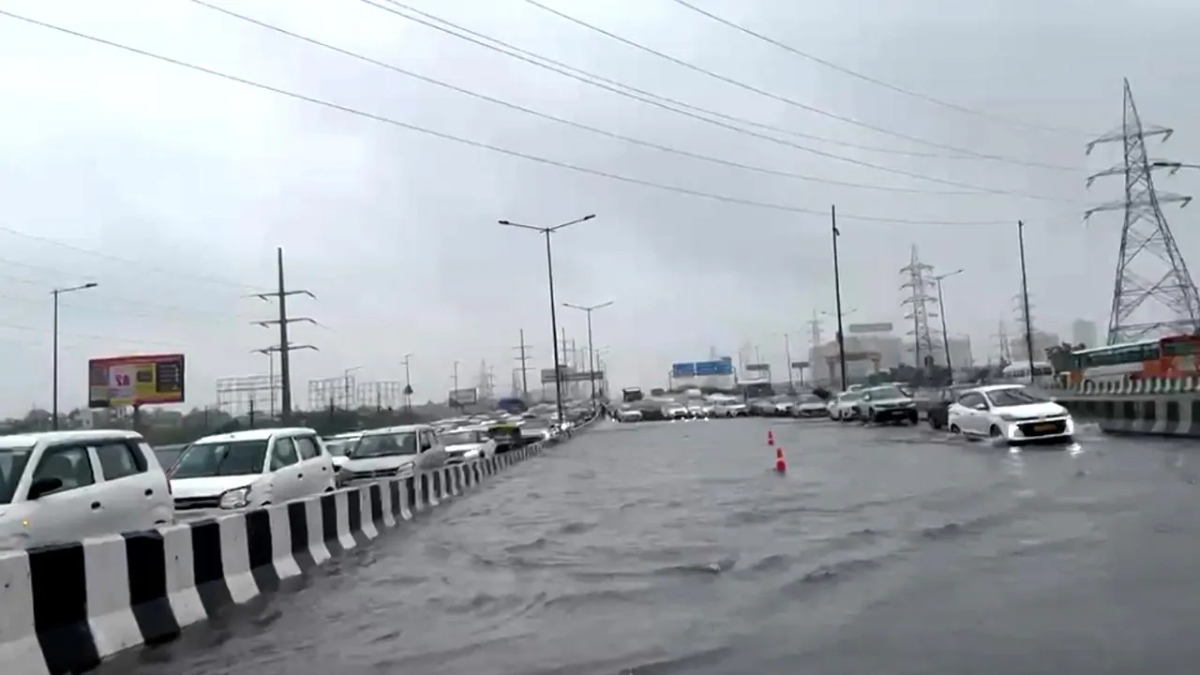
New Delhi, July 9, 2026 — Continuous monsoon rains have once again exposed the fragile urban infrastructure of the National Capital Region (NCR). A severe spell of rainfall has led to heavy waterlogging on National Highway 9 (NH-9)—formerly known as NH-24—near the crucial Ghazipur border. The accumulation of water has crippled traffic movement on one of Delhi’s most vital lifelines, leaving thousands of commuters stranded in agonizing, miles-long traffic snarls connecting Uttar Pradesh to the national capital.
By Thursday afternoon, large sections of the highway near the Ghazipur toll plaza and the neighboring wholesale poultry market (murga mandi) were completely submerged under a deep sheet of stagnant water. The lack of functional drainage effectively turned the multi-lane highway into a shallow canal, forcing bumper-to-bumper traffic to a literal crawl and sending shockwaves through the region’s broader transit network.
A Lifeline Brought to a Standstill
NH-9 is not just an ordinary highway; it serves as a critical commuter corridor linking dense residential hubs in Ghaziabad, Noida, and western Uttar Pradesh with central and southern Delhi. The highway also runs alongside and merges with sections of the Delhi-Meerut Expressway (DME). When a bottleneck occurs at the Ghazipur bottleneck, the ripple effect is felt almost immediately across multiple major routes.
On Thursday, the situation turned chaotic as the morning rush hour peaked. Water levels on the lower lanes of NH-9 quickly rose to the exhaust pipes of smaller vehicles and hatchbacks, causing dozens of motorbikes and cars to break down mid-transit. The failure of the local drainage network meant that rainwater could not recede, leaving a slick, dirty sheet of water stretching across all available lanes.
The crisis was compounded by structural overflow from the adjacent Ghazipur poultry market. Heavily inundated by the rains, the mandi’s waste-laden water spilled over onto the highway and the entry ramps of the DME up to the UP Gate. Commuters reported that the mix of overflow and stagnant water turned the entire area into a foul-smelling swamp, significantly worsening the conditions for motorists and stranded bikers who had nowhere to seek shelter.
Commuter Woes and Ground Realities
For regular office-goers, the waterlogging turned a standard 30-minute trip into a grueling multi-hour ordeal. Bikers trying to escape the flooded asphalt by mounting the pedestrian footpaths found no relief, as portions of the pavements had cracked or been intentionally broken by authorities in a desperate bid to let the standing water drain away.
“It was completely unmanageable,” said Ankur Sharma, an executive stuck in the traffic jam for over ninety minutes. “The water was nearly touching my car’s doors. On normal days, the MCD toll plaza area is already a bottleneck due to commercial trucks, but today, with the waterlogging, it became an absolute nightmare.”
Other commuters traveling on the elevated sections of the Delhi-Meerut Expressway described looking down at NH-9 and seeing vehicles generating massive waves as they attempted to push through the deluge. The slow speed of the vehicles below eventually choked the merging loops, causing traffic to backup onto the main expressway lanes as well.
Official Response and Emergency Measures
As public anger mounted, teams from the Delhi Traffic Police and the National Highways Authority of India (NHAI) were deployed to the ground to manage the gridlock and accelerate water evacuation.
In a statement addressing the crisis, an NHAI official explained that the heavy rainfall volume overwhelmed the existing infrastructure. “Due to severe rainfall in the past 24 hours, acute waterlogging was reported at key locations on NH-9. The standard drainage pumps previously installed at these low-lying spots could not cope with the sheer volume of water flowing from neighboring city drains. We have now deployed higher-capacity mobile pumps and standby arrangements to flush the water out into deeper channels.”
To ease the immediate pressure on the border, the Delhi Traffic Police issued an urgent traffic advisory, actively diverting vehicles away from the Ghazipur border.
Traffic personnel are working in coordination across state lines, with Ghaziabad Traffic Police deploying additional units to redirect vehicles before they reach the flooded choke points at the UP Gate.
The Underlying Issue: A Recurring Urban Failure
Local residents point out that this is far from an isolated incident. The junction near the Ghazipur border is notorious for flooding during every major downpour. While authorities have carried out periodic repair works and lane modifications in recent months, structural integration between the highway’s drainage and local civic bodies remains a persistent problem.
Urban planners note that when highways are built or expanded, their drainage systems must be engineered to handle extreme weather anomalies. However, if the local municipal drains into which the highway water empties are choked with garbage or silted up, the water flows backward, turning expensive national highways into temporary reservoirs.
With the meteorological department predicting more rain over the next 48 hours, authorities face a race against time. While the higher-capacity pumps are slowly lowering water levels on NH-9, commuters are urged to check real-time map updates and traffic alerts before leaving their homes, as any fresh spell of rain could easily cause the area to flood again.