

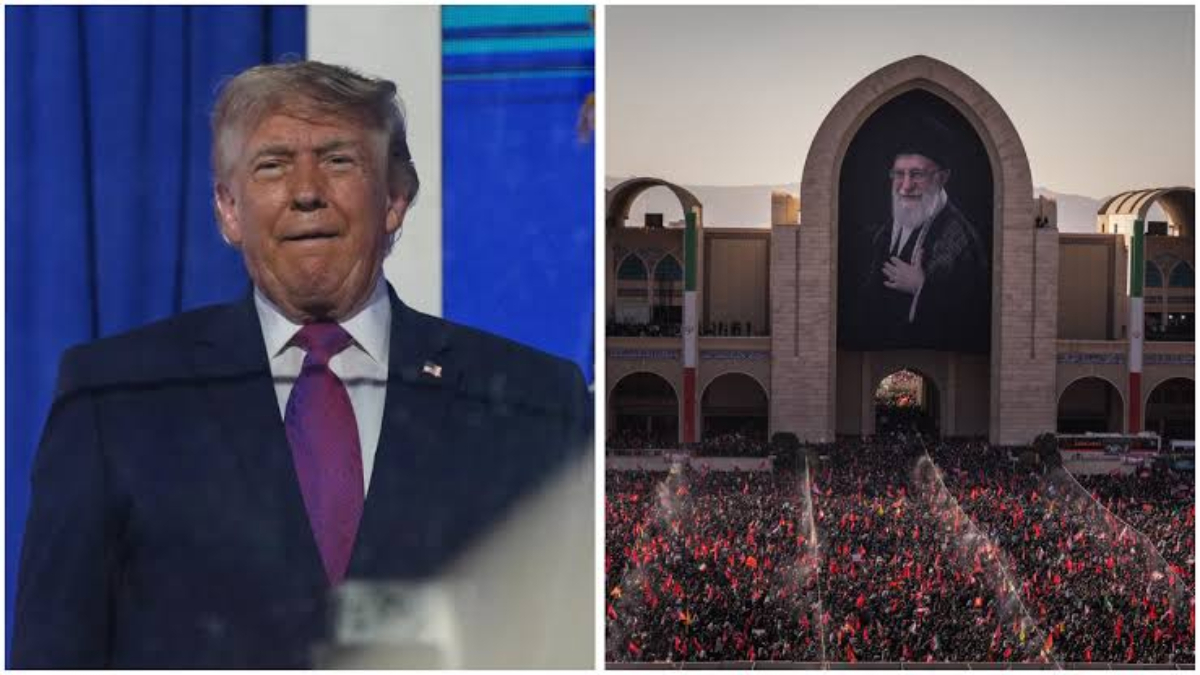
New Delhi, July 11, 2026 — The fragile peace in West Asia is teetering on the edge of total collapse. On Saturday, July 11, 2026, U.S. President Donald Trump issued a blistering, scorched-earth warning to Tehran, stating that the U.S. military is ready to “completely decimate and destroy” Iran if the regime attempts to act on threats against his life.
The extraordinary escalation came immediately after a highly volatile, week-long state funeral for Iran’s late Supreme Leader, Ayatollah Ali Khamenei, which concluded with massive crowds and official eulogists openly calling for Trump’s assassination. The war of words marks a dangerous breaking point for a shaky, weeks-old interim truce designed to halt a devastating four-month-old regional war.
“Locked and Loaded”: The White House Reacts
Taking to his social media platform, Truth Social, President Trump did not mince words regarding the hostile rhetoric broadcasting from Tehran. He claimed that the United States has an immense arsenal primed for immediate retaliation.
The sharp warning follows days of intense diplomatic and military friction. Senior U.S. officials have spent the week demanding that Iran issue a formal public statement guaranteeing safe passage through the Strait of Hormuz—the world’s most vital oil transit corridor. Tensions boiled over earlier this week when Iran attacked three commercial vessels in the strait. Tehran has flatly rejected Washington’s demands, insisting it maintains absolute control over the international waterway and intends to levy fees on passing ships, fundamentally defying decades of global maritime law.
Fury in the Streets of Tehran and Mashhad
Trump’s aggressive stance is a direct reaction to the highly orchestrated fury on display during the multi-city funeral procession for Ayatollah Ali Khamenei. Khamenei, who ruled Iran for over three decades, was killed at age 86 alongside four family members during a massive, surprise U.S.-Israeli joint airstrike on February 28, 2026—an attack that initiated the current war.
Because of the heavy fighting that followed, the state funeral was delayed for months. When ceremonies finally commenced across Iran and Iraq, the Iranian government used the event to project ideological fervor and unity. Millions of black-clad mourners flooded the streets, beating their chests and waving red flags—the traditional Shiite symbol for unavenged blood and incoming retaliation.
However, it was the explicit, state-sanctioned targeting of Donald Trump that shocked international observers. During a massive gathering at Tehran’s Grand Mosalla, prominent state-approved poet and eulogist Mohammad Rasouli took to the loudspeakers to stoke the crowd’s anger.
“Why is the most bastard man in the world still alive?” Rasouli shouted to the ocean of mourners, who responded with thunderous cheers. “Why should we not kill the man who killed our imam? It is a disgrace for us if we do not kill your killer. Trump’s killing is our duty.”
The calls for assassination were not limited to poetry. Massive banners and placards reading “Kill Trump” and “We will kill Trump and Netanyahu”—complete with crosshairs drawn over photos of Trump, Vice President J.D. Vance, and Israeli Prime Minister Benjamin Netanyahu—were carried through the streets of Tehran and Najaf, and ultimately to the holy city of Mashhad, where Khamenei was buried early Friday.
A Regime in the Shadows
The highly public funeral also spotlighted deep structural vulnerabilities within the Iranian leadership. While top figures like President Masoud Pezeshkian and Revolutionary Guard commanders appeared in public for the first time since the war began, one critical figure was noticeably absent: Ayatollah Mojtaba Khamenei.
Mojtaba was quietly named Iran’s new Supreme Leader ten days after his father’s death, but he has not been seen or heard from in over three months. Reports indicate that the new leader is currently in deep hiding, heavily protected after sustaining injuries in the very airstrike that killed his father. Furthermore, intelligence suggests that Israel has explicitly threatened to eliminate Mojtaba if he steps into the public eye, turning the new leader into a ghost inside his own country.
The Path to War and a Fractured Truce
The current geopolitical crisis traces back to late February, when the U.S. and Israel launched preemptive strikes against Iran’s nuclear facilities and command structures, citing an active nuclear weapons program and an imminent threat to global security. The conflict quickly engulfed the region, drawing in proxy networks like Hezbollah and heavily disrupting global energy markets.
While a preliminary ceasefire agreement was signed last month, it has proven to be incredibly fragile. The U.S. has continued to launch sporadic, defensive airstrikes against Iranian assets following repeated crossfire, and Trump’s latest “1,000 missiles” threat signals that Washington has little interest in continuing diplomatic patience.
U.S. intelligence agencies have been tracking credible Iranian plots to assassinate Trump and other former administration officials since 2020, when Trump ordered the drone strike that killed Iranian General Qassem Soleimani. However, the open, institutionalized calls for the sitting American president’s murder at a state funeral have fundamentally shifted the paradigm.
With both nations effectively walking away from the negotiating table, the Middle East sits on a knife’s edge. Tehran refuses to back down on its maritime blockade of the Strait of Hormuz, and Washington is openly threatening total destruction. As the dust settles on the burial of Ali Khamenei, the region looks less like it is entering a period of mourning, and more like it is bracing for a catastrophic second wave of war.