

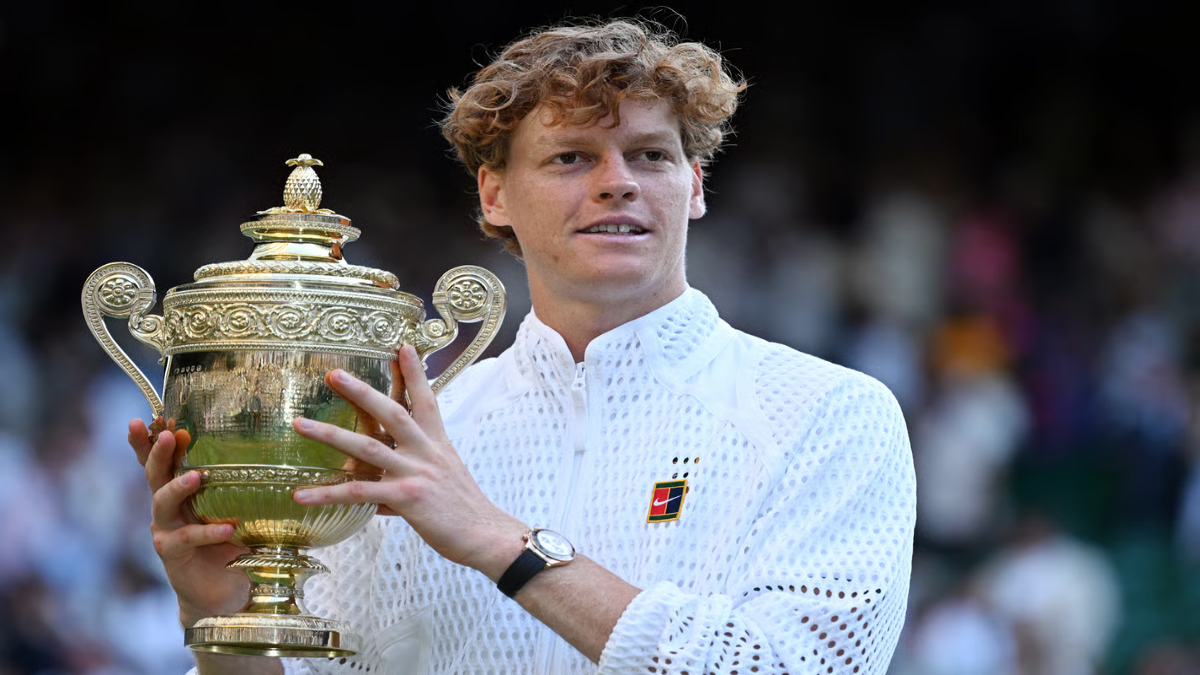
New Delhi, July 13, 2026 — Under the shifting, breezy skies of Centre Court, World No. 1 Jannik Sinner proved once again why he rules the modern tennis landscape. In a punishing, high-stakes battle of baseline heavyweights, the 24-year-old Italian overcame a slow start and a mid-match injury scare to defeat Germany’s Alexander Zverev 6-7 (7-9), 7-6 (7-2), 6-3, 6-4, capturing his second consecutive Wimbledon title.
The victory brings Sinner’s Grand Slam tally to five and firmly cements his status as the game’s undisputed premier player. By defending the famous Gentlemen’s Singles Trophy, Sinner also became only the 10th man in the Open Era to retain the Wimbledon crown, joining an elite club of legends who have mastered the slick lawns of the All England Club back-to-back.
A Heavyweight Clash From the First Ball
The final brought together the two top seeds and the tour’s in-form players. Zverev arrived in London riding high on the momentum of winning his first Grand Slam title at the French Open in June, aiming to complete the rare “Channel Slam”—winning Paris and Wimbledon in the same summer. Sinner, meanwhile, was on a mission of redemption. Just over a month prior, his 30-match winning streak came to an agonizing halt in a grueling, humid second-round exit at Roland Garros to Juan Manuel Cerundolo.
From the opening game, the tactical blueprint was clear. This was going to be a war of microscopic margins centered around two of the biggest serves in tennis. Zverev was a human lightning bolt, routinely hitting first serves up to 139 mph (224 kph) and keeping Sinner pinned deep. The first set flew by without a single break of serve, hurtling into a tense tiebreak.
Sinner opened up an early lead in the tiebreak, but the German refused to budge. Standing tall on the baseline, Zverev tracked down Sinner’s heaviest groundstrokes, eventually forcing errors from the Italian to snatch the tiebreak 9-7. As Zverev roared toward his player’s box, the Centre Court crowd settled in for a long afternoon. Sinner had not lost a set since his opening-round match against Miomir Kecmanovic—now, his title defense was officially under siege.
The Momentum Shifts on Centre Court
Great champions are defined by how they react to adversity, and Sinner did not panic. In the second set, the Italian adjusted his return positioning, gradually reading Zverev’s thunderous delivery. Sinner leaned on his own reconstructed serve, placing aces with surgical precision rather than raw speed to escape tight service games.
Once again, neither player could puncture the other’s delivery, triggering a second consecutive tiebreak. This time, however, Sinner took complete control. He punished Zverev’s second serves and forced a string of unforced forehand errors from the German. Sinner raced away with the tiebreak 7-2, letting out a rare, passionate fist pump as he leveled the match. The momentum had fundamentally shifted.
The physical toll of the match escalated dramatically in the third set. At 3-3, after nearly two hours and 45 minutes of brutal tennis, Zverev earned his very first break point of the match. Sinner responded with a delicate, disguised drop shot. Chasing it down, Zverev slipped awkwardly on the worn grass, hyperextending his right knee.
The stadium went dead silent as Zverev clutched his knee in obvious pain. Showing ultimate sportsmanship, Sinner immediately walked around the net to help his rival to his feet. Though Zverev bravely chose to play on without a medical timeout, the injury severely compromised his movement. Visibly frustrated, Zverev threw his racket after a missed forehand, dropping his serve for the first time all match. Sinner capitalized instantly, closing out the set 6-3.
Ice in His Veins
By the fourth set, the afternoon wind had turned gusty and unpredictable, throwing off both players’ rhythms. Zverev, despite being physically hampered, dug deep and relied on his massive first serve to keep himself within striking distance.
The pivotal moment of the championship arrived with Sinner serving at 1-2, trailing 15-30. With the wind swirling and Zverev threatening to break back, Sinner displayed the ice-cold composure that has come to define his world number one ranking. He calmly stepped up to the line and rattled off three consecutive unreturned service winners to hold.
A few games later, Sinner delivered the knockout blow. At 3-4, he engineered the point of the match—a breathtaking defensive lob followed by a crisp, winning volley that brought the crowd to its feet and broke Zverev’s serve.
Serving for the championship at 5-4, Sinner didn’t flinch. Zverev mounted one final, desperate stand, but on his first championship point, Sinner hammered a blistering forehand winner perfectly down the line. The Italian dropped flat on his back on the grass, staring up at the London sky in pure relief and jubilation.
A Historic Payday and a Growing Legacy
The historic triumph earned Sinner a massive £3.6 million ($4.6 million) winner’s check from Wimbledon’s record £64.2 million prize fund. More importantly, the victory marked Sinner’s 100th career Grand Slam match win and extended his psychological dominance over Zverev, marking his 10th consecutive victory over the German.
Zverev, who still takes home a runner’s up prize of £1.8 million and moves up to World No. 2, was gracious in defeat. “Jannik proved today why he is the best player in the world. I gave it everything, but he was just too good on the big points.”
With the grass-court season wrapped up, Sinner heads into the hard-court summer firmly atop the tennis hierarchy. By conquering his demons from Paris and taming the lawns of SW19 once again, Jannik Sinner has shown the world that his era is well and truly here.