

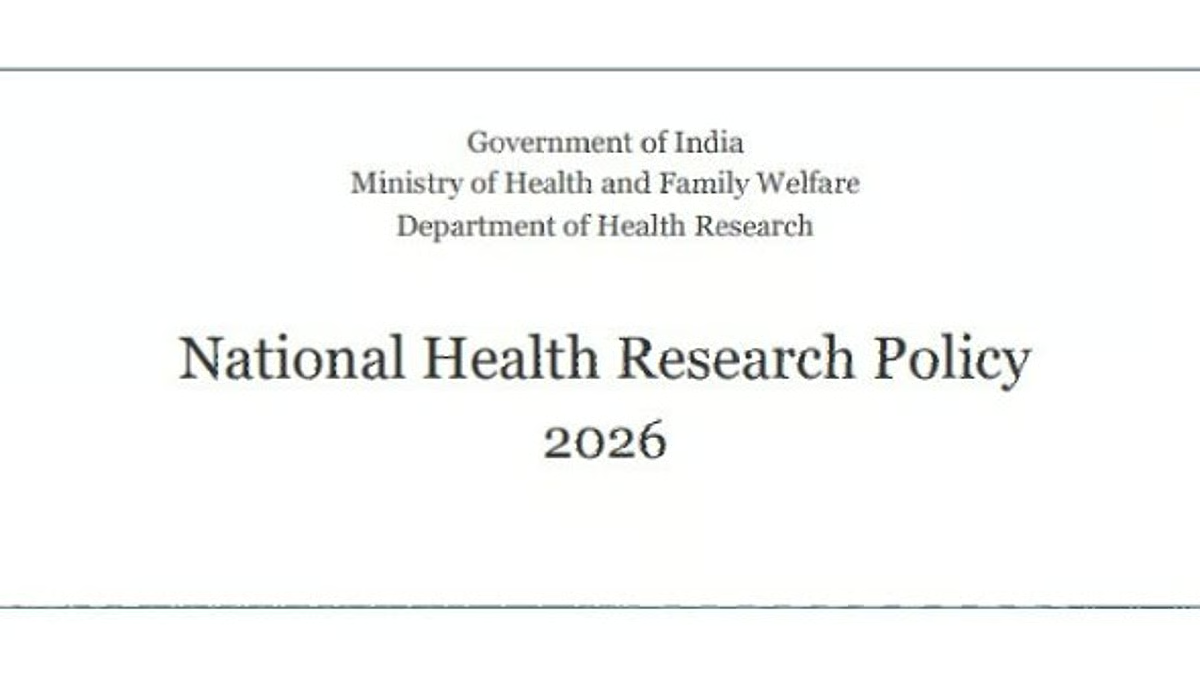
New Delhi, July 13, 2026: In a major step toward reshaping the country’s medical science landscape, the Ministry of Health and Family Welfare has officially unveiled the draft National Health Research Policy (NHRP). Aimed at steering India toward self-reliance and modernizing its clinical infrastructure, the government has formally invited suggestions, critiques, and feedback from the public, medical professionals, and researchers. The ambitious policy seeks to move India away from a fragmented research ecosystem and toward a highly coordinated, impact-oriented national system geared toward solving real-world healthcare challenges.
The policy is designed to align directly with the broader “Viksit Bharat 2047” vision, focusing on creating homegrown health technologies, gathering clinical evidence tailored to Indian demographics, and preparing the nation for emerging biological and pandemic threats.
Establishing the National Health Research Agenda (NHRA)
At the absolute center of this draft policy is the creation of a National Health Research Agenda (NHRA). For years, medical research in India has faced criticism for being scattered, with various institutions working in silos and duplicating efforts. The NHRA will serve as the master blueprint to streamline these efforts.
The Department of Health Research (DHR) will function as the nodal department responsible for drafting, coordinating, and periodically updating this national agenda. To oversee this massive undertaking, the government will form the National Health Research Stewardship Committee, a high-level body providing strategic direction to ensure that research funding matches India’s actual disease burden and healthcare realities.
Rather than enforcing a rigid, top-down mandate, the policy frames the NHRA as a shared reference point. Central scientific departments, state governments, and Union Territories will be encouraged to adapt the national guidelines to fit their local contexts, taking into account regional health system capacities and distinct localized health crises.
Cutting Red Tape and Opening Infrastructure
One of the most significant shifts introduced in the draft policy is a direct attack on bureaucracy. Recognizing that administrative delays, complex financial clearances, and regulatory red tape routinely stall critical scientific breakthroughs, the Health Ministry has explicitly committed to lowering these barriers. The draft proposes simplified regulatory pathways to fast-track approvals without compromising on safety and ethical standards.
A Push for Diverse Funding and Private Collaboration
Historically, medical research in India has relied overwhelmingly on government grants, leaving the ecosystem vulnerable to budget constraints. The draft National Health Research Policy outlines a clear roadmap to diversify funding streams. While pledging an increase in public investment, the document heavily emphasizes the need to leverage private enterprise and philanthropic organizations.
By actively engaging the private sector, the government hopes to bridge the gap between initial laboratory research and commercial production. The goal is to build an environment where Indian biopharmaceutical and medical device companies can comfortably invest in high-risk, high-reward research, ultimately developing affordable diagnostics, vaccines, and therapeutics explicitly designed for the Indian population.
Driving Equity, Inclusivity, and Ethics
Beyond the focus on technology and funding, the draft policy anchors itself firmly on health equity and ethics. The Ministry has emphasized that the ultimate benchmark of any scientific breakthrough is its accessibility to the most vulnerable populations. The policy framework demands that future health research look closely at social determinants of health, healthcare affordability, and systemic delivery gaps.
Additionally, the policy aims to revitalize the research culture among young medical students. By proposing revamped career pathways, material incentives, and structured mentorship programs, the ministry hopes to make medical research an attractive, emotionally rewarding career choice, countering the long-standing trend where the brightest medical minds strictly favor lucrative curative practice over laboratory science.