

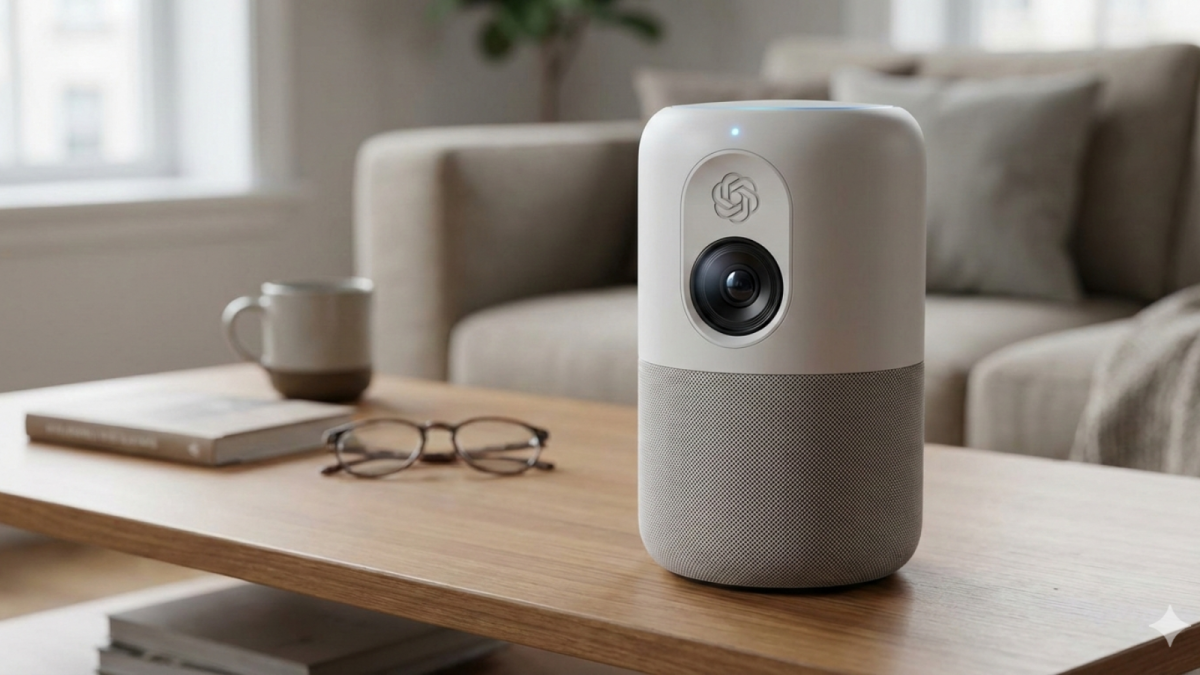
New Delhi, July 15, 2026: The tech world has long speculated about what a physical device designed by OpenAI would look like. While many anticipated an “AI iPhone” to disrupt the smartphone market, newly leaked details reveal a completely different strategy. According to reports from Bloomberg’s Mark Gurman, OpenAI’s first foray into consumer electronics will be a portable, screenless smart speaker that can move autonomously. Internally described as a new category of “home computer built for the AI era,” the device is being engineered not just as a passive tool, but as a living, proactive companion designed to blend seamlessly into everyday home life.
A Smart Speaker That Feels “Alive”
Unlike standard smart speakers like the Amazon Echo or Google Nest, which sit static on counter tops waiting for a wake word, OpenAI’s upcoming device is designed to possess a sense of presence. It features integrated mechanical elements that allow it to shift, turn, and move on its own during interactions. This physical articulation is intended to make the speaker feel less like a cold gadget and more like an active participant in the room.
To support this mobility, the device runs on a rechargeable battery, allowing users to easily carry it from the kitchen to the bedroom rather than leaving it tethered to a single wall outlet. Furthermore, the speaker is equipped with an integrated camera and a suite of environmental sensors. These components give the device the ability to literally “read the room,” granting it spatial awareness so it can visually identify users, recognize their actions, and adapt its behavior based on the context of its surroundings.
Powered by “GPT-Live” and Deep Personalization
The core intelligence driving the hardware is a next-generation voice architecture reportedly dubbed GPT-Live. Building upon the foundations of ChatGPT’s advanced voice capabilities, GPT-Live allows the device to listen and speak simultaneously, adjust its tone mid-conversation, and process complex audio prompts with virtually zero latency.
However, the real differentiator for OpenAI is the device’s intense focus on proactive personalization. Traditional voice assistants only speak when spoken to, but OpenAI’s companion is built to actively learn its owner’s habits over time. With permission to securely sync with personal digital services—such as calendars, messages, and emails—the AI will attempt to anticipate a user’s needs before they even articulate them. For example, internal demonstrations showed the speaker observing a user’s evening routine and proactively nudging them toward an earlier bedtime after scanning their calendar and spotting a high-priority morning meeting scheduled for the next day.
Beyond productivity, the device functions as a robust central hub for the modern smart home. It can effortlessly control connected appliances, stream media, answer open-ended questions, and draft contextual replies to incoming messages using the full reasoning capabilities of OpenAI’s latest models.
The Jony Ive Connection and Apple DNA
The aesthetic and physical engineering of the device are heavily shaped by legendary design talent. The hardware initiative is the direct result of OpenAI’s massive $6.5 billion all-stock acquisition of io Products in mid-2025—an AI hardware startup co-founded by former Apple design chief Jony Ive. Following the buyout, Ive and his high-profile creative firm, LoveFrom, took the reins of OpenAI’s industrial design division.
The speaker itself is being spearheaded by Evans Hankey and Tang Tan, both former heads of industrial design and product design at Apple. In fact, OpenAI’s hardware team has become a haven for Cupertino talent, reportedly hiring more than 400 former Apple engineers who previously worked on foundational products like the iPhone, iPad, and Mac. This deep concentration of Apple DNA explains why the hardware focuses so heavily on premium build quality, intuitive physical interaction, and tightly integrated software ecosystems.
The Impending Legal Clash with Apple
While the product represents a massive leap forward for OpenAI, it has also landed the company in hot water. In July 2026, Apple filed a major trade-secrets lawsuit against OpenAI, specifically targeting its hardware chief and alleging a coordinated, aggressive campaign to siphon proprietary designs, manufacturing techniques, and supply chain secrets away from Apple via ex-employees.
OpenAI has firmly denied any wrongdoing, countering that their moving, screenless audio system “veers significantly” from anything Apple currently offers or has publicly planned. While Apple does sell the stationary HomePod line, tech analysts point out that Apple is also quietly developing its own advanced home robotics—including a rumored tabletop device featuring a display mounted on a robotic arm. The lawsuit is widely viewed as an attempt by Apple to protect its turf and slow down a powerful new competitor in the smart-home space.
Product Specifications & Expected Rollout
Despite the legal turbulent waters, OpenAI is pushing forward with its release roadmap. The moving speaker is reportedly the first of roughly five distinct hardware devices OpenAI currently has in its development pipeline.
The Privacy Elephant in the Room
As exciting as a self-moving, camera-equipped AI companion sounds, it will undoubtedly face immense public scrutiny regarding user privacy. Dropping an always-listening microphone and a context-aware camera into private living spaces requires a massive amount of consumer trust. OpenAI will have to meticulously demonstrate how it handles local edge processing versus cloud data transmission, how it secures personal information like emails, and how users can easily blind the camera or disable the mechanical tracking features.
If OpenAI can successfully assuage these privacy concerns and navigate Apple’s aggressive legal injunctions, this screenless companion could completely redefine how humans interact with computers at home. By ditching the glowing glass screens that dominate modern life in favor of fluid, natural motion and hyper-intelligent voice, OpenAI is betting that the future of computing isn’t something we look at—but something that lives alongside us.