

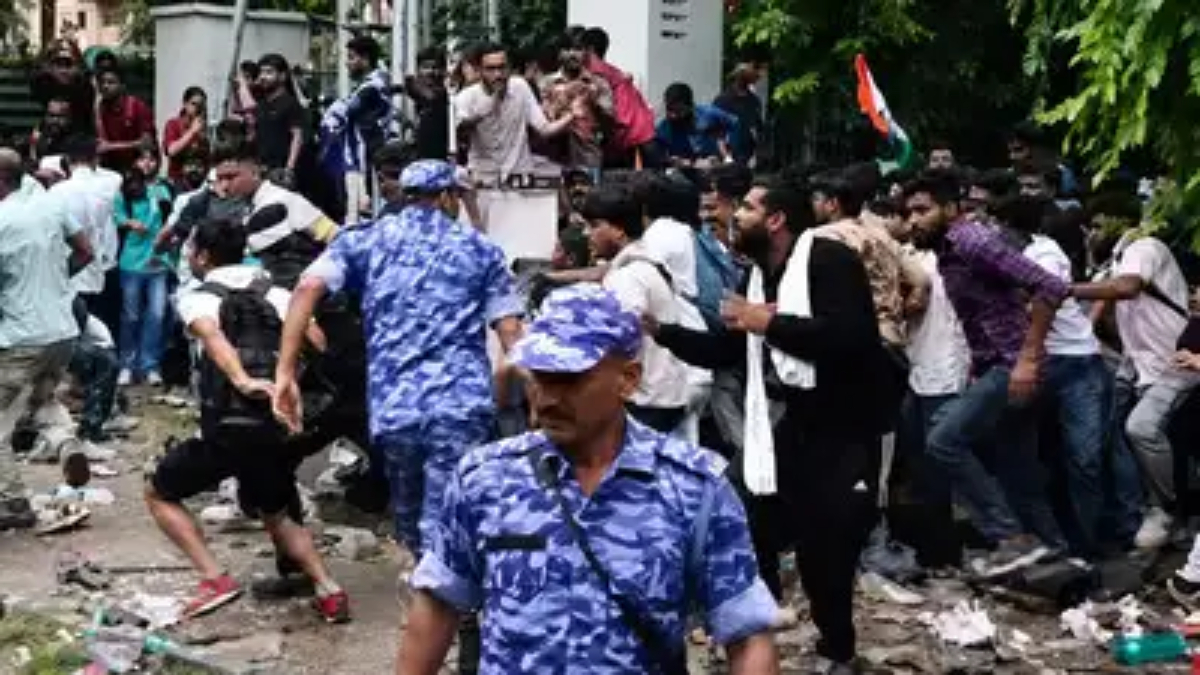
New Delhi, July 20, 2026 — Tensions boiled over in the national capital as thousands of demonstrators participating in the “Chalo Sansad” march clashed with security forces near Parliament Street and Kerala Bhawan. The confrontation escalated when a section of the crowd attempted to breach barricades to reach the Parliament building, prompting the Delhi Police and Rapid Action Force (RAF) to resort to a lathicharge and disperse the crowd.
The high-stakes agitation, organized by the Cockroach Janta Party (CJP) alongside student union representatives and social activists, coincided with the opening day of Parliament’s Monsoon Session. Demanding immediate administrative accountability over widespread examination irregularities—specifically regarding the NEET medical entrance exam—protesters demanded systemic reforms and the resignation of top officials.
How the Scuffle Unfolded Near Kerala Bhawan
The march began peacefully around the designated protest site at Jantar Mantar. However, as the crowd swelled to several thousand, demonstrators began moving down Parliament Street toward the barricaded security perimeter.
Several protesters and law enforcement personnel sustained minor injuries during the chaos. Police quickly cordoned off the entire corridor leading toward Parliament, detaining between 10 to 15 prominent leaders and agitators.
Core Demands Behind the Agitation
The primary driver of the “Chalo Sansad” rally is growing public outrage over competitive exam integrity. Over the past several weeks, student organizations, civil society groups, and legal activists have rallied against allegations of paper leaks, marking discrepancies, and delayed investigations surrounding national examinations.
- Key Demands:
- Comprehensive structural reform of national testing agencies.
- High-level judicial probe into recent NEET-UG scoring discrepancies.
- Accountability and direct parliamentary debate on exam security measures.
Activist Sonam Wangchuk, who has been on an indefinite hunger strike regarding education reforms, delivered a message from Safdarjung Hospital, urging lawmakers to address these systemic issues inside Parliament. Prominent public figures and MPs, including Aazad Samaj Party chief Chandra Shekhar Azad and actor Prakash Raj, visited the protest venue earlier in the morning to show solidarity.
City Transit and Security Fallout
In response to the escalating situation, authorities placed Central Delhi under strict surveillance. Section 163 of the Bharatiya Nagarik Suraksha Sanhita (BNSS)—which prohibits public assemblies of five or more people without prior permission—was strictly enforced across the district.
To curb crowd gathering and prevent rumors from spreading:
- Metro Disruptions: Delhi Metro temporarily closed entry and exit gates at five major central stations—Rajiv Chowk, Janpath, Patel Chowk, Central Secretariat, and Seva Teerth.
- Internet Restrictions: Mobile internet access was temporarily throttled or restricted in specific pockets surrounding the Parliament complex to manage security coordination.
- Traffic Diversions: Arterial roads near Janpath, Ashoka Road, and Windsor Place were barricaded, creating severe traffic bottlenecks during morning peak hours.
Official Response: Police & Government Statements
Delhi Police officials stated that the CJP and associated groups had not obtained official clearance for a march toward the Parliament complex.
Despite the violent turn at the barricades, CJP Chief Spokesperson Saurav Das confirmed that dialogue channels were opened. Speaking while being escorted to the Deputy Commissioner of Police’s office, Das noted.
Political Waves Inside Parliament
The street clashes immediately resonated inside the halls of Parliament. On the opening day of the Monsoon Session, Opposition MPs raised slogans demanding an immediate discussion on the student protests and examination security.
Both the Lok Sabha and Rajya Sabha experienced repeated interruptions and shouting matches shortly after convening. Speaker Om Birla repeatedly appealed for order, urging members to use debate rather than disruption to address national concerns. However, continued chaos forced early adjournments.
What Lies Ahead
While police have restored order around Parliament Street and Kerala Bhawan, security forces remain deployed in force across central Delhi. Organizers have stated that their future strategy depends on the outcome of discussions with senior government officials.
With the Monsoon Session scheduled to run over the coming weeks, the issue of entrance exam integrity and student rights is set to dominate both street politics and parliamentary proceedings.