

New Delhi, June 13, 2026: For more than six decades, few things have captured the imagination of car enthusiasts quite like a Lamborghini flagship. It is the definitive “poster car”—a machine designed not just to break lap records, but to shatter design norms, shock the senses, and dominate bedroom walls across the globe. At the heart of this enduring legacy is a single, glorious masterpiece of engineering: the naturally aspirated V12 engine.
From the elegant curves of the 1960s to the sharp, electrified geometry of today’s hypercars, Lamborghini’s V12 bloodline has undergone a dramatic evolution. The journey from the groundbreaking Miura to the cutting-edge Revuelto showcases how the Italian automaker has repeatedly rewritten the supercar rulebook, proving that even as the automotive landscape shifts, the drama of the raging bull remains untouched.
1966: The Birth of the Supercar
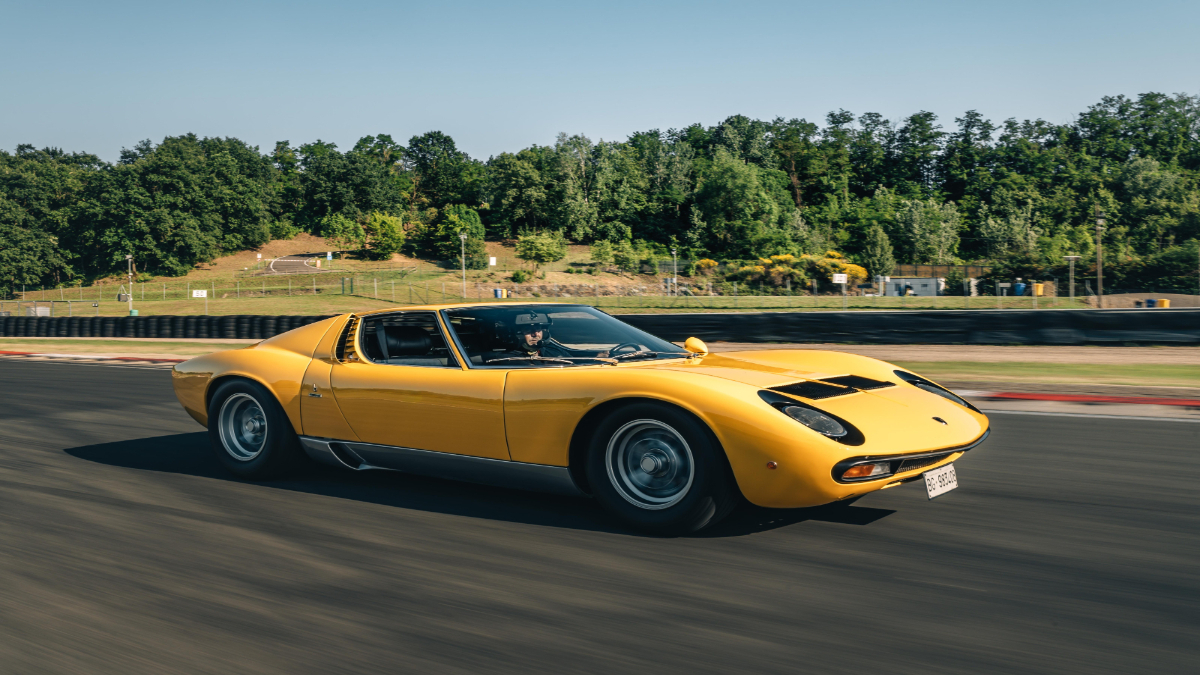
Before the mid-1960s, high-performance sports cars traditionally kept their engines up front. Then came the Lamborghini Miura in 1966, and the automotive world changed forever. Built by a team of young, brilliant engineers working after hours, the Miura placed its 4.0-liter V12 engine sideways (transversely) right behind the driver’s head.
Wrapped in an incredibly beautiful, low-slung body designed by Marcello Gandini at Bertone, the Miura didn’t just challenge rivals like Ferrari—it made them look instantly outdated. With a top speed of around 174 mph, it was the fastest production car of its day. The Miura didn’t just invent a new category; it gave birth to the very concept of the modern “supercar.”
1974: The Wedge That Shocked the World
If the Miura was an exercise in pure beauty, its successor was a masterclass in visual shock value. When the Lamborghini Countach debuted in the 1970s, it looked less like a car and more like a spaceship that had crash-landed on tarmac. It traded the soft, flowing curves of the 1960s for a sharp, aggressive, geometric wedge profile.
The Countach also introduced two features that would define Lamborghini flagships for generations to come: the engine was turned 90 degrees to sit longitudinally (lengthwise) down the center of the car, and it featured iconic, vertically opening scissor doors. As the car evolved into the 1980s with massive rear wings, flared wheel arches, and a larger 5.2-liter Quattrovalvole (four valves per cylinder) V12, it officially cemented its status as the ultimate, definitive bedroom-poster car for millions of kids worldwide.
1990: Cracking the 200 MPH Barrier
Entering a new decade, Lamborghini needed a machine that could modernize its signature madness without losing its raw edge. The answer was the Lamborghini Diablo, arriving in 1990. Named after a legendary 19th-century fighting bull, the Diablo was wider, sleeker, and significantly more refined than the brutal Countach.
Underneath its smooth carbon-fiber and aluminum skin lay an enlarged 5.7-liter V12 engine that unleashed nearly 500 horsepower. It was the first production Lamborghini to breach the elusive 200 mph barrier, topping out at a fierce 202 mph. Later variants introduced all-wheel drive (VT) and stripped-out, track-focused setups (SV), proving that Lamborghini could build a car that was civilized enough to drive to a hotel, yet wild enough to dominate a racetrack.
2001: The Audi Era and Modern Precision
The turn of the millennium marked a monumental shift for the brand. Acquired by the Volkswagen Group and placed under Audi’s stewardship, Lamborghini gained access to world-class engineering discipline and manufacturing budgets. The first true child of this new era was the 2001 Lamborghini Murciélago.
Designed by Luc Donckerwolke, the Murciélago retained the absolute theater of its ancestors—the low stance, the massive V12 engine, and the scissor doors—but paired them with modern electronics, structural reliability, and a sophisticated permanent all-wheel-drive system. The engine eventually grew to a massive 6.5 liters. In its final, extreme iteration—the LP670-4 SuperVeloce (SV)—it stood as a screaming, lightweight tribute to the old-school mechanical rawness of the original Lamborghini V12 architecture.
2011: Stealth Fighters and Carbon Monocoques
In 2011, Lamborghini retired the classic V12 engine blueprint that had powered its cars in various upgraded forms since the 1960s. They built a completely clean-sheet, brand-new 6.5-liter V12 engine from scratch and dropped it into the Lamborghini Aventador.
Inspired heavily by modern stealth fighter jets, the Aventador featured a cutting-edge carbon-fiber passenger cell (monocoque) and an incredibly aggressive, angular design. It kept the naturally aspirated V12 alive at a time when almost every other manufacturer was turning to turbochargers and downsizing. Over its highly successful 11-year run, the Aventador became a modern legend, culminating in the SVJ, which used active aerodynamics to shatter the lap record at Germany’s famous Nürburgring circuit.
2026: The New Era of Electrified Lightning
The modern automotive landscape demands sustainability, but Lamborghini refused to sacrifice the soul of its brand. The current flagship, the Lamborghini Revuelto, is a brilliant showcase of how traditional mechanical theater can thrive alongside futuristic tech.
The Revuelto is Lambo’s first HPEV (High Performance Electrified Vehicle). It keeps a screaming, naturally aspirated 6.5-liter V12 engine that revs all the way to a spine-tingling 9,500 rpm. However, Lamborghini has flipped the engine 180 degrees and paired it with a lightweight 3.8-kWh lithium-ion battery pack and three high-output electric motors.
This hybrid setup isn’t just about lowering emissions; it’s about absolute performance. The electric motors fill in any slight gaps in power delivery, providing instant torque and cornering precision via active torque vectoring on the front wheels.
For short bursts, the Revuelto can even slide through city streets in “Città” mode silently on pure electric power. But when you mash the throttle, all 1,001 horsepower awake at once, rocketing the car from 0 to 100 km/h in a mind-bending 2.5 seconds and onward to a top speed well over 217 mph. Special editions, like the recently revealed Italia and NA63, continue to keep the model at the absolute peak of collector desirability.
From the smooth contours of the Miura to the hybrid-electric thunder of the Revuelto, the core philosophy of Lamborghini has never wavered. It is a lineage built on unapologetic drama, sensory overload, and striking design. The technology under the skin has completely changed, but the ultimate mission remains exactly the same: