

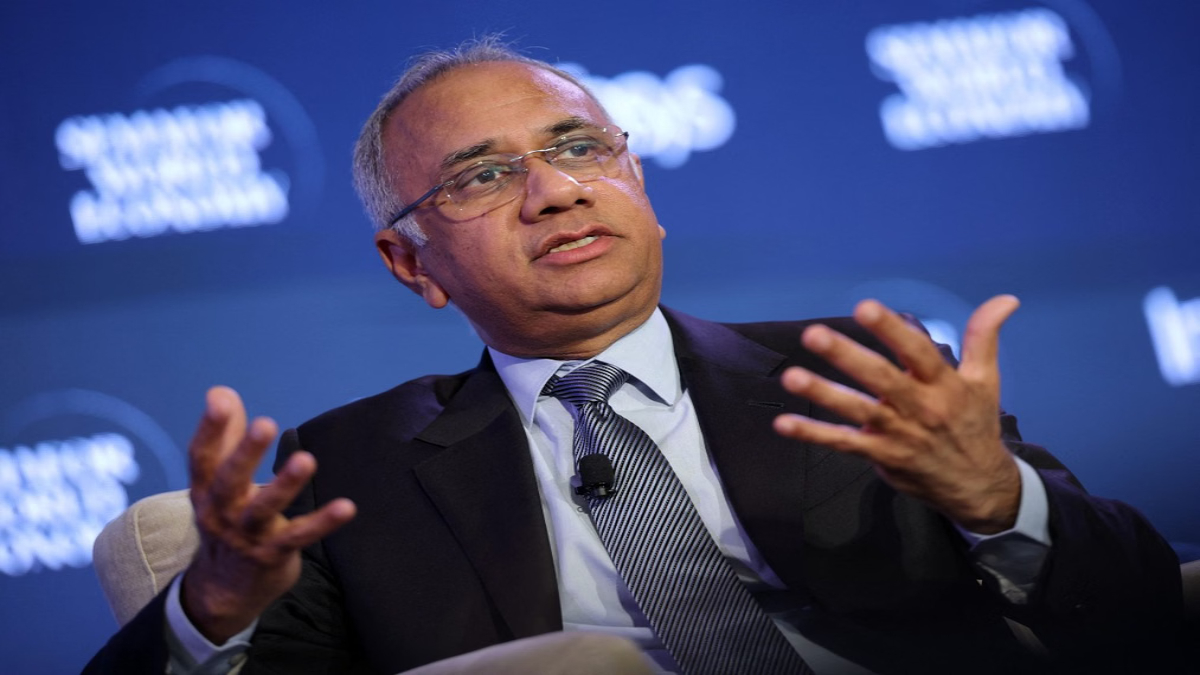
New Delhi, May 30, 2026: Infosys Chief Executive Officer and Managing Director Salil Parekh saw his annual compensation rise by a modest 2.5% to ₹82.6 crore (approximately $8.69 million) for the fiscal year 2025–26 (FY26), according to the company’s newly released annual report. The small bumps in executive pay reflect a highly calculated approach to cost discipline as India’s $315-billion IT services industry navigates a transformative era marked by slowing legacy growth and heavy artificial intelligence (AI) disruptions.
Parekh, who is already the longest-serving non-founder CEO at the Bengaluru-headquartered firm, saw his package edge up from ₹80.62 crore in the previous fiscal year. Interestingly, while the compensation rose in terms of the Indian Rupee (INR), the overall valuation in U.S. dollars dipped slightly from last year’s $9.44 million. This discrepancy is entirely due to macroeconomic currency shifts, as the Indian Rupee depreciated by nearly 10% against the U.S. dollar over the course of the fiscal year.
Breaking Down the $8.7 Million Compensation Structure
Like most top-tier tech executives, the vast majority of Parekh’s take-home pay is directly tied to performance and equity milestones rather than a rigid base salary. By tying leadership wealth directly to shareholder value, Infosys ensures its executive team remains intensely focused on long-term corporate health.
The true driver of Parekh’s package was the exercise of stock options. During fiscal 2026, the CEO exercised 272,400 Restricted Stock Units (RSUs) under the company’s 2015 incentive framework and an additional 64,690 RSUs under its 2019 plan. The perquisite value of these exercised shares amounted to ₹50.75 crore—accounting for more than 61% of his total earnings.
Furthermore, the board approved an array of fresh, forward-looking stock grants. These include 230,621 performance-based RSUs tied directly to strict revenue and operational targets, 13,273 RSUs anchored to Environmental, Social, and Governance (ESG) milestones, and 33,183 RSUs tethered closely to cumulative total shareholder returns.
The Executive vs. Employee Pay Gap
Unsurprisingly, the disclosure of multi-million dollar executive pay packages frequently brings attention to internal income disparities. The annual report revealed that Salil Parekh’s overall earnings stood at 742 times the Median Remuneration of Employees (MRE) at Infosys. If you filter out the massive gains he made from exercising legacy stock options, that ratio drops significantly to a more standard 289 times the median worker’s salary.
Meanwhile, the broader workforce at Infosys experienced stable upward mobility:
- Median Employee Pay: The median remuneration for an Infosys employee reached ₹11,13,024 ($11,716), marking a clear 4% climb from the previous year’s median of ₹10,72,008.
- Domestic Salary Revisions: Indian employees saw an average annual salary increase of roughly 11%, a figure that factor in standard promotions, annual evaluations, and role-based pay revisions.
- Global Workforce Trends: For the tech major’s international workforce spanning across North America, Europe, and Asia-Pacific, salary adjustments were deployed dynamically to stay in step with respective local market trends.
At the very top of the hierarchy, unique leadership dynamics remain at play. Infosys co-founder and Chairman Nandan Nilekani voluntarily chose to forgo any form of remuneration or sitting fees for his services during the fiscal year—a continuous trend for the veteran leader.
Strong Financials Meet a Cautious Horizon
The slight 2.5% acceleration in executive pay aligns with a steady, if cautious, financial performance by the IT giant. Infosys closed out the 2025–26 fiscal year with an impressive global workforce of over 328,000 employees, reporting the following financial outcomes:
- Revenue from Operations: Touched ₹1,78,650 crore ($18.8 billion), logging a 9.6% growth rate compared to the previous year.
- Net Profit: Scaled up 10.2% to land at ₹29,440 crore ($3.1 billion).
- Free Cash Flow: Concluded at a highly resilient ₹33,097 crore ($3.48 billion).
The final quarter of the fiscal year (January to March) was particularly robust, yielding a 20.8% surge in quarterly net profits. However, looking ahead into fiscal 2027, the company has offered a conservative revenue growth forecast of 1.5% to 3.5% in constant currency terms. This projection falls slightly short of the 2% to 4% growth window Wall Street and local analysts were aggressively hoping for.
Navigating the Tech Industry’s “Deployment Gap”
The conservative outlook issued by Infosys is a direct reaction to systemic changes shaking up global tech spending. Enterprise clients are rapidly pivoting away from traditional, labor-intensive legacy software maintenance, moving their tech budgets toward artificial intelligence, automation, and intelligent agents.
In his annual letter to shareholders, Chairman Nandan Nilekani highlighted that trillions of dollars in enterprise capabilities remain locked inside vulnerable, rigid legacy environments built for an entirely different era. He noted that this “technical debt” is no longer just a backend line item—it has evolved into a strategic liability that drags down the precise agility required to successfully scale modern AI frameworks.
According to Nilekani, the primary bottleneck holding companies back isn’t the AI technology itself, but rather the internal complexity of enterprise data silos and undocumented software dependencies.
As corporate clients rethink their technology budgets in response to AI innovators, enterprise leaders like Parekh are tasked with completely reinventing their business models. While competitors like Tata Consultancy Services (TCS) also posted modest CEO pay hikes—with TCS head K Krithivasan taking home $2.96 million (₹28 crore) in FY26—the tech sector’s leadership is clear: executive rewards will remain strictly anchored to how successfully they steer their organizations through the looming AI frontier.