
)
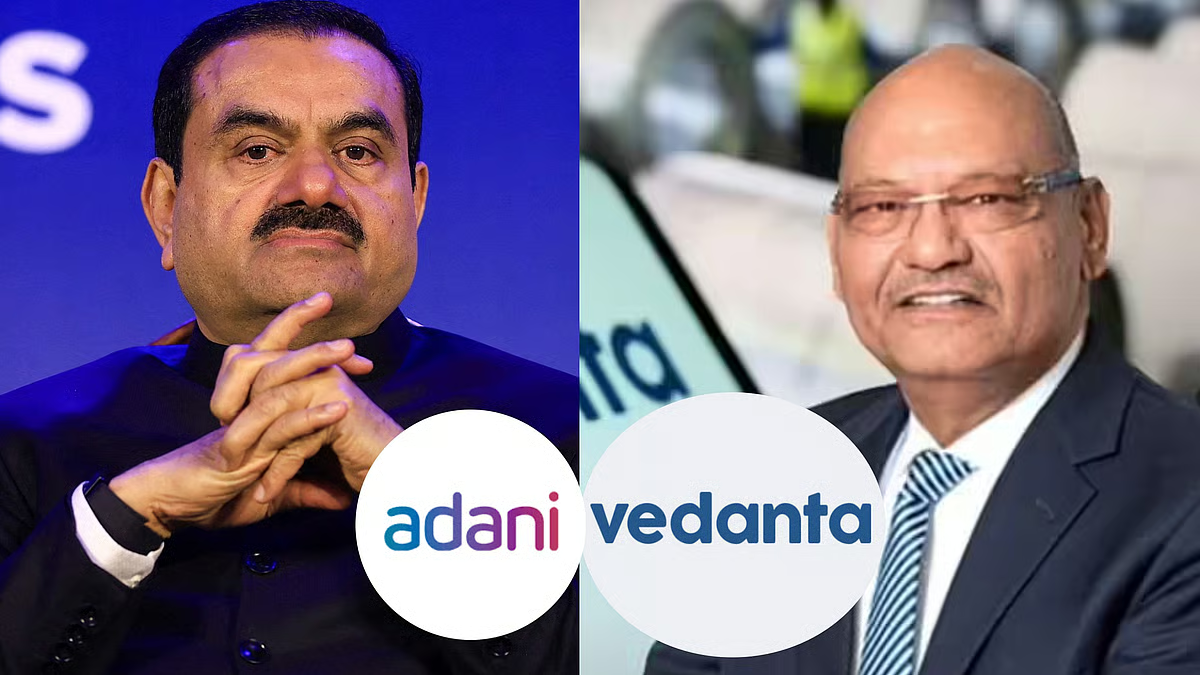
New Delhi, May 4, 2026 — In a major development for India’s corporate insolvency landscape, the National Company Law Appellate Tribunal (NCLAT) has dismissed the petitions filed by Vedanta Limited, effectively upholding the selection of Adani Enterprises as the successful resolution applicant for the debt-ridden Jaiprakash Associates Limited (JAL).
The ruling by a two-member bench, comprising Chairperson Justice (retd) Ashok Bhushan and Technical Member Barun Mitra, brings a decisive end to a contentious legal battle, paving the way for the Adani Group to proceed with its approximately ₹14,535-crore acquisition plan.
The Heart of the Dispute
The conflict stemmed from the insolvency resolution process of Jaiprakash Associates, a company that entered the Corporate Insolvency Resolution Process (CIRP) in June 2024 following a petition by ICICI Bank. With admitted claims exceeding ₹57,000 crore, the company’s assets—which include cement plants, real estate projects in the Delhi-NCR region, and the iconic Buddh International Circuit—became the subject of a high-stakes bidding war.
Vedanta Limited had challenged the decision of the Committee of Creditors (CoC) to select the Adani Group’s bid. Vedanta’s core argument was based on financial value; the company claimed that its own revised resolution plan, reportedly valued at over ₹17,900 crore, offered significantly higher returns to creditors than the ₹14,535-crore plan submitted by Adani Enterprises. Vedanta alleged that the process lacked transparency and that the CoC had failed to properly evaluate its superior financial offer.
NCLAT’s Verdict: Protecting ‘Commercial Wisdom’
In its order, the NCLAT bench found no merit in Vedanta’s arguments. The tribunal emphasized that the decision-making power of the Committee of Creditors is paramount under the Insolvency and Bankruptcy Code (IBC).
The NCLAT observed:
- Commercial Wisdom: The tribunal reiterated that the CoC’s decision, taken with a massive 93.81% majority in November 2025, was a product of the creditors’ “commercial wisdom.” It noted that this decision cannot be labeled as arbitrary or perverse simply because a higher financial offer was presented later.
- No Procedural Irregularity: The bench found no material irregularity in how the Resolution Professional conducted the bidding process.
- Strict Adherence to Deadlines: The CoC had successfully argued that Vedanta’s revised, higher offer was submitted after the prescribed deadline and after the company had become aware of its competitors’ positions. The tribunal upheld the sanctity of the structured bidding process, noting that allowing post-deadline modifications would undermine the framework.
“No grounds have been made out by the appellant (Vedanta) to interfere with the decision of the adjudicating Authority (NCLT),” the NCLAT stated.
A Long Road to Resolution
The resolution of Jaiprakash Associates has been a long and complex journey since its admission into insolvency in 2024. The process attracted significant interest, with 28 expressions of interest received and six final bidders—including Dalmia Cement and Jindal Power—competing for the assets.
The legal tussle saw several stages:
- NCLT Approval: In March 2026, the Allahabad bench of the National Company Law Tribunal (NCLT) approved the Adani Group’s plan.
- Appellate Challenge: Vedanta appealed this decision to the NCLAT, which refused an interim stay in March, a decision later upheld by the Supreme Court.
- Final Dismissal: With today’s NCLAT ruling, the legal obstacles to the acquisition have been largely cleared.
What This Means for the Industry
This ruling is seen as a reinforcement of the principles of the IBC. By prioritizing the collective commercial judgment of lenders over the individual financial bids of corporate entities, the tribunal has signaled that the insolvency process is intended to be efficient and time-bound.
For the Adani Group, this victory secures a diverse portfolio of assets, including significant cement manufacturing capacity and high-value real estate in the National Capital Region. For Jaiprakash Associates’ creditors, the implementation of the plan brings a conclusion to years of financial uncertainty.
While Vedanta retains the right to approach the Supreme Court, legal experts note that the company faces a steep climb, given that the apex court has already declined to interfere with the lower tribunal’s interim proceedings. For now, the focus shifts to the implementation of the resolution plan and the eventual transfer of assets.