

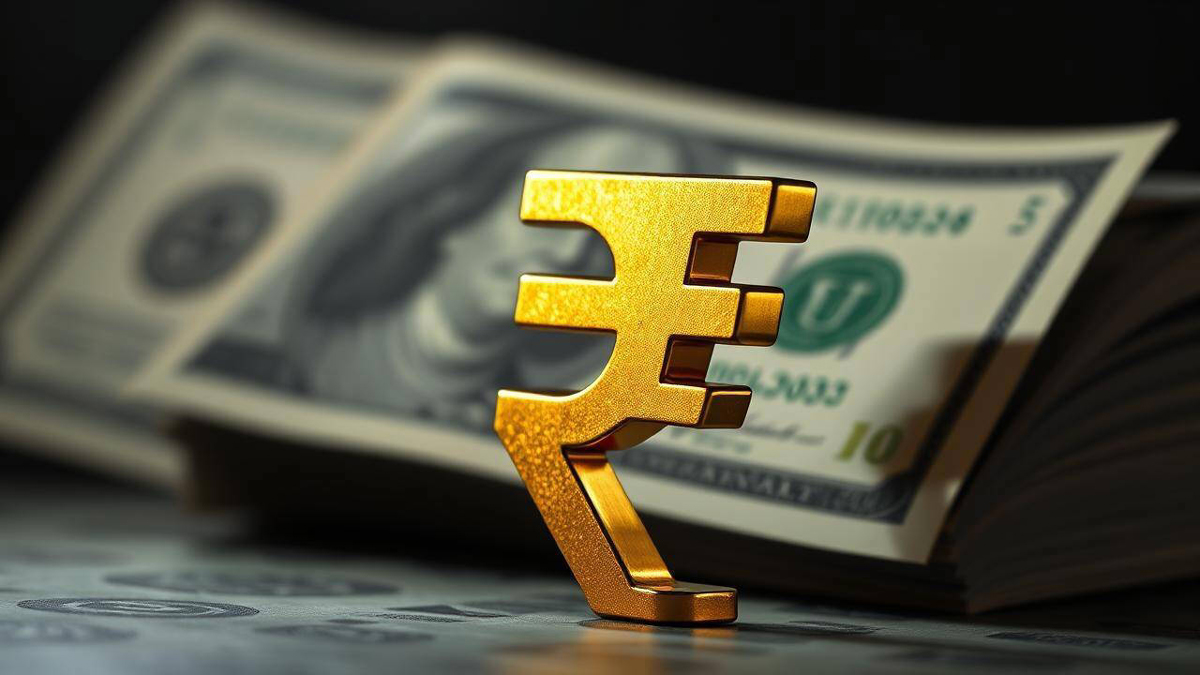
New Delhi, December 01, 2026: The Indian rupee began the new calendar year on a cautious note, depreciating by 11 paise to touch a near-record low of 89.99 against the US dollar in early trade on Thursday, January 1, 2026. The decline comes amidst a backdrop of persistent foreign fund outflows and a strengthening greenback in the global markets.
Opening Market Dynamics
At the interbank foreign exchange market, the local unit opened at 89.94 before losing further ground to hit 89.99. This follows a close of 89.88 on the final trading day of 2025. Market analysts suggest that while the 90-per-dollar mark is a significant psychological level, the currency is currently navigating a complex “capital account challenge” rather than a traditional trade-driven deficit.
Key Factors Weighing on the Rupee
The rupee’s sluggish start to 2026 is attributed to several macroeconomic and geopolitical factors:
- Foreign Fund Outflows: Foreign Institutional Investors (FIIs) remained net sellers, offloading equities worth ₹3,597.38 crore in the final session of 2025. The shift of capital toward other emerging markets offering better risk-adjusted returns has kept the rupee under pressure.
- Trade Policy Uncertainty: The delayed progress on a crucial India–U.S. trade deal and the overhang of global tariffs—specifically those related to the U.S. administration’s reciprocal tariff policies—continue to weigh on investor sentiment.
- Dollar Strength: The dollar index, which measures the greenback against a basket of six major currencies, edged up 0.09% to 98.32, making dollar-denominated assets more attractive.
- Weak FDI Inflows: Recent data indicates that Foreign Direct Investment (FDI) turned negative on a net basis between January and October 2025, removing the “anchor flow” that typically stabilizes the balance of payments.
Expert Commentary
Forex experts believe the Reserve Bank of India (RBI), under Governor Sanjay Malhotra, may allow the rupee to adjust in line with market forces while remaining active to prevent excessive volatility.
“The rupee enters 2026 with both challenges and cushions. While global uncertainty persists, India’s strong macroeconomic parameters and ample forex reserves provide a necessary safety net,” noted Amit Pabari, MD of CR Forex Advisors.
Analysts expect the USD/INR pair to trade within a range of 89.30 to 90.20 in the short term. However, some researchers warn that if the psychological barrier of 90 is breached decisively, it could trigger further hedging by importers, potentially pushing the currency toward the 91 or 92.50 levels.
Equity Market Contrast
In contrast to the currency’s slide, the domestic equity markets showed resilience. The BSE Sensex rose over 200 points to 85,414.98, and the NSE Nifty climbed 47.55 points to 26,177.15 in early trade. This divergence highlights a strong domestic institutional appetite for Indian stocks even as global investors remain wary.
As global markets remain thin due to New Year’s Day holidays in the US, Europe, and parts of Asia, the rupee’s trajectory in the coming days will likely depend on the resumption of full-scale global liquidity and upcoming domestic industrial data.