

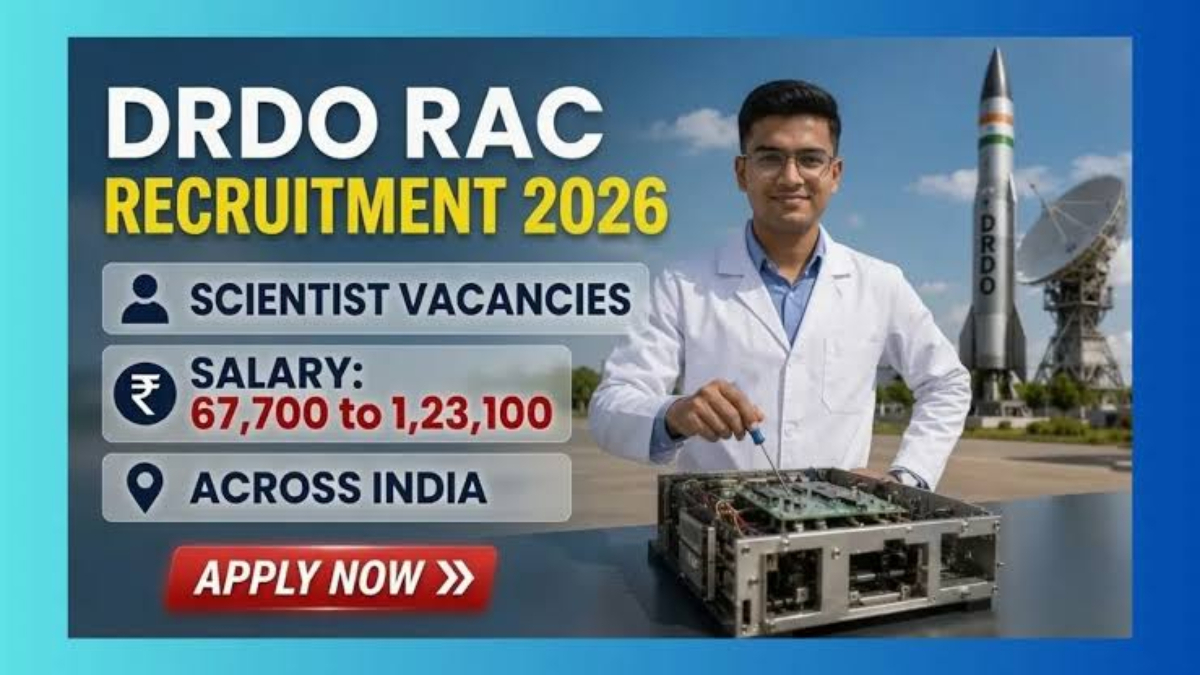
New Delhi, June 19, 2026 — The countdown has officially begun for high-caliber engineers and researchers aiming to secure a prestigious career in India’s premier defense research wing. The Defence Research and Development Organisation (DRDO) is closing its online application window today, June 19, 2026, for the direct lateral recruitment of 33 scientist positions. Eligible professionals have until 4:00 PM to finalize and submit their applications through the Recruitment and Assessment Centre (RAC) portal at rac.gov.in.
This specialized recruitment drive, structured under Advertisement Number 157, targets experienced scientific minds capable of driving India’s next generation of defense engineering, strategic systems, and indigenous defense technologies. With the clock ticking, officials have urged candidates to complete their payments and document uploads early to avoid the inevitable last-minute server bottlenecks associated with major government hiring deadlines.
A Lateral Push for Aatmanirbhar Bharat
Unlike entry-level scientist hiring which heavily pulls from raw academic pools or standardized graduate entrance exams, this lateral recruitment focuses entirely on mid-to-senior professionals who bring verified industry or research experience. The objective is directly aligned with the Union Government’s ongoing Aatmanirbhar Bharat (Self-Reliant India) initiative. As regional security dynamics shift rapidly, DRDO requires a fresh injection of technical leadership to head specialized projects ranging from advanced radar configurations and Unmanned Aerial Vehicles (UAVs) to quantum computing, computational imaging, and missile technologies.
The selected candidates will find themselves placed across a vast network of highly specialized DRDO laboratories situated throughout the country. Rather than spending years navigating institutional hierarchies, lateral entrants will step into critical development cycles immediately, collaborating alongside the country’s leading defense technologists on high-impact projects vital to national security.
Breakdown of Vacancies and Pay Scales
The 33 premium vacancies are meticulously distributed across three distinct senior hierarchical tiers within the Defence Research and Development Service (DRDS) cadre. All announced positions currently fall under the unreserved category, opening the floor to highly competitive national selection criteria.
Beyond the attractive base pay frameworks provided under the 7th Central Pay Commission (CPC), chosen officers are eligible for standard central government allowances. These include Dearness Allowance (DA), House Rent Allowance (HRA), transport provisions, and distinct medical benefits. More importantly, the roles provide elite intellectual incentives, including government-sponsored research grants, opportunities for international technological exchange, and substantial institutional backing for experimental projects.
Strict Eligibility and Age Criteria
Because these roles bypass basic foundational training, the eligibility matrix demands a flawless match of academic pedigree and long-term hands-on experience.
1. Scientist C
This tier acts as the primary stepping stone for young professionals transitioning from private tech giants or private aerospace labs into core defense structures. The upper age limit is strictly capped at 35 years as of the closing date. Academically, applicants must hold a First Division Bachelor’s Degree in Engineering or Technology, or a First Division Master’s degree in specific scientific disciplines. Additionally, a minimum of 3 years of post-qualification industrial, design, or research and development experience is mandatory.
2. Scientist D
Designed for senior mid-level researchers, the maximum age limit for this rank is 45 years. Candidates are required to hold a first-class professional degree along with a minimum of 7 years of relevant, high-level scientific experience. Core disciplines targeted in this tier include Mechanical Engineering, Electronics & Communication, and specialized Physics fields such as Medical or Radiation Physics.
3. Scientist E
The most senior tier available in this notification allows for a maximum age of 45 years (with specific, legally mandated relaxations up to 56 years for central government employees or ex-servicemen under strict clauses). Applicants must bring an extensive track record containing at least 11 years of pioneering research, experimental design, or production leadership in strategic domains like digital communication networks or advanced aeronautical systems.
Critical Steps for Final Submission
For candidates racing against the 4:00 PM cutoff, the application flow must be executed flawlessly to prevent immediate automated rejection. The RAC has outlined a highly systematic submission path:
- Official Portal: Navigate only to the verified Recruitment and Assessment Centre platform at
rac.gov.in. - Profile Verification: Ensure that the generated login credentials match your active mobile number and email ID, as all upcoming communication regarding test schedules or interview venues will be strictly automated through these channels.
- Document Authenticity: Scanned copies of your passport-size photographs, digital signatures, first-division degree certificates, and most crucially, unambiguous experience certificates detailing the exact duration of employment must be clear. Blurry or incomplete uploads will cause the application to be filtered out during basic sorting.
- Application Fees: A nominal fee of ₹100 is applicable for male candidates belonging to the General, OBC, and EWS categories. Meanwhile, all female applicants, alongside candidates from Scheduled Castes (SC), Scheduled Tribes (ST), and Persons with Disabilities (PwD), are completely exempted from payment.
The Road Ahead: Selection Process
Filing the application is merely the first phase of an intensely competitive vetting process. Given the technical nature of these lateral positions, the RAC does not rely on generic screening. Initial shortlisting will occur based on the quality, depth, and relevance of the candidates’ past experience and academic publications.
Those who survive the preliminary document screening will be summoned for an exhaustive, in-person Personal Interview conducted by a high-level selection board at the RAC headquarters in New Delhi. The authorities have explicitly clarified that no virtual or online interviews will be accommodated, emphasizing the rigorous psychological and technical screening required for individuals handling sensitive national defense secrets.
As the application window closes this afternoon, the focus shifts to the screening boards. For 33 chosen professionals, this recruitment marks the beginning of an exceptional chapter—one where their everyday engineering decisions directly fortify the strategic sovereignty of the nation.
You can learn more about the deep eligibility requirements, specific engineering streams, and interview structures by watching the DRDO Scientist Recruitment Breakdown Video, which outlines the key career progression metrics for these positions.