

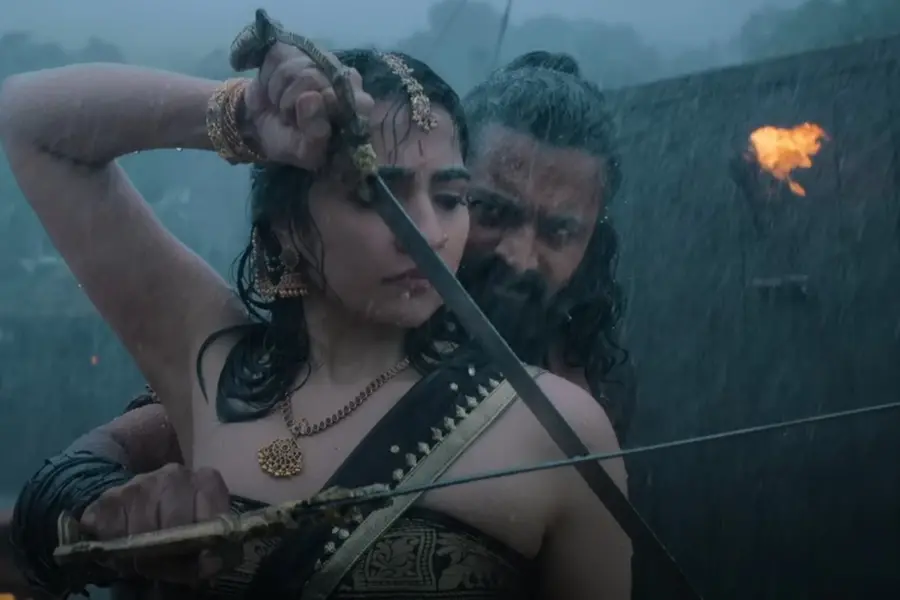
In the rapidly evolving landscape of Indian cinema, few names have commanded as much respect and curiosity as Rukmini Vasanth. Known for her nuanced performances and deliberate choice of scripts, the actor has carved a niche that balances mainstream appeal with artistic integrity. When the announcement came that she would be joining the juggernaut that is the Kantara franchise—specifically the prequel Kantara: Chapter 1—audiences and critics alike were eager to understand what drew her to such a massive, culturally charged project.
Released in October 2025, Kantara: Chapter 1 not only lived up to the towering expectations set by its predecessor but also allowed Rukmini Vasanth to showcase a dimension of her craft that many had not yet seen. In various interviews reflecting on her journey with the film, the actor has opened up about the initial hesitation, the artistic hunger, and the ultimate decision that led her to step into the shoes of the formidable Princess Kanakavathi.
The Call of a Complex Character
For any actor, joining a sequel—or in this case, a prequel—to a global phenomenon is a daunting prospect. The pressure to match the intensity of the original Kantara is immense. However, for Rukmini, the decision to sign on was rooted in something deeper than just the film’s box-office potential.
It was the complexity of Kanakavathi that served as the primary hook. Rukmini has often spoken about the “fallacy of the nice girl”—a common trope in early career stages where actors are encouraged to stick to “safe,” virtuous, and traditional heroine roles to maintain audience favor. Kantara: Chapter 1 offered her the exact opposite.
“I was very anxious about the fact that she turns out to be a negative character,” Rukmini admitted in post-release interviews. “In the early stages, you don’t really delve into the grey. There’s this idea of what a traditional heroine should be, the values she should embody, and where in the film you’re meant to exist.”
By choosing to play a character with complex, sometimes antagonistic shades, Rukmini consciously broke away from the expectations of the industry. She recognized that true growth as an actor often happens in the uncomfortable spaces—where the character’s motivations are not black and white, but layered with ambition, duty, and internal conflict.
A Cultural Tapestry
Beyond the character arc, the gravitational pull of Kantara: Chapter 1 was, for lack of a better word, its “roots.” In an era where cinema is increasingly globalized, Rukmini has been vocal about her commitment to regional stories that are deeply embedded in culture.
She drew a parallel between the storytelling in Kantara and the timelessness of Indian epics like the Ramayana and the Mahabharata. In her view, the reason these stories have survived for millennia is that they are passed down through generations, keeping cultural identity alive.
“Likewise, it’s a great effort by Rishab Shetty and Hombale Films to tell such rooted stories,” she remarked. For her, the film was an opportunity to contribute to a medium that doesn’t just entertain but serves as a bridge for cultural continuity. To embody a character like Kanakavathi, she had to immerse herself in the rituals, the music, and the specific atmosphere of the region, an experience she described as transformative.
The Physicality of the Role
The leap from the roles she had played previously to the world of Kantara: Chapter 1 required more than just an emotional shift; it demanded a physical metamorphosis. The period action-thriller setting called for skills that were far removed from her real-life persona.
The transformation was comprehensive. Rukmini undertook rigorous training, learning sword fighting and horse riding to lend authenticity to the Princess of the narrative. These were not just checklist items for a production; they were tools that allowed her to inhabit the character’s world.
“The cultural transformation happened by studying about the region,” she explained. “A lot of credit goes to Rishab Shetty and the writers. They wrote a well-grounded character… Not just emotionally, but it’s a great character to play since now I can hold a sword and ride a horse.”
Overcoming the “Anxiety of the Grey”
Perhaps the most compelling part of her journey was how she moved past the fear of playing a “negative” character. As she noted, the fear wasn’t just about the role itself but about the “compounding effect” it might have on her career. Early in an actor’s trajectory, there is a constant, lingering worry that one wrong move could threaten future opportunities.
However, once she arrived on the set—amidst the dense Kundapur forests where the film was shot—the anxieties faded. The immersive nature of the production took over. She spoke of the dichotomy of being on set: you are either fully committed to the world of the film, or you are distracted by the minutiae of the reality around you. She chose the former.
By fully committing to the complexity of Kanakavathi, Rukmini realized that the audience, too, craves depth. They want to see actors who aren’t afraid to take risks. If the actor doesn’t connect with the core of the character, the audience never will—a philosophy that clearly resonated, as her performance was widely lauded by critics and audiences across the country.
A Legacy of Conscious Choices
Rukmini Vasanth’s involvement in Kantara: Chapter 1 marks a significant pivot in her career. It demonstrates a move away from the pressure of being a “star” and toward the goal of being an “actor” who fearlessly chooses projects that challenge her and the audience.
Her performance as Kanakavathi stands as a testament to the fact that when a story is rooted in authenticity and a character is written with layers of grey, the audience is willing to follow the actor down any path. Looking back at her decision to say “yes,” it is clear that it was never about the size of the production or the potential for blockbuster status—though those arrived in spades. It was about the opportunity to tell a story that felt vital, to explore a character that felt dangerous, and to contribute to a cinematic universe that is, fundamentally, about honoring the heritage from which it springs.
As we look at her filmography moving into 2026, the inclusion of Kantara: Chapter 1 stands as a bold chapter—one that proves Rukmini Vasanth is not just following the trends of Indian cinema, but actively helping to redefine them.