

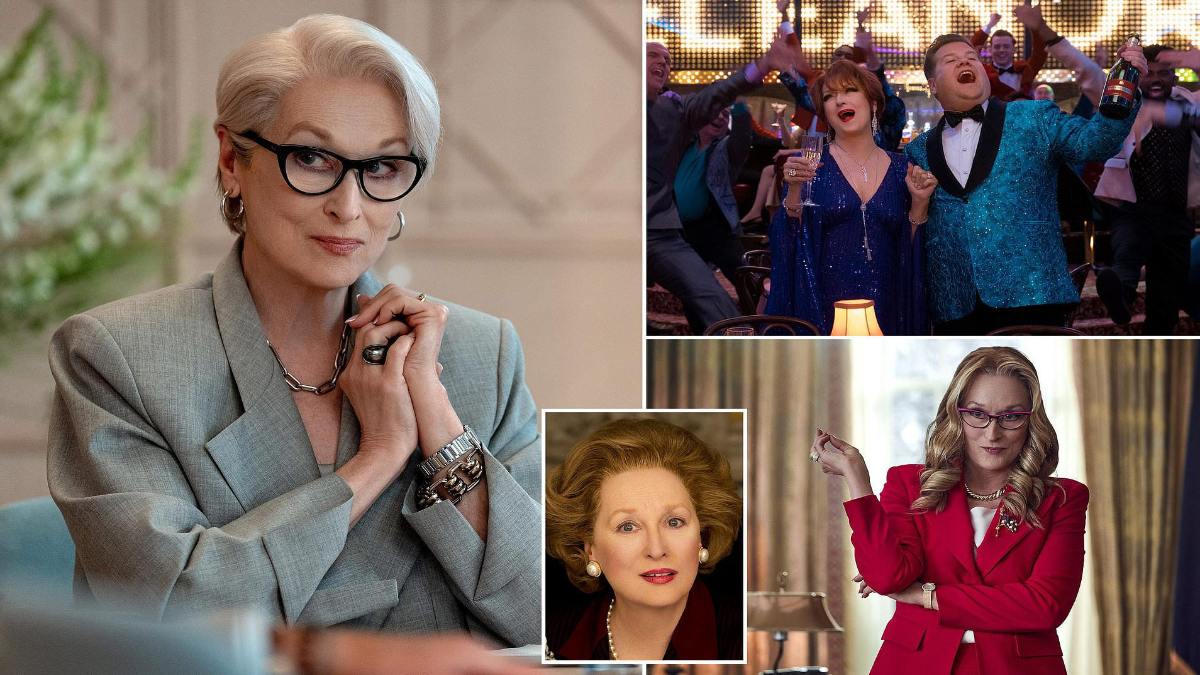
New Delhi, May 13, 2026: Critics have long hailed Meryl Streep as the “greatest living actress,” but a new and harsher narrative is beginning to take hold in 2026. While she remains a titan of the industry, a growing chorus of film historians and online commentators are using a new, unflattering term to describe her recent output: “Streepslop.”
As the legendary actress returns to the big screen this year with the highly anticipated sequel, The Devil Wears Prada 2, the conversation has shifted from her technical brilliance to a perceived “sad truth” about her career trajectory. Critics are no longer just asking if she’s overrated; they are questioning if she has become the face of a specific kind of high-brow cinematic mediocrity.
The Rise of “Streepslop”
The term “slop” was recently recognized by Merriam-Webster as a defining word of the digital age, typically referring to low-quality, AI-generated, or formulaic content designed solely to fill space. In the world of film criticism, “Streepslop” has emerged as a biting critique of movies that seem to exist only as “Oscar bait”—films that lack a soul but are designed to secure a nomination for their lead.
Critics argue that for the last decade, Streep has frequently lent her immense talent to projects that are fundamentally hollow. These films often follow a predictable pattern:
- A Historical “Greatest Hit”: A biopic about a famous figure where the makeup and accent do the heavy lifting.
- The Over-the-Top Matriarch: A role where Streep plays a loud, eccentric mother-figure that feels more like a caricature than a human.
- Low Stakes, High Gloss: Polished dramas that look beautiful but say very little about the human condition.
The “sad truth” that detractors point to is that Streep’s presence has become a sort of protective shield. Studios can release a mediocre script, knowing that as long as Streep is at the center, critics will feel obligated to praise the performance, and the Academy will likely offer a nomination.
Why the Tide is Turning
The shift in sentiment isn’t just about the quality of the films; it’s about a changing philosophy in acting. For decades, Streep was praised for her “technique”—the perfect accents, the precise gestures, and the “cerebral” approach to a role. However, in 2026, modern audiences and younger critics are gravitating toward vulnerability and raw realism.
Classic Hollywood icons like Katharine Hepburn famously once critiqued Streep for being “too cerebral” and over-reliant on technique. Today, that critique is being echoed by a generation that finds her performances “manufactured.” When every tilt of the head and every pause feels calculated, it can create a barrier between the character and the audience.
Furthermore, industry peers have occasionally voiced frustration over the “Streep-first” rule. Susan Sarandon once noted that “everything goes to Meryl first,” suggesting that the worship of Streep has occasionally stifled other talented actresses of her generation who might have brought a different, perhaps more grounded energy to those same roles.
Meryl’s Counter-Attack: The “Marvel-isation” of Cinema
Streep, never one to stay silent, has recently pushed back against the state of the industry, though her defense has unintentionally fueled the fire. In recent promotional interviews for The Devil Wears Prada 2, she criticized the “Marvel-isation” of modern cinema.
“We got the villains and we got the good guys, and it’s so boring,” Streep remarked. “I think we tend to Marvel-ize the movies now.”
She argued that the industry’s obsession with clear-cut heroes has killed the “messy” and “layered” storytelling she loves. However, critics were quick to point out the irony: while she decries the lack of nuance in superhero films, many find her recent “Streepslop” dramas just as formulaic, merely catering to an older, “prestige” audience rather than a comic-book-loving one.
Is She Actually “Overrated”?
The “overrated” label is nothing new for Streep. It became a global talking point in 2017 when Donald Trump used the term after her scathing Golden Globes speech. At the time, Streep leaned into the insult, jokingly calling herself the “most over-berated” actress of her generation.
But looking at the data, the label is hard to justify. With a record 21 Academy Award nominations and three wins, her resume is unmatched. Even her harshest critics admit that her “floor” is higher than most actors’ “ceiling.” The issue isn’t that she is a bad actress; it’s the exhaustion of a “Streep-centric” culture that feels like it’s on autopilot.
The Evolution of the “Streep Movie”
| Era | Style | Notable Works |
| The Golden Era | Raw, emotional, transformative. | Sophie’s Choice, The Deer Hunter |
| The Technical Era | Mastery of accents and historical figures. | The Iron Lady, Out of Africa |
| The “Streepslop” Era | Polished, safe, and formulaic. | The Prom, Let Them All Talk |
The Verdict for 2026
Meryl Streep is currently at a crossroads. As The Devil Wears Prada 2 hits theaters, she is attempting to bridge the gap between her prestige past and a more commercially driven present. The sequel finds her reprising the iconic Miranda Priestly, a role that succeeded precisely because it was “messy” and didn’t fit the “good guy/bad guy” mold she now criticizes.
If the film succeeds in showing a more human, vulnerable side of the fashion dragon, she may silence the “Streepslop” critics. If it feels like a hollow retread, the “overrated” whispers may turn into a roar.
Ultimately, the “sad truth” may not be about Streep herself, but about a Hollywood system that is too afraid to let its biggest icon fail. By constantly casting her in “safe” prestige films, the industry has turned a once-daring artist into a brand. For Meryl Streep to regain her crown, she may need to stop being a “goddess” and start being “messy” again.