

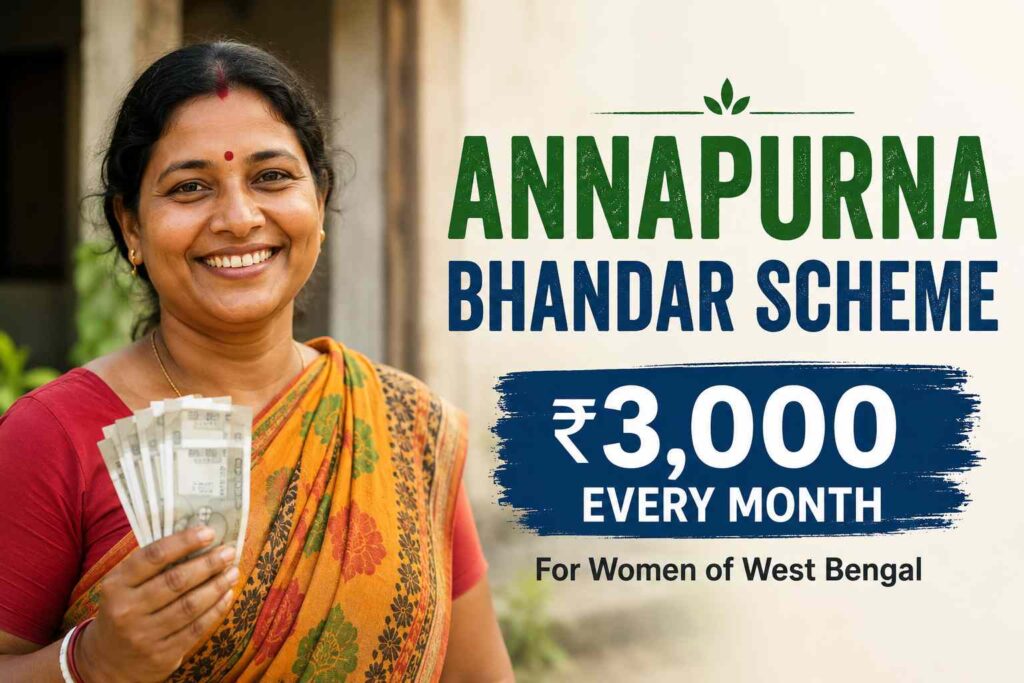
New Delhi, May 23, 2026: In a monumental shift for the socio-economic landscape of West Bengal, the newly elected state government has officially notified the rollout of the highly anticipated Annapurna Yojana (also referred to as the Annapurna Bhandar Scheme). Replacing the previous government’s flagship ‘Lakshmir Bhandar’ programme, this revamped initiative nearly doubles the financial assistance for eligible women, raising the monthly allowance to ₹3,000 per month (amounting to ₹36,000 annually).
According to an official notification issued by the Women and Child Development and Social Welfare Department, the scheme will legally take effect on June 1, 2026. Along with the cash transfer, the government has also coupled this rollout with a bonus benefit: 100% free travel for women in all state-run buses, effective from the same date.
As the launch date approaches, here is a comprehensive guide on who qualifies for the scheme, how the online application process will function, and what the transition means for millions of existing Lakshmir Bhandar beneficiaries.
Who is Eligible? The Mandatory Criteria
The West Bengal government has laid down strict, clear-cut boundaries regarding who can and cannot claim the ₹3,000 monthly stipend. Aimed at empowering women and securing financial stability for economically vulnerable households, the riders for eligibility include:
-
Gender and Residency: The applicant must be a woman and a permanent resident of West Bengal.
-
Age Bracket: Women aged between 25 and 60 years are eligible.
-
Taxpayer Exclusion: The applicant must not be an active income tax payer.
-
Employment Restrictions: The scheme explicitly bars permanent government employees. Women receiving regular salaries or pensions from the Central or State government, statutory bodies, government undertakings, Panchayats, municipal bodies, or local authorities are excluded. Furthermore, those working in teaching or non-teaching roles in government-aided educational institutions do not qualify.
What Happens to Existing Lakshmir Bhandar Beneficiaries?
For the millions of women currently enrolled under the older Lakshmir Bhandar scheme, the government has delivered a major sigh of relief: automatic migration.
Current beneficiaries do not need to submit a fresh application to receive the enhanced ₹3,000 benefit. The system will auto-shift their profiles into the Annapurna Yojana database. However, this migration comes with a rigorous filtration process based on the Special Intensive Revision (SIR) 2026 data.
Who will be excluded from automatic migration?
-
Beneficiaries identified as deceased, permanently shifted out of the state, or marked as fraudulent/duplicate during the data audit.
-
Absentee electors identified during recent voter slip distributions.
The CAA and Appeal Provision: The notification significantly clarifies that beneficiaries who have filed appeals before the SIR tribunal or those who have submitted applications under the Citizenship (Amendment) Act (CAA) will continue to receive their financial assistance uninterrupted until their respective pleas or cases are legally disposed of.
Important Action Item: Because the transfers are handled strictly through the Direct Benefit Transfer (DBT) framework, existing beneficiaries must ensure that their registered bank accounts are active and securely linked with their Aadhaar cards to prevent payment failures come June.
How to Apply Online: Step-by-Step Guide
For those who are turning 25, have recently settled in the state, or missed out on previous welfare schemes, a dedicated Annapurna Yojana Portal will officially go live on June 1, 2026. Fresh applicants can register themselves digitally by following these steps:
-
Step 1: Access the Official Portal: Visit the official West Bengal state portal (wb.gov.in) or the dedicated Annapurna Bhandar URL once it is formally activated on June 1. (Citizens are strongly cautioned to avoid clicking on third-party or unverified links before the launch).
-
Step 2: Mobile & OTP Verification: Enter an active mobile number. A One-Time Password (OTP) will be sent to the device to authenticate and log into the portal safely.
-
Step 3: Ration Card Integration: Input your Ration Card (RC) number. The portal’s architecture is built to auto-fetch registered household and family particulars directly from the food and supplies database.
-
Step 4: Aadhaar Authentication: Enter your Aadhaar number and pass a second OTP verification linked to your UIDAI-registered phone number to confirm your identity.
-
Step 5: Fill Out Personal Data: Fill in any remaining fields regarding your address, structural family details, and declaration of non-taxpayer status carefully.
-
Step 6: Bank Account Registration: Enter your active bank account number and corresponding IFSC code. Ensure this is a personal account, not a joint one, and that it features enabled DBT capabilities.
-
Step 7: Upload Documents: Upload digital copies of mandatory documents (typically a passport-size photograph, Aadhaar card, Voter ID, and the front page of your bank passbook/cancelled cheque).
-
Step 8: Review and Submit: Carefully cross-verify all inputted data against physical documents to avoid rejection, hit submit, and securely note down the Application Reference Number for future status tracking.
Note for rural/offline populations: For those lacking internet access, the government will accept physical forms through designated state streams like local Duare Sarkar camps, Block Development Offices (BDO), and Municipality desks.
The Strict Verification and Approval Process
Unlike a self-declared digital registration that approves instantly, every fresh application under the Annapurna Yojana will go through a multi-tier bureaucratic audit to minimize leakage and eliminate ineligible entries.
Once an application is successfully logged into the system:
-
Local Enquiry: Authorised local government or municipal civic body inspectors will conduct residential and economic status inquiries based on the applicant’s locality.
-
Review and Recommendation: Following the physical or database verification, Block Development Officers (BDOs) in rural pockets and Sub-Divisional Officers (SDOs) in urban centers will compile lists of eligible candidates and forward them online to higher authorities. In the capital city, Kolkata Municipal Corporation (KMC) officials will execute this verification.
-
Final Sanctioning Authority: The District Magistrates (DMs) of the respective districts will act as the ultimate sanctioning authorities to release funds. For the urban populace of Kolkata, the Commissioner of the KMC holds the sanctioning power.
Once approved, the final enquiry and sanction reports will be publically tracked on the portal, and the monthly payout of ₹3,000 will be credited via DBT smoothly at the start of each month cycle. Women across West Bengal are advised to get their Aadhaar-linked documentation organized this week to ensure they can onboard the platform seamlessly when operations begin on June 1.