

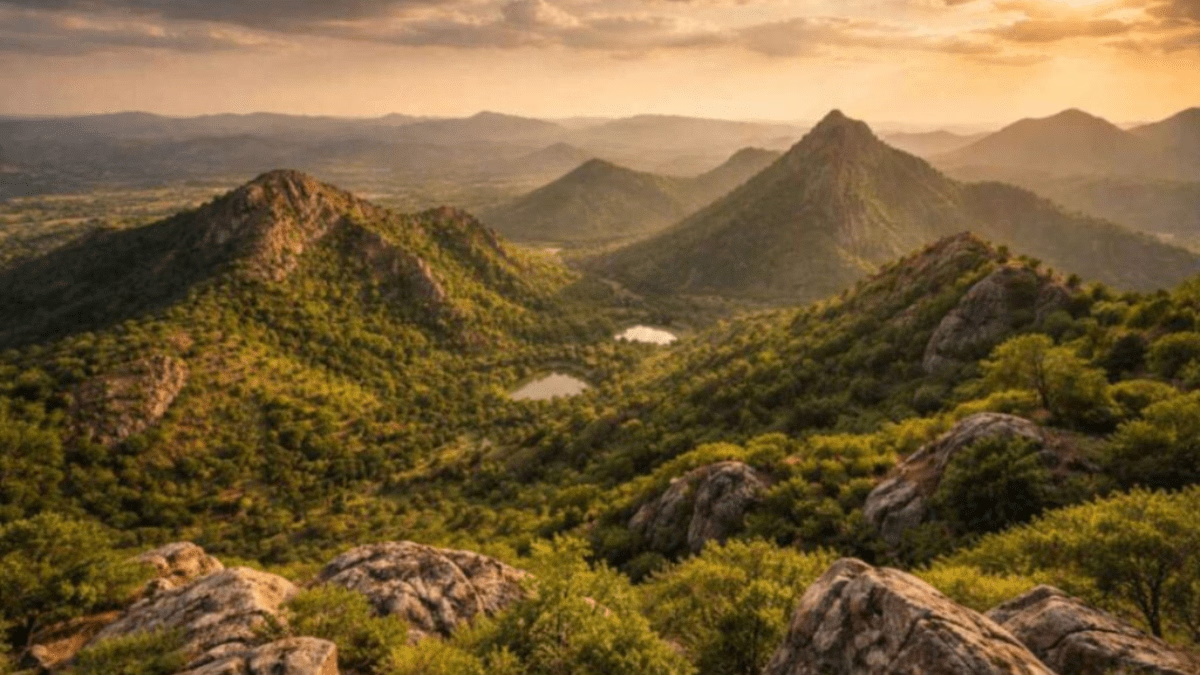
New Delhi, December 25, 2025 — In a landmark decision aimed at safeguarding one of the world’s oldest mountain systems, the Union Ministry of Environment, Forest and Climate Change (MoEF&CC) has issued a directive to states for a complete ban on the grant of any new mining leases across the entire Aravalli Range.
The order, which applies uniformly from Delhi to Gujarat, comes on the heels of a massive public and political row regarding the “redefinition” of the Aravalli hills and a subsequent intervention by the Supreme Court.
A Uniform Shield for the “Green Wall”
The Aravalli Range serves as a critical ecological barrier, preventing the eastward expansion of the Thar Desert into the fertile plains of North India and the National Capital Region (NCR). For years, the range has faced fragmentation due to unregulated mining, leading to groundwater depletion and worsening air quality.
Under the new directive, the Centre has emphasized that the Aravallis must be treated as a continuous geological ridge. The ban on new leases is intended to:
- Preserve the integrity of the ancient landscape.
- Stop unregulated and illegal mining activities.
- Protect biodiversity corridors and vital groundwater recharge zones.
Expanding the “No-Mining” Zones
Beyond the immediate freeze on new permits, the Centre has tasked the Indian Council of Forestry Research and Education (ICFRE) with identifying additional “inviolate” zones. These are areas where mining will be permanently prohibited based on:
- Ecological Sensitivity: Protecting rare flora and fauna.
- Geological Importance: Maintaining the structural stability of the hills.
- Landscape Considerations: Ensuring the ridge remains unbroken.
The ICFRE is also mandated to develop a Management Plan for Sustainable Mining (MPSM). This science-based plan will assess the “carrying capacity” of the region, ensuring that any existing activity does not exceed the environment’s ability to recover.
Strict Oversight for Existing Operations
While the order halts new leases, it does not immediately shut down existing, legally operating mines. However, these operations are now under a “microscope.” State governments have been directed to:
- Ensure strict compliance with Supreme Court environmental safeguards.
- Implement real-time monitoring through satellite imagery and drones.
- Enforce stringent restoration and rehabilitation measures for mined-out land.
“The government stands fully committed to the long-term protection of the Aravalli ecosystem, recognizing its critical role in preventing desertification and recharging aquifers,” stated a senior official from the MoEF&CC.
The Controversy Behind the Order
The Centre’s move follows a period of intense scrutiny. In late 2025, a Supreme Court-approved definition suggested that only landforms with an elevation of 100 meters or more would be classified as “Aravalli Hills.” Critics and environmentalists argued that this “100-meter rule” could leave nearly 90% of the lower-lying ridges vulnerable to exploitation.
The current directive appears to be a corrective measure to address these concerns, ensuring that the “Aravalli landscape” is protected regardless of specific height thresholds in a way that prioritizes the ecosystem over industrial demand.