

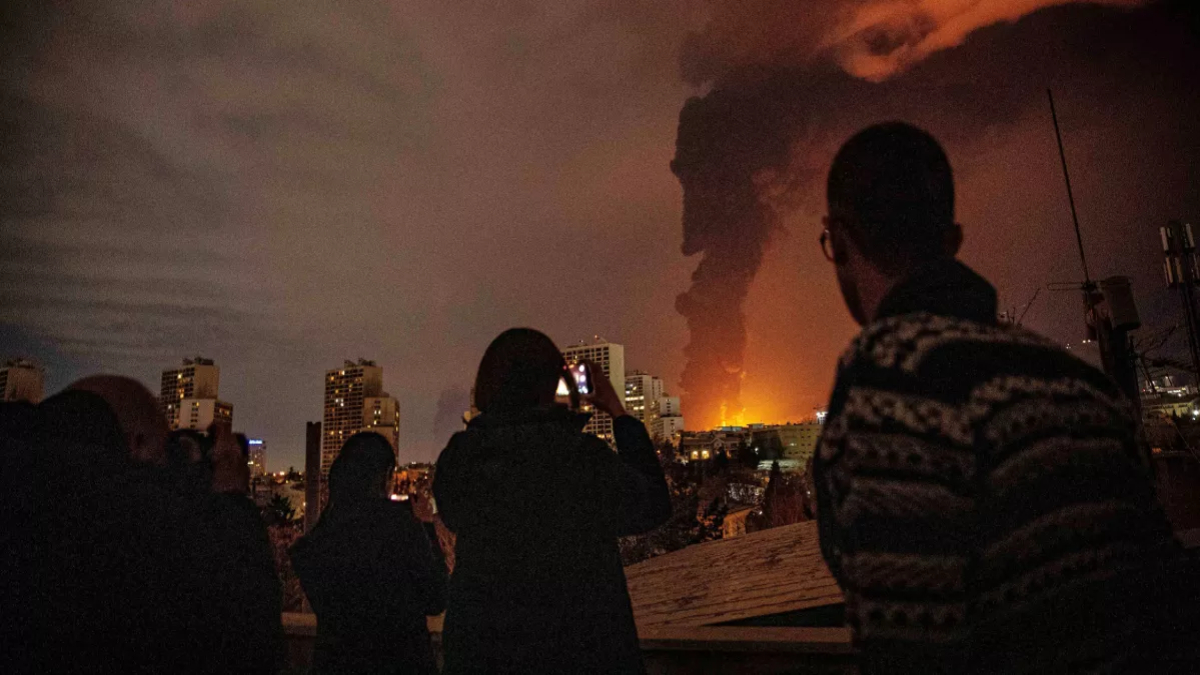
New Delhi, March 12, 2026 – The Middle East conflict reached a critical flashpoint on Thursday as Bahraini authorities issued an urgent directive for residents to remain indoors following a targeted attack on energy infrastructure. The assault, attributed to Iranian forces, ignited a massive blaze at a fuel storage facility in the Muharraq Governorate, sending thick plumes of smoke over the island nation and heightening fears of a full-scale regional war involving the United States and Israel.
Residents Asked to Shelter in Place
Early on Thursday morning, Bahrain’s Ministry of Interior released a public safety advisory via social media, instructing citizens and residents in the districts of Hidd, Arad, Qalali, and Samaheej to “remain in their homes.” The government emphasized the need to close all windows and ventilation systems as a “precaution against the potential effects of smoke” emanating from the inferno at the Muharraq facility.
The site of the attack is of strategic importance, located near the Bahrain International Airport and vital oil infrastructure. Emergency services were deployed immediately to contain the fire, which reportedly illuminated the pre-dawn sky with orange flashes.
Regional Retaliation and Energy Sabotage
The strike on Bahrain is part of a broader wave of attacks targeting Gulf nations. According to regional reports, Iran has significantly ramped up its campaign against energy terminals, tankers, and infrastructure in response to ongoing U.S.-Israeli military operations.
In addition to the Bahrain incident, the following developments were reported on Thursday:
- Kuwait and Saudi Arabia: Air defense systems in both nations were active at dawn, intercepting several “hostile drones” launched from Iranian territory. In Kuwait, a residential building was reportedly damaged, resulting in at least two injuries.
- Maritime Conflict: In Iraqi waters, a U.S.-owned oil tanker, the Safesea Vishnu, was targeted by an Iranian “suicide” boat. Reports confirm the death of an Indian national in the attack, while the remaining 27 crew members were rescued.
- The UAE and Oman: A container ship off the coast of Dubai was struck by an unknown projectile, causing a minor fire. Meanwhile, in Oman, civil defense teams worked through the night to battle fires at the Salalah port after drones hit fuel storage tanks.
Global Impact: Oil Prices Surge
The systemic targeting of energy hubs around the Strait of Hormuz—a waterway responsible for a fifth of the world’s oil supply—has sent shockwaves through global markets. Brent crude prices surged past the $100-per-barrel mark early Thursday, as traders reacted to the “almost complete halt” of commercial shipping in the Gulf.
In a bid to stabilize the volatile market, the U.S. Department of Energy announced the release of 172 million barrels of oil from the Strategic Petroleum Reserve. This move is part of a 32-nation coordinated effort by the International Energy Agency (IEA) to release 400 million barrels to mitigate supply shocks.
Diplomatic Tensions and Trump’s Stance
U.S. President Donald Trump, while stating that the conflict could be a “short excursion,” warned that Washington would drastically ramp up military responses if Tehran continued to obstruct international trade routes. Conversely, Iranian state media warned of a “prolonged war” that would devastate the world economy.
In a show of regional solidarity, India has co-sponsored a UN resolution condemning the “egregious” attacks against Gulf Cooperation Council (GCC) nations and Jordan. The resolution calls for an immediate halt to the targeting of civilian infrastructure and commercial vessels.
As the smoke continues to rise from Muharraq, the international community remains on high alert. With Israel vowing to continue strikes on Iranian and Hezbollah targets in Lebanon and Tehran, the window for a diplomatic de-escalation appears to be closing rapidly.