

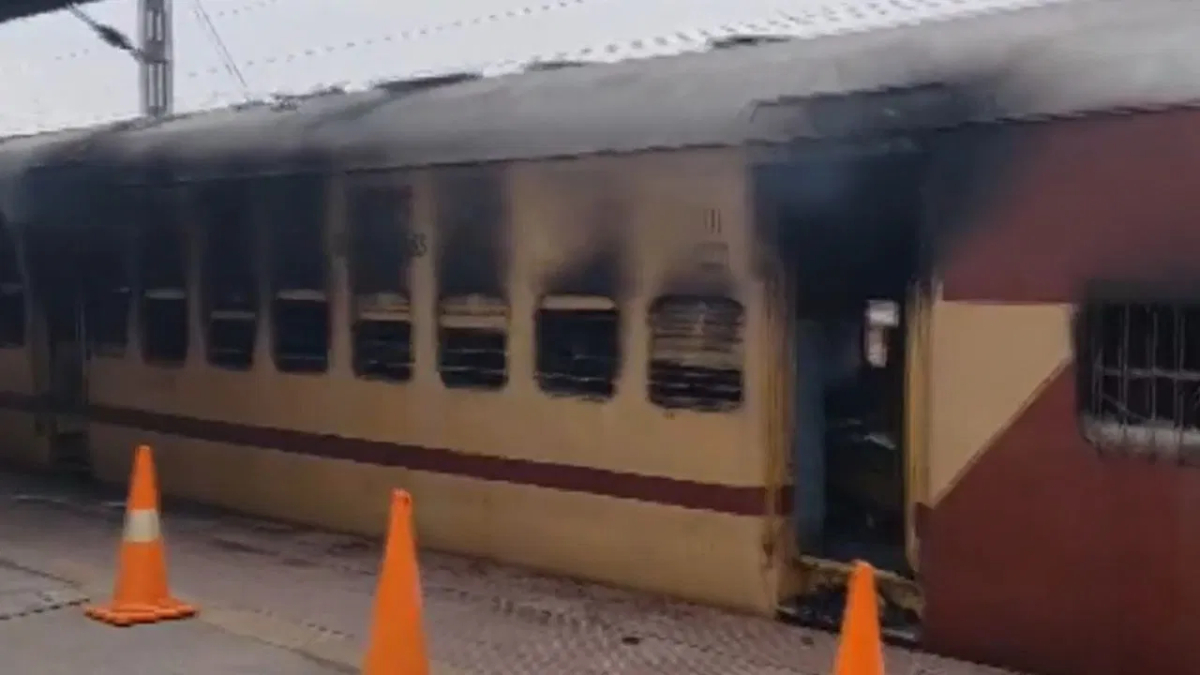
New Delhi, May 18, 2026 — A major tragedy was narrowly averted at the Sasaram Railway Station on Monday morning after a massive fire broke out in a stationary passenger train. The incident, which occurred on May 18, 2026, involved the Sasaram-Patna Fast Passenger (Train No. 53212) and has once again raised serious concerns regarding electrical safety and maintenance protocols within the Indian Railways.
According to preliminary reports from railway officials and eyewitnesses, the fire is suspected to have been triggered by a short circuit in the electrical wiring of one of the coaches. While the blaze completely gutted a general compartment, no casualties or injuries were reported as the coach was largely empty at the time of the incident.
Incident Timeline: A Morning of Chaos
The drama unfolded at approximately 6:00 AM on Platform Number 6 of Sasaram Junction. The train was being prepared for its scheduled departure to Patna, which was slated for 6:45 AM.
Early morning commuters and railway staff were startled when thick, black smoke began billowing from a general coach. Within minutes, the smoke gave way to leaping orange flames that quickly engulfed the entire bogie. The proximity of the train to the platform infrastructure and nearby trees caused a momentary wave of panic, with passengers on adjacent platforms seen running for safety.
Local residents and passengers at the station reported that the fire intensified rapidly. “We saw smoke first, and before anyone could fetch a fire extinguisher, the whole coach was an inferno,” said a local vendor at the station.
Emergency Response and Containment
The Railway Protection Force (RPF), Government Railway Police (GRP), and local fire brigade teams were alerted immediately. Fire tenders from the Rohtas district headquarters were dispatched to the station.
The response was a race against time to ensure the flames did not spread to the rest of the rake or the station’s overhead high-tension wires. To prevent a chain reaction:
- Power Cut: Railway authorities immediately disconnected the Overhead Equipment (OHE) power supply to the tracks to prevent further electrical hazards.
- Decoupling: In a swift move, railway technicians and shunting staff managed to detach the burning coach from the rest of the train, isolating the fire.
- Dousing the Flames: Firefighters battled the blaze for over an hour before it was brought under control.
By 8:30 AM, the fire was completely extinguished, leaving behind the charred metallic skeleton of the affected coach.
Preliminary Findings: The Short Circuit Theory
While a formal high-level inquiry has been ordered by the East Central Railway (ECR) zone, preliminary technical inspections point toward an electrical short circuit in the coach’s internal wiring or battery box.
“Initial observations suggest a technical fault in the electrical circuit,” stated RPF Inspector Sanjeev Kumar. “However, we are investigating all possibilities, including the possibility of an external ignition source or a malfunction in the fans and lighting system of the older coach.”
The incident in Sasaram is particularly alarming as it comes just 24 hours after a similar fire was reported on the Delhi-bound Rajdhani Express in Madhya Pradesh’s Ratlam district. The frequency of these “short circuit” related fires has put the railway’s electrical maintenance wing under intense scrutiny.ol
Safety Gaps and Public Outcry
Despite the successful evacuation and lack of injuries, the incident has sparked anger among regular commuters. Several eyewitnesses alleged that the initial response was hampered by a lack of functional firefighting equipment on the platform.
Locals also pointed out that the aging rolling stock used for local passenger trains often lacks the advanced fire-retardant materials and automatic detection systems found in premium trains like the Vande Bharat or Rajdhani Express.
Impact on Rail Traffic
Following the fire, operations at Sasaram Junction were partially disrupted for several hours. Several trains were halted at outer signals as a safety precaution while the charred coach was being moved to the siding for forensic examination.
The Sasaram-Patna Passenger train eventually resumed its journey with a nearly two-hour delay after the damaged bogie was replaced and the rest of the train was cleared by safety inspectors.
The Path Forward: Railways Order Safety Audit
In response to the back-to-back fire incidents in Bihar and Madhya Pradesh, the Railway Board has reportedly signaled a nationwide safety audit of all passenger coaches. The audit will focus on:
- Wiring Integrity: Checking the age and condition of internal wiring in non-AC coaches.
- Overload Protection: Ensuring that circuit breakers (MCBs) are functioning correctly to trip in the event of a surge.
- Fire Extinguisher Accessibility: Verifying that every coach and platform is equipped with serviced and functional fire extinguishers.
A senior official from the Danapur Railway Division confirmed that a technical team has been deployed to Sasaram to collect samples from the burnt coach. “We take passenger safety with the utmost seriousness. The inquiry report will be finalized within a week, and strict action will be taken if any negligence is found in the maintenance schedule,” the official added.
Conclusion
The Sasaram train fire serves as a stark reminder of the vulnerabilities within the vast Indian rail network. While the early hour and the station’s location prevented a loss of life, the sight of a passenger coach reduced to ashes in minutes highlights the urgent need for modernized safety infrastructure across all tiers of rail travel—not just for premium services.
As the investigation continues, the focus remains on whether the Indian Railways can move beyond “preliminary short circuit” explanations toward a more robust, preventative maintenance culture that ensures such sparks never turn into infernos again.