

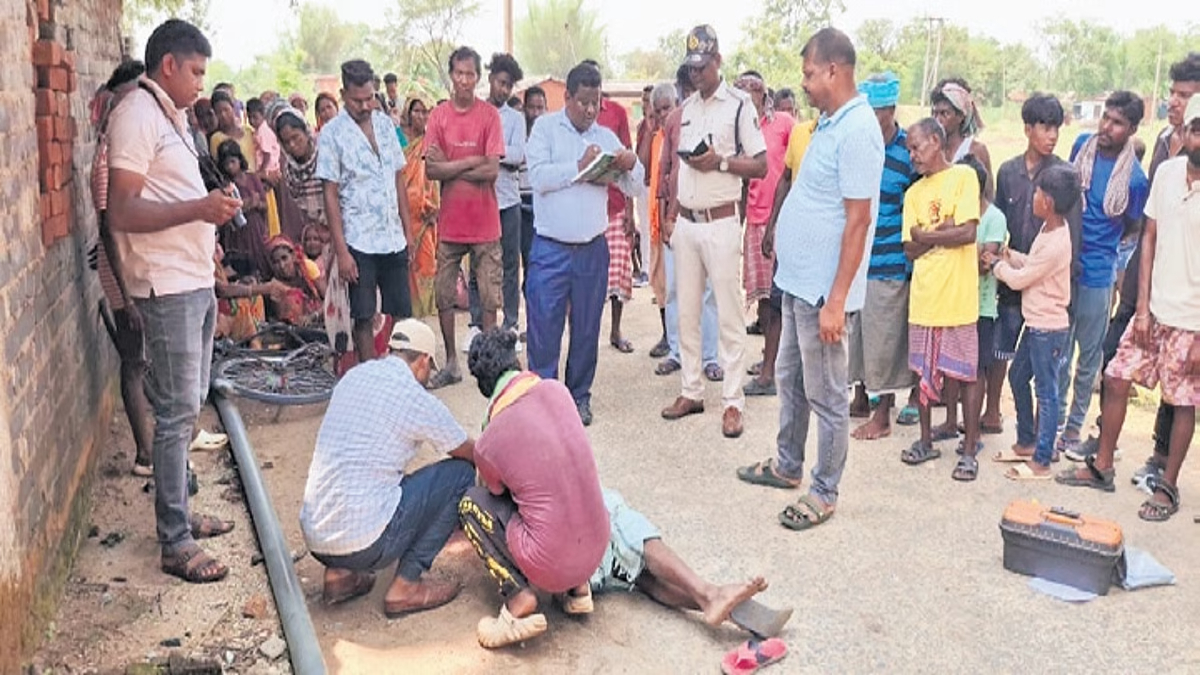
New Delhi, May 14, 2026 — A remote village in Odisha’s tribal heartland was gripped by horror this week after a local man allegedly hacked two of his neighbors to death in a senseless spree of violence, only to be killed himself by an enraged mob minutes later.
The incident, which occurred in a secluded hamlet late Tuesday evening, has sent shockwaves through the district, highlighting the volatile nature of “jungle justice” and the fragile state of security in regions where police presence is often miles away.
The Sequence of Terror
According to eyewitnesses and preliminary police reports, the suspect, identified as 42-year-old Mantu Munda (name changed for legal reasons), emerged from his home armed with a sharp-edged traditional axe (tangia). Without any apparent immediate provocation, Munda allegedly attacked a 55-year-old farmer and a 48-year-old woman who were returning from their fields.
Both victims were struck multiple times in the neck and head, dying almost instantly on the dusty village road. The screams of the victims and the sight of the blood-stained axe triggered a panic that quickly curdled into collective rage.
As word of the double murder spread through the village like wildfire, a group of nearly 50 men and women cornered Munda near the village outskirts. Despite the suspect’s attempt to flee into the dense forest nearby, the mob surrounded him.
A Life for a Life: The Mob Retaliation
The scene quickly shifted from a crime of individual violence to one of collective vigilantism. Eyewitnesses, speaking on the condition of anonymity, described a chaotic and brutal confrontation. The villagers, fueled by the immediate grief of losing two respected community members, overpowered Munda.
“He was like a man possessed,” said one village elder. “But the people were not ready to wait for the police. They saw the bodies of their neighbors and took the law into their own hands.”
By the time the nearest police unit—located nearly 15 kilometers away—reached the scene after being alerted by the village headman (Sarpanch), Munda had succumbed to severe injuries sustained from stones, sticks, and the same axe he had used earlier.
The Official Response
Senior police officials, including the Superintendent of Police (SP), visited the village on Wednesday to oversee the investigation. Three bodies—the two initial victims and the suspect—were sent for post-mortem examinations.
The police have registered two separate First Information Reports (FIRs):
- The First FIR: Details the double murder committed by Munda.
- The Second FIR: Addresses the mob lynching, naming “unknown persons” for the murder of the suspect.
“While we understand the immense grief and anger of the community, mob justice cannot be condoned in a civilized society,” the SP stated during a press briefing. “Taking a life in retaliation is a criminal offense, and we are currently scanning mobile footage and recording statements to identify the primary instigators of the mob attack.”
Underlying Tensions and Mental Health
Initial investigations suggest that Munda may have been suffering from long-term untreated mental health issues or was embroiled in a long-standing land dispute with the victims. Tribal regions in Odisha have frequently seen “witch-hunting” or land-related violence, often exacerbated by a lack of access to legal recourse and psychological support.
Experts point out that in many of these interior pockets, the absence of a visible state apparatus often leads communities to revert to traditional, albeit violent, forms of dispute resolution.
“When the nearest police post is hours away and the judicial process takes decades, the ‘eye for an eye’ philosophy often becomes the default setting for rural justice,” says Dr. Aruna Mohanty, a sociologist specializing in tribal affairs.
Key Takeaways from the Incident
| Aspect | Detail |
| Location | Rural Odisha (Tribal belt) |
| Initial Crime | Double murder with a sharp weapon (tangia) |
| Retaliation | Mob lynching resulting in the suspect’s death |
| Police Action | Two separate FIRs lodged; investigation ongoing |
| Current Status | Village under heavy police deployment to prevent further communal flare-ups |
The Road Ahead: Prevention and Policing
The Odisha state government has faced increasing pressure to improve the response time of emergency services in tribal districts. This incident follows a string of similar “mob justice” cases reported across the state in early 2026, prompting calls for more “Gram Rakshis” (village guards) and better community policing initiatives.
For now, a heavy police contingent remains stationed in the village to prevent further retaliatory violence between families. The silence in the hamlet is heavy, broken only by the sound of mourning for three lives lost in a single evening of unbridled rage.
As the investigation continues, the primary challenge for the state will be to convince these remote communities that the law of the land is more effective—and more just—than the law of the mob.