

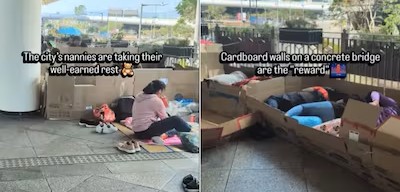
New Delhi, April 27, 2026: A stark portrayal of the massive wealth gap in one of the world’s most affluent cities was captured in a viral video on Sunday, April 26, 2026. The footage, which has amassed millions of views across Instagram and TikTok, depicts hundreds of foreign domestic workers spending their mandatory day off huddled inside makeshift cardboard boxes. These flimsy structures, erected under bridges and along pedestrian overpasses, serve as the only source of privacy for the women who keep the city running.
The “Invisible Labor Crisis” was highlighted by content creators who noted that these workers are essentially rendered homeless for one day every week. Because of the mandatory “live-in” rule in Hong Kong, foreign domestic helpers are required by law to reside in their employers’ homes. When Sunday—their only rest day—arrives, many are forced to leave these residences but have no private space of their own to occupy.
Privacy in a Box: The Reality of the Live-In Rule
The viral clips show women from the Philippines and Indonesia sitting, eating, and even sleeping inside large cartons. These boxes are used to create small “rooms” that shield them from the eyes of the public in a city that depends on their labor but offers little space for their recreation. It is argued by activists that while these workers raise the children of the elite and maintain luxury apartments, they are treated as temporary fixtures without a right to dignity.
The reaction from the internet has been deeply divided, sparking a fierce debate over workers’ rights and ethical conduct. Many viewers expressed fury at the systemic inequality, with some describing the scene as a modern-day labor crisis. Comments left on the video suggest that the sight of women sleeping on concrete under bridges is a “brutal” reminder of how luxury is often built on the back of suffering.
Also Read: Erika Kirk’s Emotional Plea During WHCD Evacuation
A Community Divided: Choice vs. Necessity
In contrast, some social media users defended the practice, claiming that the workers gather in these public spaces by choice to socialize with friends. It was argued that the cardboard structures are a practical way to create a picnic-like atmosphere and that the workers have room and board provided during the work week. Others pointed out that Hong Kong offers many free public parks and beaches, suggesting that the bridge gatherings are a cultural tradition rather than a forced circumstance.
Despite the varying perspectives, the footage has forced a renewed conversation about the “live-in” mandate and the lack of affordable public community centers for migrant workers. The video remains a top trending topic as of April 27, 2026, serving as a powerful visual testament to the complexities of urban life. For the thousands of workers involved, the cardboard boxes represent a fragile boundary between their professional duties and their personal humanity.