

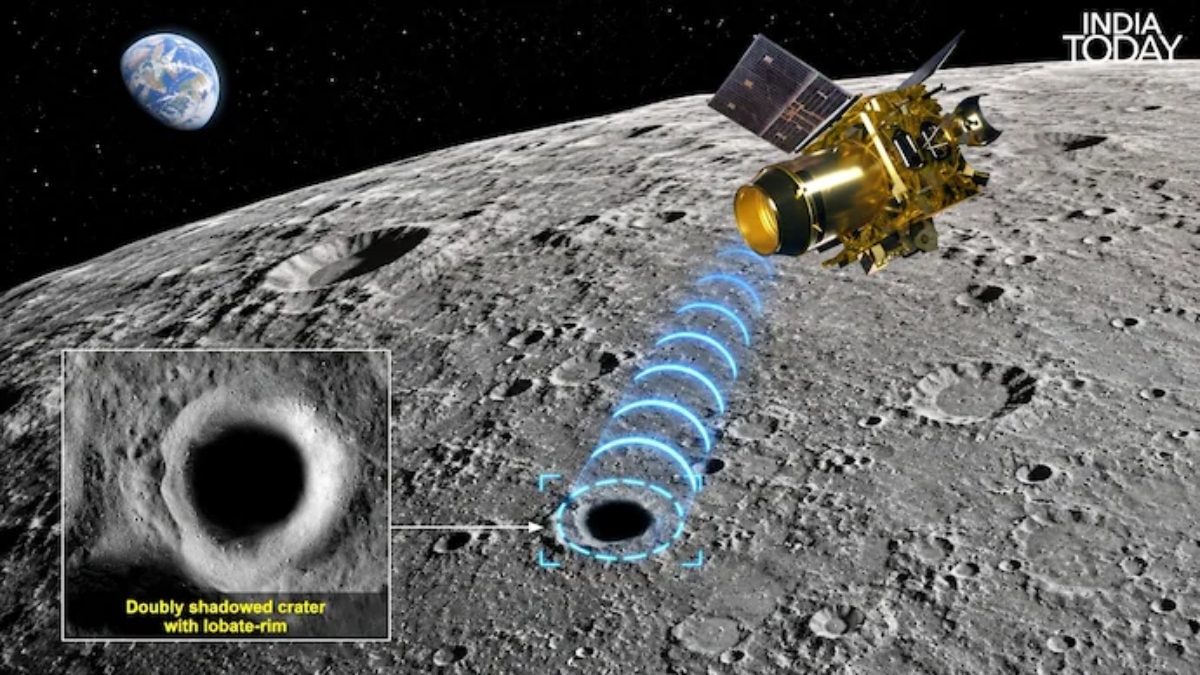
New Delhi, May 29, 2026: Nearly six years after its launch, India’s second lunar mission, Chandrayaan-2, has achieved a monumental breakthrough that could reshape the future of international space exploration. While the mission’s robotic lander, Vikram, suffered a tragic crash landing on the lunar surface in September 2019, its trailing companion—the Chandrayaan-2 orbiter—remained perfectly healthy and operational in a circular polar orbit.
Scientists from the Physical Research Laboratory (PRL) in Ahmedabad, working in coordination with the Indian Space Research Organisation (ISRO), have published a definitive study confirming strong evidence of hidden water ice buried beneath the surface of the Moon’s South Polar Region. The landmark discovery, published in the prestigious Nature portfolio journal npj Space Exploration, marks a major leap forward in our understanding of lunar resources and provides vital data for establishing permanent human bases on the Moon.
Exploring the Deepest Darkness: “Doubly Shadowed” Craters
The breakthrough focuses on some of the most hostile, extreme, and dark environments in the entire solar system: Permanently Shadowed Regions (PSRs) at the lunar south pole. Because the Moon is only slightly tilted relative to the sun, the deep floors of certain polar craters never receive a single ray of direct sunlight.
Because these regions have remained frozen in absolute darkness for billions of years, scientists have long suspected them to be the ultimate celestial refrigerators—capable of trapping and preserving volatile compounds like water ice over vast geological timescales. Finding concrete proof, however, required peering through the pitch-black darkness without relying on visual cameras.
The Technology Behind the Discovery
To see into these abysses, scientists bypassed traditional photography entirely and relied on the orbiter’s crown jewel: the Dual Frequency Synthetic Aperture Radar (DFSAR). The DFSAR is a highly sophisticated microwave imaging instrument that operates across L- and S-band radio frequencies. Crucially, it stands as the first fully-polarimetric radar ever sent to map the Moon.
Instead of needing light, the radar fires specialized microwave signals directly into the dark craters and meticulously reads how those signals bounce back to the orbiter. When radar waves hit ordinary, dry lunar dust and jagged rocks, they bounce back scattered in a specific, predictable pattern. However, when those waves encounter solid water ice buried beneath the dirt, they experience “volumetric scattering,” meaning the signals bend and bounce around inside the ice layer before reflecting back in a completely different arrangement.
To ensure they weren’t accidentally misidentifying rough rocky terrain as ice, the PRL research team established a strict, refined radar metric. They calculated two critical polarimetric parameters:
- Circular Polarization Ratio (CPR): Values had to be greater than 1.
- Degree of Polarization (DOP): Values had to drop lower than 0.13.
The DOP essentially measures how much of the bounced radar signal manages to hold onto its original structural state. When the radar signals encountered these specific boundaries, it provided an unmistakable, definitive signature of subsurface water ice, separating genuine ice deposits from false alarms caused by rough boulders.
The 1.1-Kilometer Smoking Gun
Out of nine primary target craters analyzed in the South Polar Region, the advanced radar signatures confirmed the presence of buried ice beneath the floors of four specific doubly shadowed craters. One particular crater emerged as the undisputed “smoking gun” of the study.
Nestled inside the expansive and ancient Faustini crater, scientists isolated a smaller, unnamed crater measuring roughly 1.1 kilometers in diameter. Not only did this mini-crater exhibit the exact high-CPR and low-DOP radar data required to prove the existence of ice, but it also revealed a fascinating physical characteristic known as lobate-rim morphology.
A lobate rim describes a unique, flow-like or petal-shaped outline around the edge of a crater. In planetary geology, this occurs when a stray meteorite slams into a surface that contains a dense underground layer of ice. The sheer kinetic energy of the crash briefly melts or destabilizes the frozen subsurface, causing the slushy material to ooze outward like thick mud before instantly flash-freezing back into place in the vacuum of space. This visual blueprint, combined with the matching radar readouts, leaves little doubt that a rich reservoir of ice lies just inches beneath the lunar dust.
Why the Discovery Changes the New Space Race
The confirmation of subsurface water ice completely alters the economics and strategy of deep space exploration. Water is incredibly heavy and expensive to launch out of Earth’s steep gravity well. Shipping enough water to support a long-term colony would cost billions of dollars and consume massive amounts of rocket payload capacity.
By mapping localized, accessible ice deposits that can be mined directly from the lunar crust—a concept known as In-Situ Resource Utilization (ISRU)—future astronauts can theoretically live off the land.
With lunar ice processed into fuel, the Moon transforms from a barren destination into a cosmic “gas station.” Spacecraft will be able to launch light from Earth, land on the Moon to fill up their fuel tanks with lunar-derived hydrogen and oxygen, and blast off toward Mars or the outer solar system at a fraction of the current cost.
Conclusion: A Triumph of Longevity
This major breakthrough cements India’s place as an indispensable pioneer in the global lunar race. While international space agencies—including NASA with its Artemis program, China, and Russia—are actively racing to stake claims and plot landing zones around the highly coveted south pole, they will be relying heavily on the map provided by India’s aging but brilliant orbiter.
The Chandrayaan-2 mission has proven that a partial setback on the surface does not mean defeat. By turning a localized engineering tragedy into a multi-year masterclass in orbital science, ISRO has given humanity the keys to unlocking the Moon’s deepest secrets, paving a clear path forward for the next generation of space explorers.
For a detailed visual breakdown of how India detected this ice, you can watch this Chandrayaan-2 Lunar Ice Analysis which provides an insightful look into the radar data and the global implications for the south pole space race.