

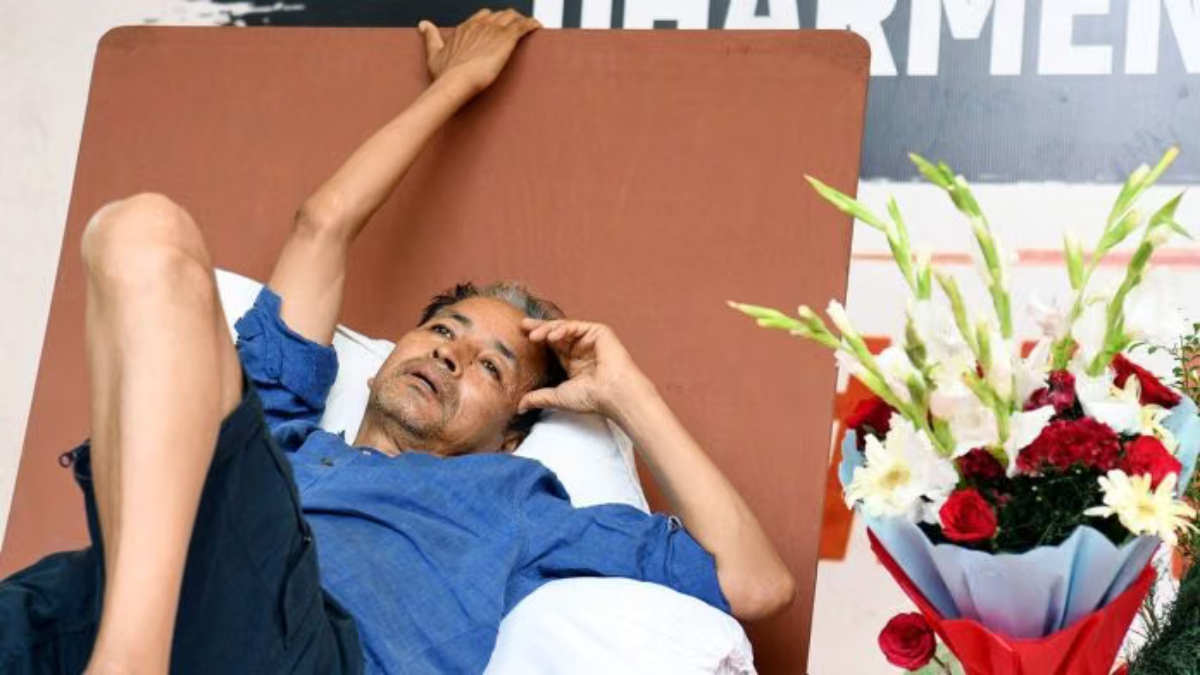
New Delhi, July 16, 2026 — In a significant legal intervention, the Delhi High Court on Thursday directed the government to ensure the urgent health, safety, and continuous medical monitoring of renowned activist Sonam Wangchuk. The directive comes as Wangchuk’s indefinite hunger strike entered its 19th consecutive day at Delhi’s Jantar Mantar, sparking massive concern over his rapidly deteriorating health.
Hearing a Public Interest Litigation (PIL) that sought immediate medical intervention for the 59-year-old Ladakhi reformer, a bench of the High Court ruled that the protection of a citizen’s life is a primary constitutional obligation. The court ordered that a government doctor must closely monitor his vitals, explicitly stating, “Whatever medical intervention is needed to save Sonam Wangchuk’s life should be done by the government”.
Deteriorating Health and Weight Loss
According to the latest medical bulletins released by the Cockroach Janta Party (CJP), the organization anchoring the agitation, Wangchuk’s prolonged fast has taken a brutal physical toll. As of his 19th day without food, the activist has lost nearly 9 kilograms, with his body weight plummeting to just 57.15 kg.
Medical professionals monitoring him on the ground noted that while he remains conscious and mentally alert, he is experiencing severe physical weakness and dizzy spells. His blood pressure was recently recorded at 105/76 mmHg and blood sugar levels hover around 80 mg/dL. Doctors have warned that continuing the fast without clinical support could trigger irreversible organ damage, which prompted civil society members to approach the judiciary for help.
The Genesis of the Protest
While Sonam Wangchuk is globally celebrated for his innovative work on climate adaptation, glacial preservation, and demanding Sixth Schedule status for Ladakh, his current demonstration in the national capital stems from an entirely different grievance.
Wangchuk joined a student-led agitation on June 28, putting his life on the line to demand absolute transparency and systemic accountability in India’s higher education system. The core demands of the ongoing Jantar Mantar protest include:
- Resignation of the Education Minister: The protestors are demanding the immediate resignation of Union Education Minister Dharmendra Pradhan over political responsibility for recent competitive exam paper leaks.
- Systemic Exam Reforms: A complete overhaul of the national examination testing mechanism to prevent future paper compromises that jeopardize the futures of millions of students.
- Justice for Students: Addressing the deep mental distress and tragic student suicides linked to exam irregularities and repeated cancellations.
Rising Tide of Solidarity and Political Support
Wangchuk’s high-profile involvement has effectively transformed a student grievance into a nationwide socio-political movement. The protest site has drawn solidarity visits from key political figures across the ideological spectrum. Leaders such as AAP national convenor Arvind Kejriwal, Trinamool Congress chief Mamata Banerjee, Samajwadi Party president Akhilesh Yadav, and Shiv Sena (UBT) chief Uddhav Thackeray have collectively appealed to Wangchuk to end his fast, while simultaneously demanding that the central government initiate an immediate dialogue with the protesters.
The protest has also deeply resonated with the cultural community. Renowned actor Atul Kulkarni observed a solidarity fast from his home, releasing a public message urging the government to show sensitivity and open lines of communication. “I am not ready to believe that our government is insensitive… Perhaps there are some misunderstandings due to which this sensitivity is not being expressed and a dialogue is not taking place,” Kulkarni stated, appealing for a peaceful resolution.
What Lies Ahead: The “Chalo Sansad” March
Despite the judicial intervention, growing physical fragility, and appeals from loved ones to break his fast, Wangchuk remains resolute. In a video address recorded from his protest cot, he spoke slowly but firmly, telling his followers that his vital signs are stable for someone on nearly three weeks of fasting.
Rather than focusing on his personal health, Wangchuk redirected the public’s focus toward their upcoming major escalation. The CJP and allied student groups, including the All India Students’ Association (AISA), have formal plans to execute a massive “Chalo Sansad” (March to Parliament) on July 20, 2026. The march is strategically timed to coincide with the opening day of the Parliament’s Monsoon Session, ensuring the issue takes center stage as lawmakers reconvene.
The Delhi High Court’s ruling ensures that a state-appointed medical team will now prevent sudden catastrophic health failure on the protest grounds. However, the political deadlock remains unbroken, with organizers stressing that only a meaningful gesture or structural reassurance from the Prime Minister’s Office will convince Wangchuk to finally break his fast.
You can watch this News Report on Sonam Wangchuk’s Health Bulletin to see the medical updates and the ground reality of his 19-day hunger strike at Jantar Mantar.