

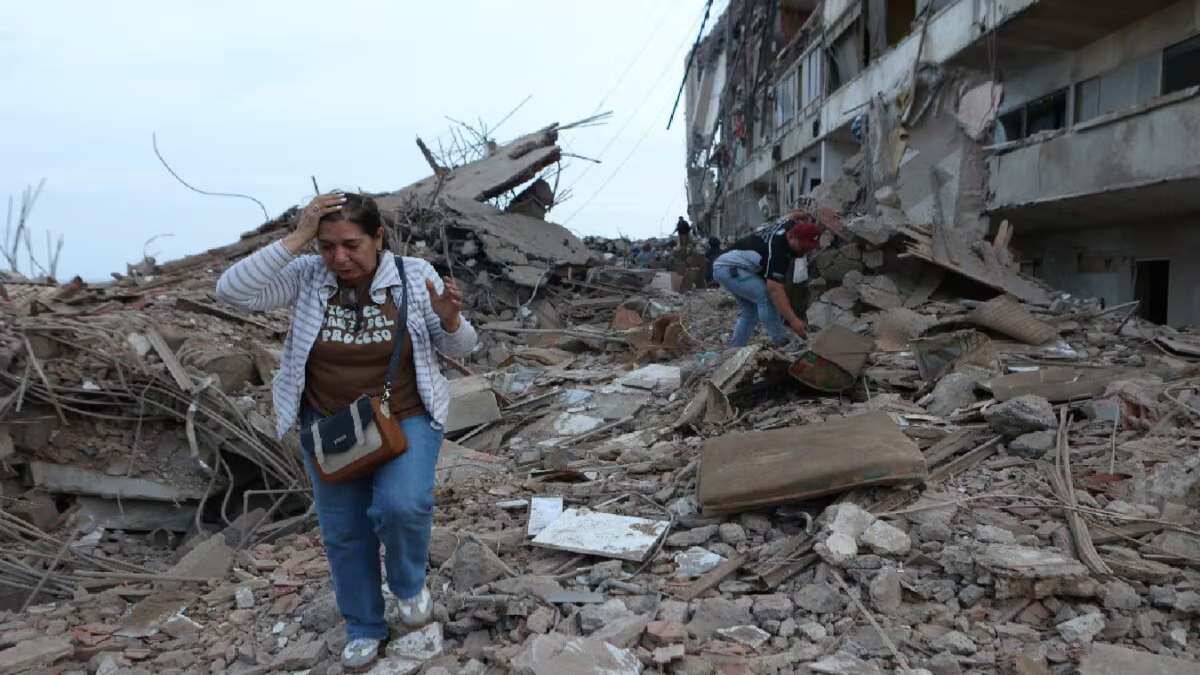
New Delhi, June 26, 2026 — A catastrophic seismic event has rewritten modern geological history after back-to-back mega-earthquakes struck northwestern Venezuela. The disaster has left cities in ruins, triggered a nationwide state of emergency, and sent shockwaves so powerful that ultra-sensitive monitoring equipment detected subtle tremors a staggering 14,000 kilometers away in India.
The double strike—the strongest the South American nation has witnessed in over 125 years—occurred in rapid succession on Wednesday evening. The disaster has sparked a monumental humanitarian crisis on the ground while leaving global geophysicists astonished by the sheer reach of the earth’s planetary kinetic energy.
The Anatomy of a Dual Strike
The disaster began at 6:04 PM local time when a massive magnitude 7.2 earthquake tore through the plate boundary zone near the San Sebastián fault system. The epicenter was pinpointed near the Veroes municipality in Yaracuy State, at a depth of roughly 22 kilometers. While citizens were still scrambling out of shaking homes, an even larger magnitude 7.5 mainshock struck just 39 seconds later. This second, shallower quake occurred at a depth of just 10 kilometers, amplifying the surface destruction exponentially.
The United States Geological Survey (USGS) classified the phenomenon as a “doublet”—two major earthquakes occurring nearly simultaneously in the same region. Because the second quake hit before structures could settle from the first, buildings that might have otherwise survived a single shock collapsed entirely.
Destruction in the Capital and Beyond
Acting President Delcy Rodríguez has declared a national state of emergency, designating the coastal region of La Guaira an official “disaster zone.” Widespread structural failures have crippled Caracas, where decades-old high-rises and modern apartment complexes alike crumbled into mounds of concrete and twisted rebar. In the upscale Altamira neighborhood, a 22-story building collapsed entirely, while entire blocks in the southeastern sector of the capital were reduced to rubble.
The current official death toll stands at 235, with more than 4,300 reported injured. However, emergency services fear these numbers represent a small fraction of the true toll, as over 40,000 people are currently listed as missing.
The country’s critical infrastructure has faced near-total collapse:
- Aviation: Simón Bolívar International Airport near Caracas suffered extensive structural damage to its terminals and runways, forcing an immediate, indefinite shutdown of all flights.
- Utilities: Major power grids failed immediately following the mainshock, plunging massive swathes of the country into darkness and cutting off cellular and internet connectivity.
- Transportation: The Caracas subway network has been completely halted, and broken water and natural gas lines have raised fears of secondary fires.
Search and rescue teams, aided by the Venezuelan Red Cross and international brigades from Mexico, Colombia, and Qatar, are working around the clock. Rescuers are racing against time, pulling survivors—including several young children trapped beneath collapsed slabs in La Guaira—from the dust-choked debris.
The 14,000-Kilometer Ripple: Shaking India
While the physical destruction remains localized to South America and neighboring Caribbean nations, the sheer energy released by the 7.5 magnitude mainshock managed to travel across the entire diameter of the Earth. In India, located nearly 14,000 kilometers away from Yaracuy State, highly advanced seismic stations operated by the National Center for Seismology (NCS) picked up unmistakable signals of the Venezuelan disaster.
Indian seismologists noted that the waves took less than twenty minutes to cut through the Earth’s interior and register on monitors in New Delhi, Hyderabad, and Assam. This ultra-distant detection highlights the interconnected nature of the Earth’s crust, proving that a severe enough fracture on one side of the globe leaves a signature on the exact opposite side.
India Pledges Solidarity and Relief
The global reach of the disaster has prompted an immediate diplomatic response from New Delhi. Indian Prime Minister Narendra Modi expressed deep distress over the scale of the devastation and the loss of lives in Venezuela. Taking to digital platforms, PM Modi stated that India stands in absolute solidarity with the people of Venezuela during this hour of crisis and is fully prepared to extend humanitarian assistance, medical supplies, and disaster relief expertise.
In response, Acting President Delcy Rodríguez publicly thanked the Indian government, noting that India’s proactive offer of support reflects a long-standing spirit of global cooperation and mutual empathy between the two nations.
The Grim Outlook Ahead
As more than 30 significant aftershocks continue to rattle central Venezuela, international disaster response agencies are bracing for the worst. The USGS PAGER system, which estimates the humanitarian impact of severe earthquakes, has released a sobering assessment: given the density of the affected urban areas and the widespread collapse of high-density housing, there is a 39% probability that the final death toll could climb into the tens of thousands.
For now, the focus remains entirely on the frantic rescue operations under the rubble of Caracas and La Guaira. While scientists continue to study how this catastrophic event shook the planet all the way to India, the immediate priority for the global community is mobilizing the aid needed to help Venezuela survive its darkest night in over a century.