

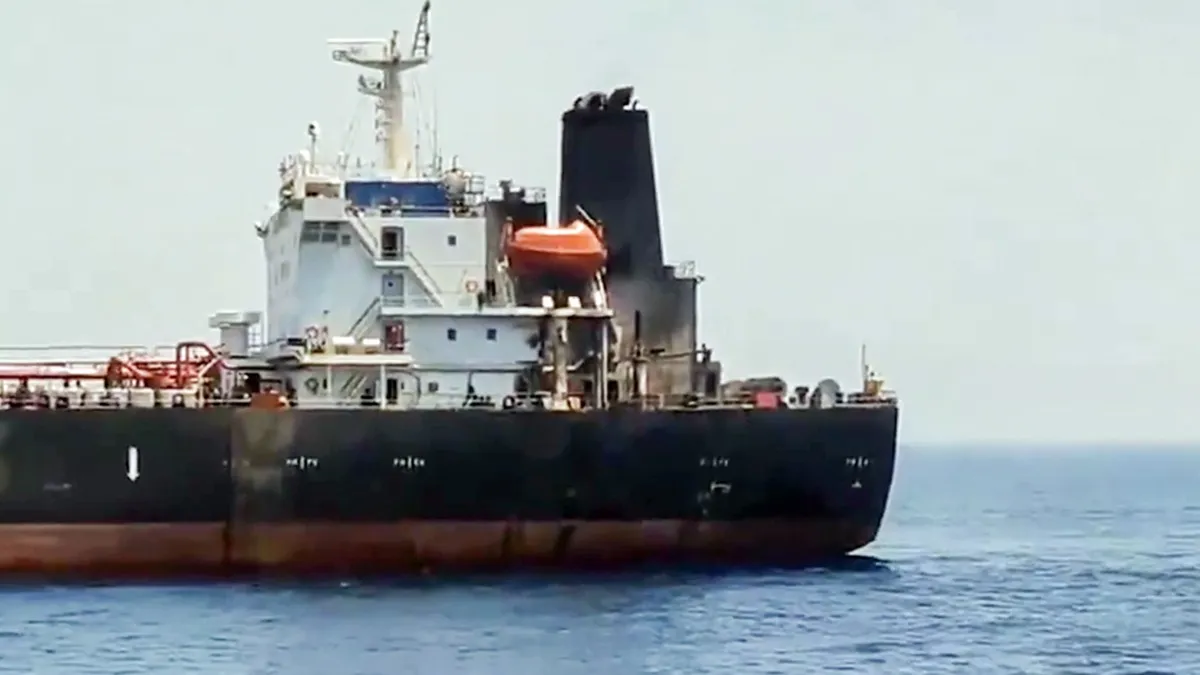
New Delhi, July 14, 2026: The vital shipping lanes of West Asia have flared up yet again, dragging innocent merchant mariners into the crossfire of a volatile international conflict. An Indian crew member was killed and six other Indian nationals were injured when two United Arab Emirates (UAE)-flagged oil tankers came under fire from Iranian cruise missiles in the Strait of Hormuz.
The attack on the tankers, named Mombasa and Al Bahiyah, occurred while the vessels were transiting Omani territorial waters in the southern lane of the strategic strait. Abu Dhabi has vehemently condemned the incident as a “blatant violation” of international law, whereas Tehran claims that the tankers were targeted because they repeatedly defied maritime warnings and traveled via unauthorized routes.
The Details of the Strike
According to a formal statement issued by the United Arab Emirates Ministry of Defence, the Mombasa and Al Bahiyah tankers were hit by two separate Iranian cruise missiles. The impact sparked immediate, intense fires on both vessels, causing significant structural damage before the shipboard emergency systems and local maritime responders brought the flames under control.
The attack resulted in the death of one Indian sailor who was stationed aboard the Mombasa. Additionally, eight other crew members suffered injuries. Among the wounded, four are in critical condition. Out of the eight injured seafarers, six are Indian nationals, while the remaining two are Ukrainian.
Rising Toll on Indian Mariners: The Bihar Connection
This tragedy is part of a deeply concerning trend that has put Indian seafarers in immense danger. Since the onset of the latest escalation in West Asia, fourteen Indian citizens have lost their lives in the region’s shipping lanes.
The threat is felt acutely in states like Bihar, which contributes a significant number of professionals to the global merchant navy. This latest casualty brings back painful memories of earlier strikes, such as the devastating missile attack on the oil tanker MV Sky Light near Khasab port. That strike killed the ship’s captain, Ashish Kumar, a resident of Bihar, and left several other crew members missing or struggling with severe physical and administrative trauma.
For families of sailors in Bihar and across India, the worsening security situation in the Persian Gulf has turned what used to be a highly lucrative career path into a high-stakes gamble with life and death.
Tehran’s Defense: “Vessels Defied Warnings”
While the international community has expressed outrage, officials in Tehran have defended the strike as a law enforcement action. The Islamic Revolutionary Guard Corps (IRGC) claimed that its naval units fired at the vessels only after they repeatedly ignored instructions and navigated through unauthorized channels.
Iranian state media reported that the tankers were using an “illegal route” and that the IRGC’s actions were intended to stop them from continuing their voyage. Tehran has additionally pointed fingers at the United States, accusing Washington of encouraging global shipping firms to bypass official Iranian maritime regulatory channels, which they say directly endangers vessels.
The Geopolitical Context: A Fragile Peace Shattered
The attacks came just days after another hostile incident targeting the Cyprus-flagged container ship GFS Galaxy, which left an Indian crew member missing.
The sudden rise in maritime violence is directly tied to the collapse of the interim ceasefire memorandum of understanding (MoU) that had temporarily stabilized relations between the United States and Iran. US President Donald Trump declared the ceasefire “over” following a series of Iranian attacks on merchant shipping. In response, the US military launched multiple waves of retaliatory airstrikes on IRGC facilities to degrade their capability to launch anti-ship missiles.
The Strait of Hormuz is widely considered the world’s most critical maritime energy bottleneck, handling nearly 20% of the world’s daily petroleum and liquefied natural gas (LNG) shipments. This latest flashpoint has sparked widespread fears of another major energy crisis, threatening to drive up global oil prices and shipping insurance premiums.
Global and Regional Reactions
The UAE’s Ministry of Foreign Affairs (MoFA) has called the double-tanker strike a serious threat to regional stability and a blatant violation of international law. The ministry emphasized that the UAE reserves the full right to respond to this hostile escalation in a manner that protects its national sovereignty, territorial integrity, and citizens.
Meanwhile, India’s Ministry of External Affairs (MEA) has voiced deep concern over the persistent danger to commercial shipping in the Gulf. Indian diplomats have repeatedly called for an immediate de-escalation of military actions, urging all parties to return to negotiations.
As military assets from the US, India, and other international coalitions step up patrols in the Arabian Sea and the Gulf of Oman, the maritime community remains on high alert. For the families of the Indian crew members aboard the Mombasa, the immediate focus remains on securing urgent medical care for the injured and bringing home the remains of the deceased sailor.