

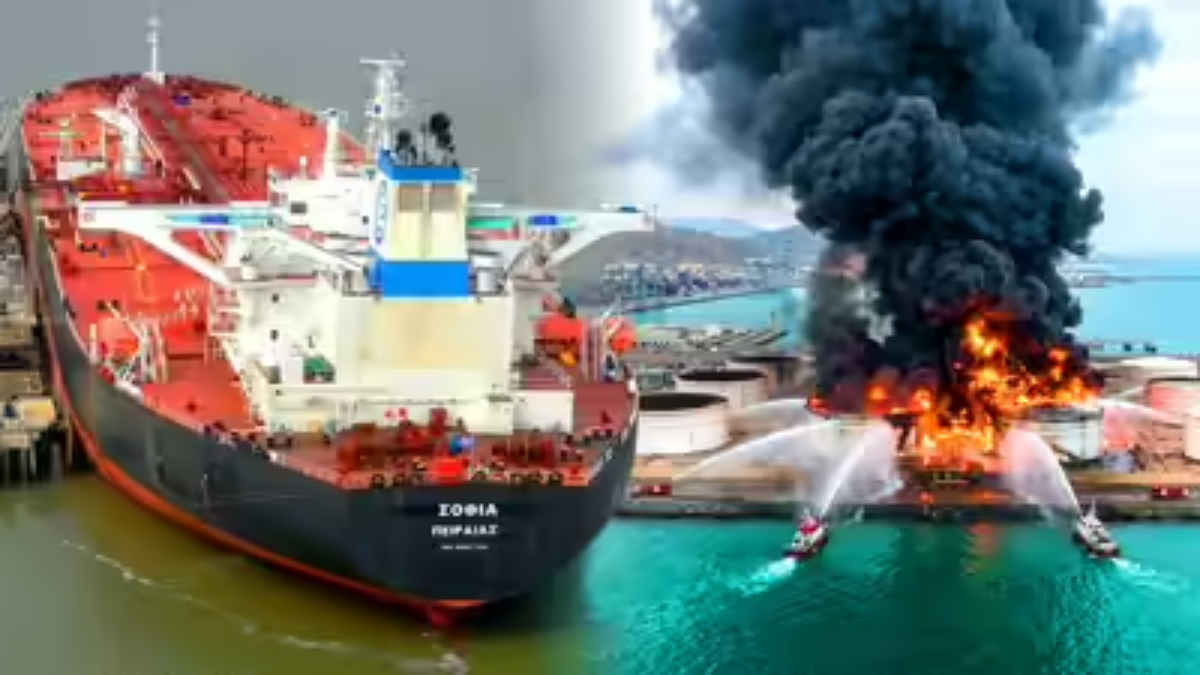
New Delhi, March 16, 2026 — In a major relief for India’s maritime community and energy sector, the Indian-flagged crude oil tanker Jag Laadki has successfully sailed out of the UAE’s Fujairah port after a close brush with a regional conflict. The vessel, which was caught in the middle of a drone attack on the terminal, has been confirmed safe with all crew members unharmed.
A Narrow Escape Amid Regional Tensions
On March 14, 2026, the Jag Laadki was positioned at the Fujairah Single Point Mooring (SPM), actively loading a massive cargo of crude oil, when the terminal came under a sudden aerial assault. Local reports and government statements indicate that the facility was targeted by drones, which triggered fires and forced a temporary suspension of loading operations at one of the world’s most critical bunkering hubs.
Despite the proximity to the strikes, the vessel did not sustain any damage. According to a statement from the Ministry of Petroleum and Natural Gas, the ship remained stable throughout the incident.
“On 14 March 2026, while the Indian-flag vessel Jag Laadki was loading crude oil at the Fujairah Single Point Mooring, the Fujairah oil terminal was attacked. The vessel and all Indian seafarers onboard are safe.”
Journey Back to India
Following the security clearance and the resumption of port activities, the Jag Laadki departed from Fujairah at 10:30 AM IST on Sunday, March 15. The tanker is currently en route to an Indian port, carrying approximately 80,800 metric tonnes of Murban crude oil.
The vessel is owned and operated by the Mumbai-based Great Eastern Shipping Company. Its safe exit is seen as a significant win for Indian diplomacy and maritime security, as it marks the fourth Indian-flagged vessel to successfully navigate out of the “war zone” in recent days without incident.
Strategic Context: The Strait of Hormuz Crisis
The incident at Fujairah occurs against the backdrop of intensified hostilities in West Asia, particularly following the US-Israel strikes on Iran in late February. The resulting conflict has seen Tehran effectively block or threaten the Strait of Hormuz, a vital maritime chokepoint responsible for nearly 20% of the world’s oil and gas flows.
Key highlights of India’s current maritime status in the region:
- Safe Transits: Beside the Jag Laadki, two LPG carriers—Shivalik and Nanda Devi—successfully crossed the Strait of Hormuz on Saturday and are expected to reach Gujarat ports by March 16–17.
- Stranded Vessels: Approximately 22 Indian-flagged vessels, carrying roughly 611 seafarers, remain west of the Persian Gulf.
- Diplomatic Efforts: Prime Minister Narendra Modi and External Affairs Minister S. Jaishankar have been in high-level talks with Iranian counterparts to ensure a “safe corridor” for Indian energy shipments.
Impact on Domestic Energy Supply
While the government has assured the public that there is no shortage of petrol, diesel, or cooking gas (LPG), the conflict has caused minor ripples in the supply chain. Industrial users have seen a slight regulation in gas supplies, and the government has stepped up monitoring to prevent panic buying or hoarding.
The Directorate General of Shipping (DGS) continues to operate a 24/7 control room to assist seafarers and their families, having already facilitated the repatriation of over 270 Indian sailors from the conflict zone.