

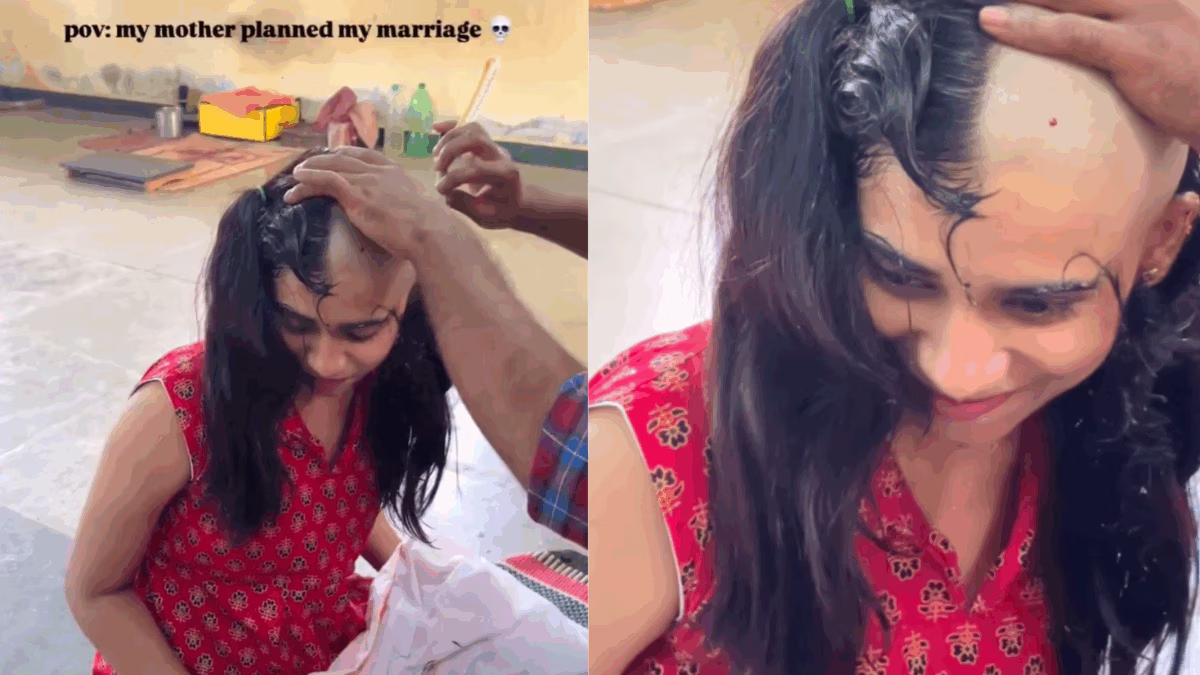
New Delhi, July 16, 2026 — In the era of algorithmic timelines, it takes less than a minute for a harmless inside joke to transform into a sweeping national debate. Content creator Keerthana Menon learned this firsthand after a short video of her shaving off her long hair set the internet ablaze. Accompanied by the playful, text-on-screen caption, “POV: My mom planned my marriage,” the video sparked a massive digital wildfire. Millions of viewers instantly jumped to the conclusion that she had taken a drastic, defiant stand against forced arranged marriage and societal expectations.
However, as the dust settles on what became a viral phenomenon with over 24 million views in just 48 hours, Menon has stepped forward to clear the air. In a detailed follow-up explanation, she clarified that her dramatic transformation had absolutely nothing to do with marriage pressure, parental control, or a rebellion against family traditions. Instead, it was simply an impulsive personal choice, a desire for change, and a meaningful act of spiritual donation supported fully by her mother.
Anatomy of a Viral Misunderstanding
The original reel captured a striking visual sequence: a young woman watching her long hair completely shaved off down to the scalp. In isolation, it was a bold cosmetic switch. But combined with the “POV” (Point of View) text about an arranged marriage, social media users filled in the blanks using a very familiar cultural script.
Within hours, mainstream meme pages, online commentators, and digital news outlets began framing the video as a heroic act of Gen-Z resistance. Activists praised it as a peaceful protest against systemic family pressure, while others debated whether physical non-conformity was an effective shield against unwanted marital arrangements. The assumption was simple: because long, beautiful hair is historically tethered to traditional standards of bridal beauty in India, shaving it off must have been a tactical move to discourage prospective grooms.
The narrative became so deeply entrenched that very few paused to consider if the premise itself was a joke. The digital audience treated the caption as a literal diary entry rather than lighthearted internet humor.
The Real Story: A Spontaneous Choice
Breaking her silence on her YouTube channel and in subsequent media interviews, Menon pulled back the curtain on the actual timeline of events. There was no impending wedding, no secret family conflict, and no demanding matchmakers knocking at her door.
The idea struck her quite casually while she was visiting a cousin. Finding herself curious about what it would feel like to have a clean-shaven head, she floated the idea to her mother. Initially, her mother assumed it was a passing joke and lightheartedly told her to go ahead with it. When it became clear that Menon was entirely serious, her mother didn’t protest; instead, she chose to accompany and support her daughter through the process. The duo ultimately traveled to a temple together, where Menon formally donated her shaved hair, turning a spontaneous personal whim into an act of traditional devotion.
Why the Internet Swallowed the Story
The speed with which the false narrative was adopted highlights a fascinating reality about modern social media culture: the internet often believes stories because they match an existing social truth, even if the specific instance is fictional.
Because these dynamics are actively at play in society, the idea that a young woman would use a razor as a weapon of protest did not sound far-fetched to millions of people. It felt entirely plausible, which completely bypassed the public’s natural skepticism. Once the internet verified that the video footage itself was real and not an AI-generated deepfake, the audience immediately accepted the written caption as factual reality.
The Aftermath and New Waves of Support
Despite the massive mix-up, the public response to Menon’s new look has remained overwhelmingly positive. Even after she pulled back the dramatic backstory, users continued to flock to her comments section to praise her aesthetic confidence and striking features. Messages like “You look bold and confident,” “More power to you,” and compliments celebrating her striking new aesthetic flooded her profile.
Interestingly, the viral moment has also inadvertently inspired others. Several women commented that they had been considering shaving their heads for personal comfort, summer heat, or medical hair donations, and seeing Menon’s video gave them the final push of confidence they needed.
Ultimately, Keerthana Menon’s viral loop serves as a dual lesson. On one hand, it stands as a classic example of how easily context can be distorted in the echo chambers of short-form video apps. On the other hand, it proves that a woman choosing exactly what to do with her own hair—whether as a religious offering, a bid for a fresh start, or just a Tuesday morning impulse—is still a powerful statement of bodily autonomy all on its own.