

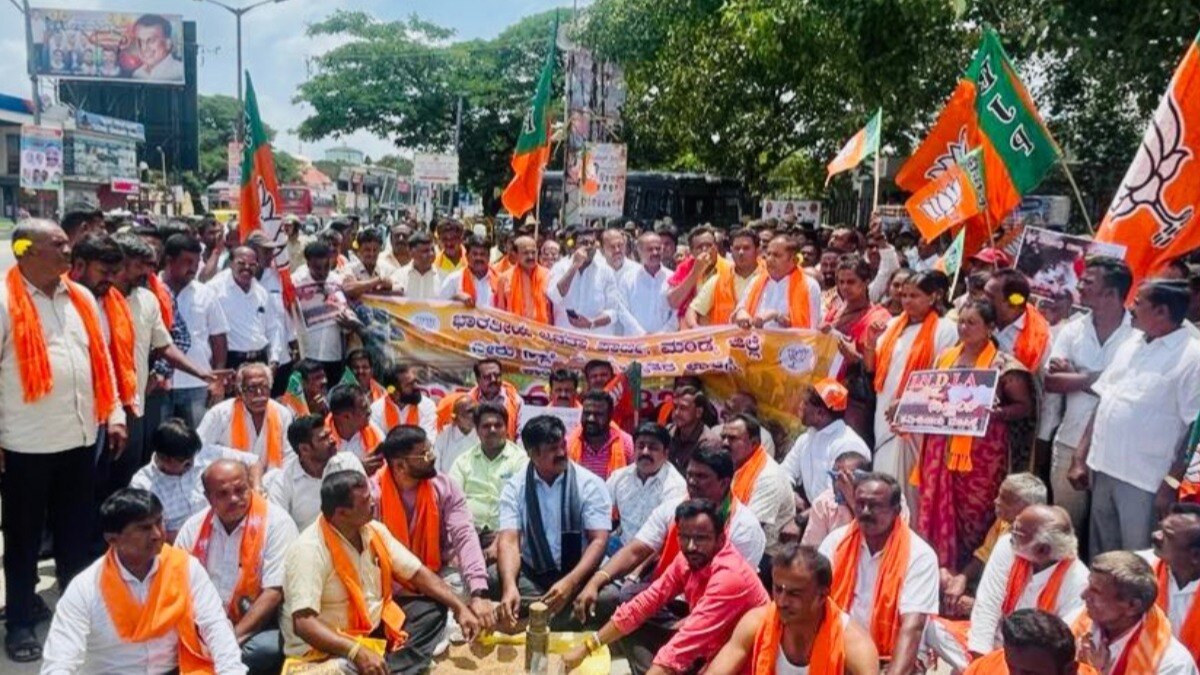
New Delhi, july 1, 2026 — The serene town of Kushalnagar in Karnataka’s scenic Kodagu district became the focal point of intense socio-political activity on Tuesday. Close to 3,000 people, including local citizens and hundreds of right-wing activists from across the district, flooded the streets in a massive protest march. Organised by various Hindu groups, the demonstration aimed to register strong condemnation against what organizers describe as a growing pattern of forceful religious conversions in the region.
The demonstration had an immediate economic impact on the town. Expressing solidarity with the protesting groups, local business owners, merchants, and traders voluntarily closed their shops and commercial establishments from 6:00 AM until noon. The six-hour shutdown kept normal life on pause as the primary commercial corridors transformed into paths for the demonstrators.
Tensions Flaring Over Local Incident
According to local reports, the tipping point for this widespread public mobilization was a recent event involving a local Hindu family. The protest was triggered by the reported conversion of a Hindu mother and her son to Islam in Kushalnagar. Activists alleged that this specific conversion was not entirely voluntary, which quickly ignited simmering anxieties within the local community regarding demographic shifts and religious practices.
The protest march commenced from the heart of Kushalnagar town and steadily progressed toward the popular Cauvery Nisargadhama tourist center. Observers noted that the roads were heavily crowded with demonstrators carrying saffron flags and chanting religious slogans, including “Jai Shree Ram,” while calling for a renewed commitment to protecting Hindu culture (Hindu Dharma). The march proceeded peacefully under the watchful eye of local law enforcement, which had deployed personnel along the route to maintain public order.
Community Leadership Urges Unity and Awareness
Following the completion of the foot march near the tourist hub, the gathering transitioned into a public awareness conference. Several prominent regional leaders addressed the massive crowd, detailing their concerns and advising families on how to navigate these challenges.
Satish Davangere, the co-convener of the Hindu Jagran Vedike’s Dakshina Karnataka province, delivered the keynote address. He emphasized that addressing religious conversions requires broad community collaboration rather than political divisions.
He further urged parents to maintain close, communicative relationships with their children. Davangere advised families to actively engage their daughters in discussions regarding their daily activities and to teach them traditional texts like the Bhagavad Gita and other historical epics to instill a strong sense of cultural identity.
Reflecting on the history of the region, Davangere alleged that incidents related to “love jihad”—a term used by right-wing groups to describe alleged efforts by Muslim men to convert non-Muslim women through marriage—first began surfacing in the Kodagu district as far back as 1995. He expressed deep worry over these long-term trends but made a point to clarify that the movement is not inherently driven by hatred toward specific communities.
“Indians are not anti-Muslim. Not all Muslims and Christians are bad,” Davangere noted, adding a call for universal religious respect. “Everyone must stay loyal to their own religion.”
Broadening the Safety and Awareness Campaign
Other leaders echoed similar sentiments, framing the rally as a defensive measure for social preservation rather than an offensive strike against minority communities. B. Amrutha Raj, the convenor of the Hindu Suraksha Samiti, stepped forward to clarify the scope and intent of their public campaign. He maintained that the awareness drives are designed to safeguard individuals from exploitation and are not directed maliciously toward any particular class or background of people.
The protesters concluded the rally by collectively demanding stricter legal intervention from the state administration. Leaders submitted appeals to local authorities, calling for a thorough investigation into recent conversion cases in the district and demanding stringent legal action against individuals found guilty of using force, financial allurement, or psychological coercion to convert vulnerable individuals.
Contextual Background: The Anti-Conversion Debate in Karnataka
This large-scale demonstration in Kushalnagar does not exist in a vacuum; it is part of a much larger, multi-year debate surrounding religious conversions across Karnataka. The state has frequently been a battleground for these sensitive issues.
Over the last several years, Karnataka has witnessed a series of flashpoints regarding religious freedom. Right-wing groups have frequently alleged that covert conversion networks operate in various districts, targeting tribal populations, economically disadvantaged families, and young women. Conversely, Christian and Muslim minority groups, alongside human rights organizations, have repeatedly denied these claims, arguing that allegations of “forced mass conversions” are often exaggerated to justify intimidation or score political points.
The legislative landscape of the state reflects these deep societal divisions. In late 2021, amid intense political debates and street protests from civil rights groups, the state government introduced the Karnataka Protection of Right to Freedom of Religion Bill (commonly known as the Anti-Conversion Bill). The law sought to impose harsh penalties—including up to ten years of imprisonment—for conversions carried out through misrepresentation, force, fraud, allurement, or marriage. While proponents argued the law was necessary to protect individuals from predatory practices, critics vehemently opposed it, claiming it infringed upon the constitutionally guaranteed right to privacy, dignity, and freedom of choice under Article 25 of the Indian Constitution.
The massive turnout in Kushalnagar highlights that despite legislative frameworks, the ground-level anxieties surrounding faith, identity, and community dynamics remain highly sensitive. As the town returns to its regular routine after the voluntary shutdown, local authorities are keeping a close watch on the situation to ensure that the peace and communal harmony of the scenic Kodagu region remain intact.