

New Delhi, May 25, 2026: — The capital of Ukraine is reeling under the aftermath of one of the most intense and destructive aerial assaults since the war began. Overnight, the Russian Federation launched a massive, coordinated barrage of missiles and attack drones across the country, with Kyiv explicitly targeted as the primary focus.
According to the latest updates from Ukraine’s State Emergency Service (DSNS) and city officials, two women have been confirmed dead in Kyiv, and the number of injured civilians has surged sharply to 87 people, including three minors.
The seven-hour attack, which kept millions of residents huddled in underground shelters, triggered major fires, devastated historic cultural institutions, and caused severe structural damage to residential neighborhoods across every district of the capital.
Direct Hit Devastates Shevchenkivskyi District
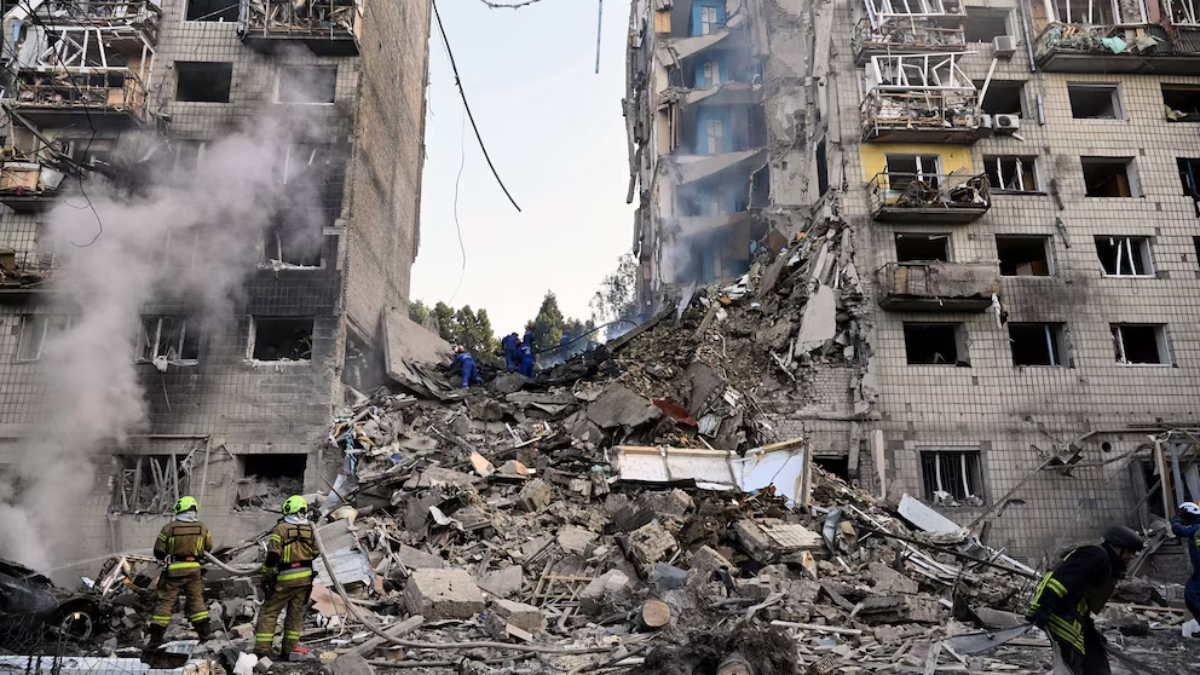
The most catastrophic single incident occurred in Kyiv’s central Shevchenkivskyi district. A direct missile strike slammed into a five-story residential apartment building, entirely obliterating an entrance section and causing a massive structural collapse.
Search and rescue teams working continuously through the rubble recovered the bodies of two women from beneath the crushed concrete.
Emergency crews have already removed over 165 square meters of heavily damaged reinforced concrete slabs as they meticulously comb through the debris. Special search dogs have been deployed to check more than 100 square meters of the immediate site to ensure no further victims remain trapped.
Alongside physical rescue efforts, DSNS psychologists have set up mobile stations on-scene, providing immediate crisis support to 112 traumatized residents.
690 Aerial Weapons: The Scale of the Retaliatory Barrage
According to the Ukrainian Air Force, the Russian military deployed a staggering total of 690 aerial weapons in the combined assault, consisting of approximately 600 attack drones and 90 cruise and ballistic missiles.
Among the weapons used was the Oreshnik, a powerful, nuclear-capable hypersonic intermediate-range ballistic missile. While Ukrainian air defense systems successfully intercepted a majority of the incoming drones and over half of the missiles, the sheer volume of the attack meant that 16 missiles and 51 drones broke through, striking 54 distinct locations across the country, while falling debris caused widespread fires in 23 separate areas.
The Kremlin openly acknowledged the assault, stating that the massive strikes were a direct retaliation for a Ukrainian drone attack earlier in the week that targeted a facility in Russian-controlled Starobilsk. Russian officials claimed the target was a command center, while local occupation authorities reported civilian casualties, prompting Moscow to vow severe punishment.
The European Union’s foreign policy chief, Kaja Kallas, strongly condemned the barrage, arguing that targeting city centers is an “abhorrent act of terror” meant to maximize civilian casualties rather than achieve a military objective.
Widespread Destruction of Kyiv’s Infrastructure and Culture
Kyiv Mayor Vitali Klitschko confirmed that damage to civilian and administrative infrastructure has been recorded at 49 locations across the capital, touching virtually every district.
Key Infrastructure Impacts:
-
Government District: Shrapnel and shockwaves caused visible exterior damage to the buildings of Ukraine’s Foreign Ministry and the Cabinet of Ministers.
-
Educational & Health Facilities: Several schools were damaged, with one in the Podilskyi district suffering a major fire. Debris also struck a building housing various United Nations agencies, shattering windows on the third floor of the World Health Organization (WHO) offices.
-
Economic Hubs: A historic central trade market was completely burned to the ground, and a massive warehouse fire broke out in the wider Kyiv region.
-
Cultural Tragedies: Culture Minister Tetyana Berezhna noted that this attack caused the single largest blow to cultural institutions in Kyiv since 2022. Notably, the national museum dedicated to the 1986 Chernobyl nuclear disaster was completely destroyed.
Terror in the Night: Civilians Seek Shelter
For the residents of Kyiv, the night was a grueling test of survival. The air raid sirens blared uninterrupted for hours as the thunderous booms of explosions and air defense interceptions shook ground-level structures.
Thousands of families scrambled into the city’s deep underground metro system, which once again transformed into a massive bomb shelter.
Matthias Schmale, a senior UN official in Ukraine, described being woken by the “terrifying loud sounds of war,” emphasizing that civilians are continuously subjected to immense, life-threatening risks.
With 87 individuals currently filling local hospitals—ranging from minor shrapnel wounds to severe trauma from structural collapses—medical personnel are working under extreme pressure.
Summary of Casualties and Damage
Ukraine has officially requested an emergency meeting of the United Nations Security Council to address the unprecedented scale of civilian infrastructure targeting and to press international allies for enhanced air defense capabilities to shield its skies from future waves. Rescue operations remain active across the worst-hit zones.