

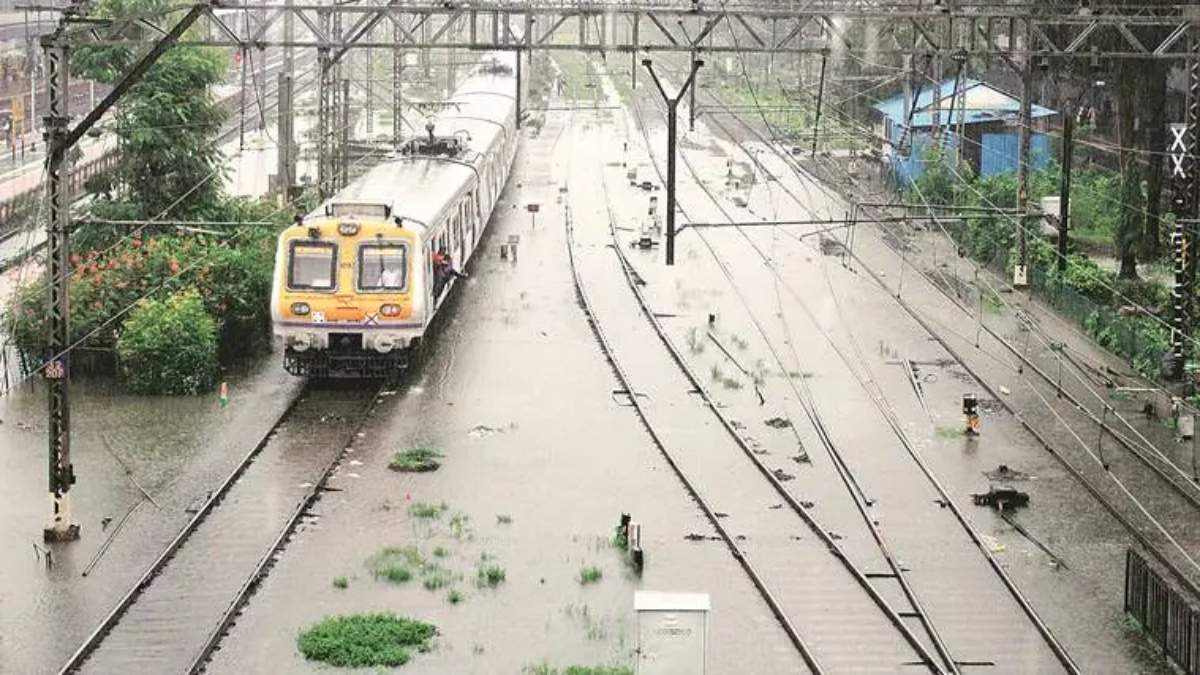
July 2, 2026 — The financial capital woke up to another morning of relentless downpours on Thursday, July 2, 2026, as an intensifying monsoon lashed the city and its surrounding metropolitan region for the third consecutive day. The ongoing deluge has triggered widespread flooding in several low-lying areas, severely crippled road traffic, and disrupted the city’s life-line local train services.
With the India Meteorological Department (IMD) issuing a Red Alert warning of extremely heavy rainfall, local authorities have urged citizens to stay indoors and avoid unnecessary travel. The civic body, Brihanmumbai Municipal Corporation (BMC), remains on high alert as stormwater drains struggle to cope with the sheer volume of water.
Deluge From the Skies: Rainfall Data Breakdown
According to the latest figures released by the BMC disaster management cell, Mumbai and its suburbs recorded staggering rainfall totals over the 24-hour period ending on Thursday morning. The eastern suburbs bore the brunt of the heavy spells, closely followed by the western belt.
The sheer volume of water is evident in the localized data gathered between Wednesday morning and early Thursday:
- Eastern Suburbs: Averaged 164 mm, with Mithagar Municipal School in Mulund logging a massive 218.6 mm, followed closely by Powai at 208.4 mm.
- Western Suburbs: Averaged 149 mm. The Santacruz observatory recorded 165.9 mm of overnight rain, while localized spots like the Santacruz workshop hit 216 mm and Andheri Fire Station reached 204 mm.
- Island City: Received comparatively lower but still significant rainfall, averaging 134 mm, with the highest downpour tracked at the G South Ward office at 187.8 mm.
The sudden cloudbursts caused Powai Lake—one of the city’s major artificial reservoirs—to overflow early Wednesday morning when its water levels exceeded its 545-crore litre storage capacity. The excess water is currently draining into the already swollen Mithi River, exacerbating the threat of flash floods in nearby settlements.
Subways Submerged and Roads Paralyzed
For the thousands of commuters attempting to navigate their morning routines, the roads turned into slow-moving rivers. Widespread waterlogging was reported from chronic flooding spots including Dadar, Parel, Hindmata, Kings Circle, Kurla, Sion, and Bandra.
The Western Express Highway (WEH), particularly around Santacruz East, witnessed massive traffic gridlocks stretching over several kilometers. Commuters reported being stuck in their vehicles for hours as reduced visibility and deep potholes slowed down vehicular movement to a crawl.
Worst hit were the city’s low-lying subways. The Andheri Subway, a critical east-west vehicular artery, recorded water accumulation of up to five feet, prompting traffic police to completely shut down the route and divert vehicles toward the Captain Gore Flyover. In addition to the flooding, the BMC received dozens of complaints regarding fallen trees and large branches blocking major roads in residential pockets like Kandivali, Borivali, and Malad, requiring urgent intervention from the Fire Department.
Local Trains Fail to Keep Pace
Mumbai’s local train network, which carries over seven million commuters daily, suffered significant scheduling setbacks on Thursday. While services were not entirely suspended, trains on the Central, Western, and Harbour lines were running 15 to 20 minutes behind schedule.
Heavy rainwater pooled directly onto the tracks at Dadar, Kurla, and Ghatkopar stations. Though central pumps were deployed immediately, the continuous downpours meant water levels remained precariously close to the wheelsets of the local trains, forcing motormen to navigate flooded sections at a highly reduced speed.
The Harbour line experienced the worst of the transport woes earlier in this wet spell when an overhead equipment (OHE) wire snapped between Navi Mumbai and Mumbai, halting train traffic completely for nearly an hour and leaving thousands of passengers stranded on platforms. Concurrently, flight operations at Chhatrapati Shivaji Maharaj International Airport experienced minor delays, with at least three flights forced into holding patterns or brief diversions due to sudden drops in visibility during heavy cloud bands.
High Tide Compound Fears
The primary anxiety for civic administrators moving into the afternoon is the arrival of a 4.27-metre high tide scheduled for 1:45 PM.
When heavy monsoon rain coincides with a high tide, the city’s drainage system becomes severely compromised. The massive incoming sea walls essentially block the stormwater drains from emptying into the Arabian Sea. If the heavy downpours persist during this window, the water has nowhere to go, drastically accelerating the rate of urban flooding.
School Closures and Safety Guidelines
Reacting swiftly to the deteriorating weather matrix, the administration in neighboring Palghar and Thane districts declared a precautionary holiday for all schools and junior colleges. While Mumbai schools haven’t faced a blanket closure order yet, many parents chose to keep children home as conditions worsened.
Tragedy has already touched the region during this wet spell; authorities reported the heartbreaking death of an 11-year-old student in Chembur after an old peepal tree was uprooted by high winds and fell directly onto a moving school bus. In light of such incidents, the civic body has issued a comprehensive safety advisory.
Essential Citizen Checklist:
- Avoid Submerged Areas: Do not attempt to drive or wade through flooded streets where water depth is unknown.
- Watch for Electrical Hazards: Stay clear of electric poles, transformers, and exposed cables, as standing water can easily become live.
- Avoid Weak Structures: Residents living in dilapidated buildings or landslide-prone hillocks (particularly in parts of Ghatkopar and Kurla) have been advised to relocate to safer municipal shelters.
- Emergency Lines: Keep the Disaster Management Control Room numbers active and rely only on official bulletins from the BMC and IMD.
The Outlook: More Rain to Come
The IMD’s current weather models suggest that Mumbai is nowhere near the end of this intense active monsoon phase. A combination of a strong offshore trough along the Maharashtra coast and a cyclonic circulation over the Bay of Bengal is continuously pumping moisture directly into the Konkan belt.
The weather bureau expects heavy to very heavy rainfall to continue across Mumbai, Thane, and Palghar for at least the next 24 to 48 hours, with occasional gusty winds reaching speeds of 50 to 60 km/h. As night approaches, the city prepares for what could be another round of intense, continuous rainfall, putting Mumbai’s famous resilience to yet another strenuous monsoon test.