
 has successfully)
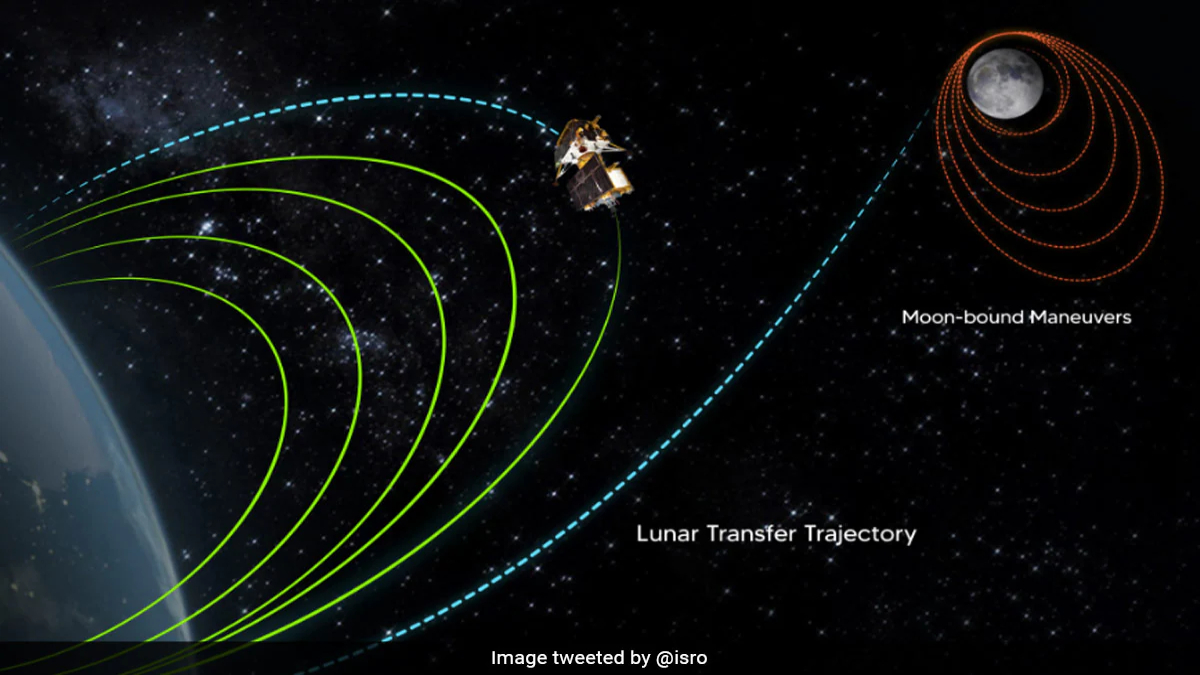
New Delhi, December 30, 2025: In a brilliant display of orbital mechanics, the Indian Space Research Organisation (ISRO) has successfully leveraged the Moon’s gravitational pull to maneuver the Chandrayaan-3 Propulsion Module (CH3-PM) into a significantly expanded Earth-bound orbit. What began as a secondary mission objective has turned into a masterclass in deep-space navigation, effectively using the Moon as a “cosmic slingshot.”
The “Slingshot” Maneuver Explained
After delivering the Vikram lander to the lunar surface in August 2023, the Propulsion Module was left with over 100 kg of surplus fuel. ISRO engineers decided to utilize this reserve to bring the craft back toward Earth—a complex journey involving multiple “gravity assists.”
A gravity assist occurs when a spacecraft flies close to a celestial body, using that body’s gravity to change its velocity and trajectory without burning significant fuel. For Chandrayaan-3, this meant entering the Moon’s Sphere of Influence (SOI)—the region where lunar gravity becomes the dominant force—multiple times.
Key Milestones of the Return Journey
The most recent phase of this journey culminated in November 2025. According to ISRO reports:
- November 4, 2025: The module re-entered the Moon’s SOI.
- November 6 & 11, 2025: The craft performed two critical lunar flybys, passing within roughly 3,740 km and 4,537 km of the lunar surface.
- The Result: These flybys “kicked” the module into a much larger orbit. Its path expanded from a $100,000 \times 300,000$ km orbit to a massive $409,000 \times 727,000$ km trajectory. Additionally, its orbital inclination shifted from 34° to 22°.
Why This Matters for Future Missions
This maneuver was more than just a scenic detour. It served as a critical technology demonstration for Chandrayaan-4, India’s upcoming lunar sample return mission. To bring moon rocks back to Earth, ISRO must master the art of launching from the Moon and navigating back into Earth’s gravity—exactly what the Propulsion Module is practicing now.
“This event garnered valuable insights… especially enhancing the understanding of disturbance torques and flight dynamics for return missions,” ISRO stated in a recent update.
Current Status: SHAPE Payload Active
Currently, the Propulsion Module is in a stable, high-altitude Earth orbit. It continues to operate the SHAPE (Spectro-polarimetry of HAbitable Planet Earth) instrument. This payload is busy studying Earth from a distance, gathering data on what a “habitable planet” looks like from space. This information will eventually help scientists identify potentially life-bearing exoplanets in distant solar systems.
By transforming a “delivery vehicle” into a long-term scientific satellite and a laboratory for return-flight physics, ISRO has once again proven that in space, even the “leftover” parts of a mission can lead to historic breakthroughs.