

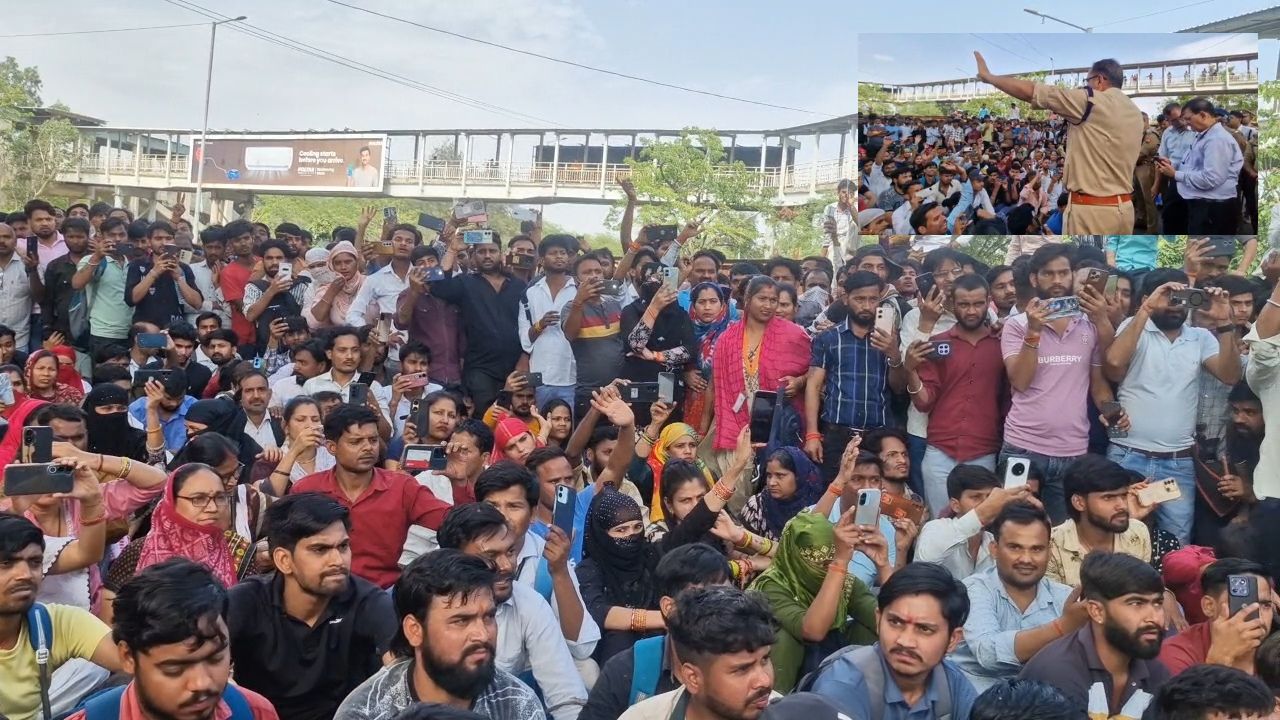
April 13, 2026 — The gleaming glass facades of Noida’s industrial sectors stood in stark contrast to the chaos unfolding on their doorsteps this Monday. What began as a localized sit-in by garment workers last Friday has exploded into a city-wide labor uprising, as thousands of industrial workers across Phase-2, Sector 60, and the Noida Special Economic Zone (NSEZ) took to the streets to protest stagnant wages and grueling working conditions.
The cry echoing through the industrial corridors of Gautam Buddh Nagar is singular and searing: “We work 12 hours a day, but we can’t even afford to live.“
The Trigger: A Tale of Two States
The unrest was ignited by a sharp disparity in regional labor policies. Just across the border, the Haryana government recently hiked its minimum monthly wage from approximately ₹14,000 to ₹19,000—a 35% jump that sent shockwaves through the National Capital Region (NCR).
In contrast, Uttar Pradesh’s revised minimum wages, which came into effect on April 1, 2026, remain significantly lower. For many unskilled workers in Noida’s sprawling garment and manufacturing hubs, the monthly take-home pay hovers around ₹11,314 to ₹13,224.
“How is a worker in Gurugram worth ₹6,000 more than a worker in Noida?” asked Rajesh Kumar, a 32-year-old machine operator who joined the protest near the Hosiery Complex. “We buy the same flour, pay the same rent, and use the same LPG. But here, we are treated like cheap machinery.”
12-Hour Days and the “₹13,000 Trap”
The protesters’ grievances extend far beyond the base salary. The 12-hour workday has become the unofficial standard across many industrial units, despite labor laws theoretically capping shifts at eight to nine hours.
Workers allege that the “overtime” they are forced to perform is often paid at single rates or remains unrecorded. For a worker earning ₹13,000 a month, a 12-hour shift translates to a grueling reality:
- Hourly Rate: Approximately ₹42 per hour.
- The Cost of Living: After paying ₹4,500 for a cramped single room in a nearby “urban village” and ₹5,000 for basic groceries and utilities, a worker is left with barely ₹3,500 for medical emergencies, children’s education, or savings.
“They call us the ‘backbone of the economy,’ but our backs are literally breaking,” said Sunita, a garment finisher. “By the time I get home after a 12-hour shift and commute, I don’t have the energy to feed my kids. And for what? ₹13,000? It’s not a wage; it’s a survival allowance.”
Monday’s Escalation: From Sit-ins to Smoke
The tension, which had been simmering for three days, boiled over on Monday morning. Protesters blockaded key roads near the NSEZ metro station, leading to massive traffic snarls that paralyzed the city’s eastern wing.
The situation turned violent in Phase-2 and Sector 84, where clashes broke out between workers and security forces. Reports indicate that at least two vehicles were set on fire, and several others were damaged as stone-pelting erupted. Police responded with tear gas and lathi charges to disperse the crowds.
The Workers’ Key Demands:
- Minimum Wage Hike: An immediate increase in the minimum wage to ₹20,000 per month.
- Wage Parity: Aligning Noida’s pay scale with the recently updated Haryana rates.
- End to Forced Overtime: Strict enforcement of 8-hour workdays and double-pay for any overtime (OT) hours.
- Direct Benefit Transfers: Ensuring bonuses and OT are credited directly to bank accounts to prevent “middleman” deductions.
The Government and Corporate Response
The political fallout has been swift. Former Chief Minister Akhilesh Yadav criticized the current administration, blaming “one-sided policies” that favor industrial capitalists over the labor force.
Meanwhile, Uttar Pradesh Chief Minister Yogi Adityanath has issued a dual-edged directive. While stating that “workers must get their due” and industries must adhere strictly to labor laws, he also ordered a crackdown on “anti-social elements” who allegedly instigated the violence.
The District Magistrate of Gautam Buddh Nagar, Medha Roopam, has attempted to calm the waters by announcing a slew of welfare measures, including:
- Mandatory payment of salaries by the 10th of every month.
- Strict monitoring of weekly offs and overtime pay.
- A dedicated control room for labor grievances.
However, for the workers on the street, these procedural promises feel hollow without a concrete revision of the base pay.
The Economic Paradox
Industry experts warn that Noida is caught in a difficult economic paradox. The city has become a global hub for mobile manufacturing and garment exports precisely because of its competitive labor costs.
“If wages are hiked by 40% overnight, many small-to-medium enterprises (SMEs) might face closure or migrate to cheaper states,” noted an official from a local industries association. “However, we cannot ignore that inflation—especially in food and housing—has outpaced wage growth for the last three years. The gap is no longer sustainable.”
A City on Edge
As of Monday evening, a heavy police presence remains deployed across Noida’s industrial sectors. Over 50 people have been detained in connection with the violence, and several factories have declared a temporary lockout to protect their assets.
The protest has become a symbol of a larger national conversation about the “working poor” in India’s high-growth corridors. While Noida’s skyscrapers continue to rise, the people building the products inside them are demanding that they no longer be left behind in the basement of the economy.
For now, the machines in Phase-2 are silent. Whether they roar back to life on Tuesday depends on whether the administration can offer more than just “welfare measures” to a workforce that can no longer afford the price of its own labor.
Quick Facts: The Wage Gap (April 2026)
- Noida (UP) Minimum Wage (Unskilled): ~₹11,314 – ₹13,224
- Gurugram (HR) Minimum Wage (Unskilled): ~₹19,000
- Protesters’ Demand: ₹20,000
- Standard Shift vs. Reported Shift: 8 Hours vs. 12 Hours