

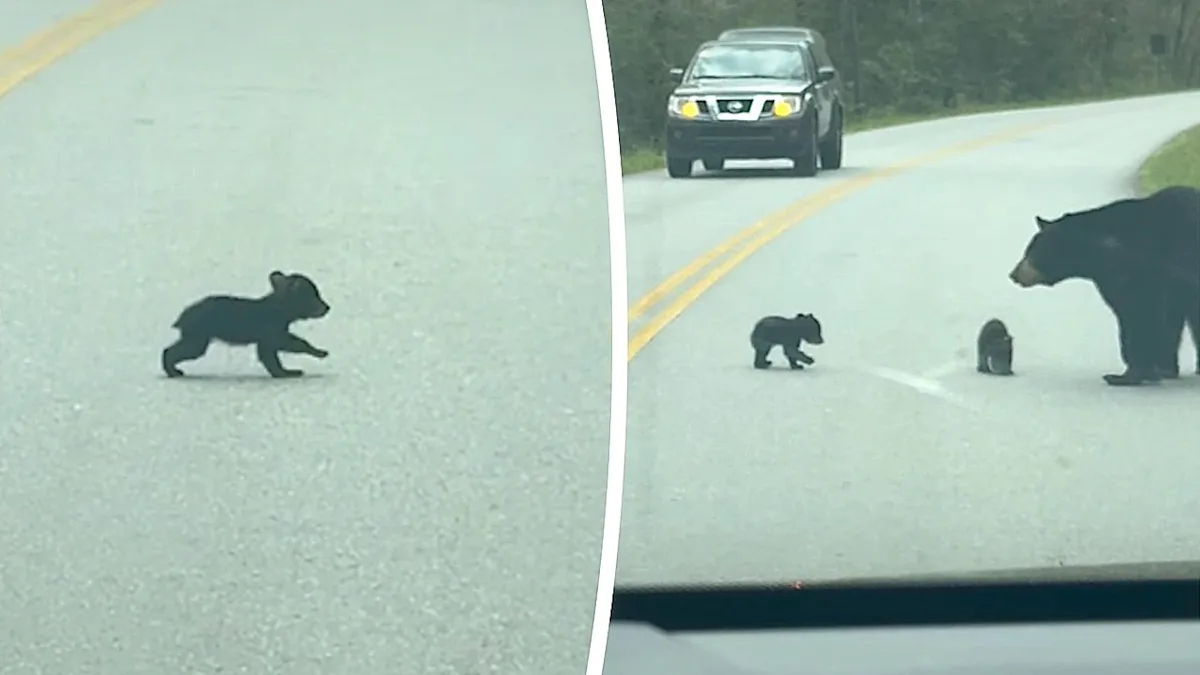
New Delhi, April 29, 2026 — It is a scene that has played out on suburban streets and remote mountain highways alike, yet it never fails to capture the hearts of onlookers. This April, the rolling hills of Western North Carolina became the stage for a heart-stopping, heartwarming moment that has taken social media by storm. A mother black bear, flanked by her three rambunctious cubs, found herself in a situation familiar to every parent on the planet: trying to get her children safely from point A to point B without any of them wandering off into danger.
The incident, which occurred earlier this month on Emma Road in Asheville, was captured on video by local resident Kristina Rupp. It has since ignited a firestorm of engagement, racking up millions of views across TikTok, Instagram, and YouTube. In the footage, drivers are seen bringing their vehicles to a complete standstill, creating a makeshift safety zone as the mama bear attempted to manage her trio of tiny, mischievous cubs.
For many, the video is more than just a wildlife sighting; it is a profound reflection of the universal challenges of motherhood.
The “Toddler” Factor
“I was actually annoyed because traffic was stopped. I thought it was a goose or something,” Rupp recounted in an interview. “But she quickly realized it was a mama bear trying to get one of her cubs out from underneath a car.”
As the video unfolded, viewers watched a classic tug-of-war between maternal authority and cub curiosity. Just as the mother bear would successfully guide one cub across the pavement, another would dart back toward the roadside brush. At one point, the mother seemed to lose her patience, a sentiment that resonated deeply with human parents watching from behind their screens.
“They were so sweet,” Rupp said. “To see this mama bear have this really complex emotion of patience, and then losing it—it was so funny. And they were being so naughty.”
The internet responded with a wave of empathy. Comment sections were filled with parents remarking, “I’ve been there,” and “Motherhood is the same across all species.” It is this shared humanity—or perhaps “shared animality”—that makes these encounters so compelling. We see the protective instinct, the frustration of a toddler-like cub ignoring commands, and the eventual, collective sigh of relief when the family finally crosses the asphalt and disappears into the safety of the woods.
A Seasonal Reality: Springtime in Bear Country
While the viral video is charming, experts from the North Carolina Wildlife Resources Commission (NCWRC) remind the public that these encounters are a natural, if challenging, part of spring in bear country. As temperatures rise and the forest floor begins to bloom, black bears emerge from their winter dens.
During the spring months, adult female bears are hyper-focused on one goal: feeding their cubs. After a winter of hibernation, calorie intake is critical. This, combined with the fact that cubs are naturally curious and often lack the survival instincts of their mothers, leads to an increase in sightings near human-inhabited areas and roads.
“Encounters like this are becoming more common,” noted a spokesperson for the NCWRC. The agency has been doubling down on its BearWise program, an initiative designed to help residents and visitors coexist with bears by reducing attractants—like unsecured trash cans and bird feeders—that draw bears toward human development.
The Rules of the Road: How to React
Seeing a bear in the wild is a privilege, but it carries a responsibility. If you find yourself in a situation where bears are crossing or near a roadway, experts emphasize the following guidelines to ensure the safety of both humans and wildlife:
- Stay Inside Your Vehicle: A car provides a necessary barrier. Never exit your vehicle to get a closer photo or video.
- Keep Your Distance: If the bear is on the road, stop at a safe distance and wait. Do not honk or yell, as this can startle the mother, potentially causing her to charge or forcing the cubs to scatter in unpredictable directions.
- Be Patient: As the viral video proved, patience is the best policy. Traffic is a temporary inconvenience; the safety of a wildlife family is paramount.
- Don’t Feed the Wildlife: This cannot be overstated. Feeding bears—intentionally or through poor garbage management—teaches them that roads and houses are sources of food, putting them in harm’s way for the rest of their lives.
Keeping Our Areas Wild
Beyond the viral clicks and the shared laughs, the recent Asheville sighting has sparked a more serious conversation about development and habitat fragmentation. As human infrastructure expands into areas traditionally occupied by wildlife, the frequency of these high-stakes crossings will likely increase.
“We’re so lucky they’re still here, as much as we’ve boomed this area so much,” Rupp reflected. “It highlights how important it is to keep some areas wild for the bears, and for all these animals, so that they don’t end up on the road in the first place.”
This sentiment is echoed by conservationists worldwide. As we continue to enjoy the beauty of wildlife, we must also consider the impact of our presence. Maintaining wild corridors and respecting the boundaries of natural habitats are essential to ensuring that these “mama bear” moments remain a source of wonder rather than tragedy.
The Lasting Lesson
As we head into the summer months, the Asheville mama bear and her three cubs serve as a timely reminder of the wild world living right on our doorsteps. They are neighbors, not entertainment. Watching a mother guide her young across a busy road is a privilege that asks us, in return, for patience, respect, and a commitment to keeping their wild world intact.
So, the next time you find yourself stuck in traffic because a family of bears is taking their sweet time crossing the street, remember the video that captured hearts around the world. Take a deep breath, keep your windows up, and appreciate the fleeting, precious glimpse of life in the wild. After all, if the mama bear can keep her cool while her toddlers run amok on a highway, we can certainly wait a few minutes for them to reach the other side.