

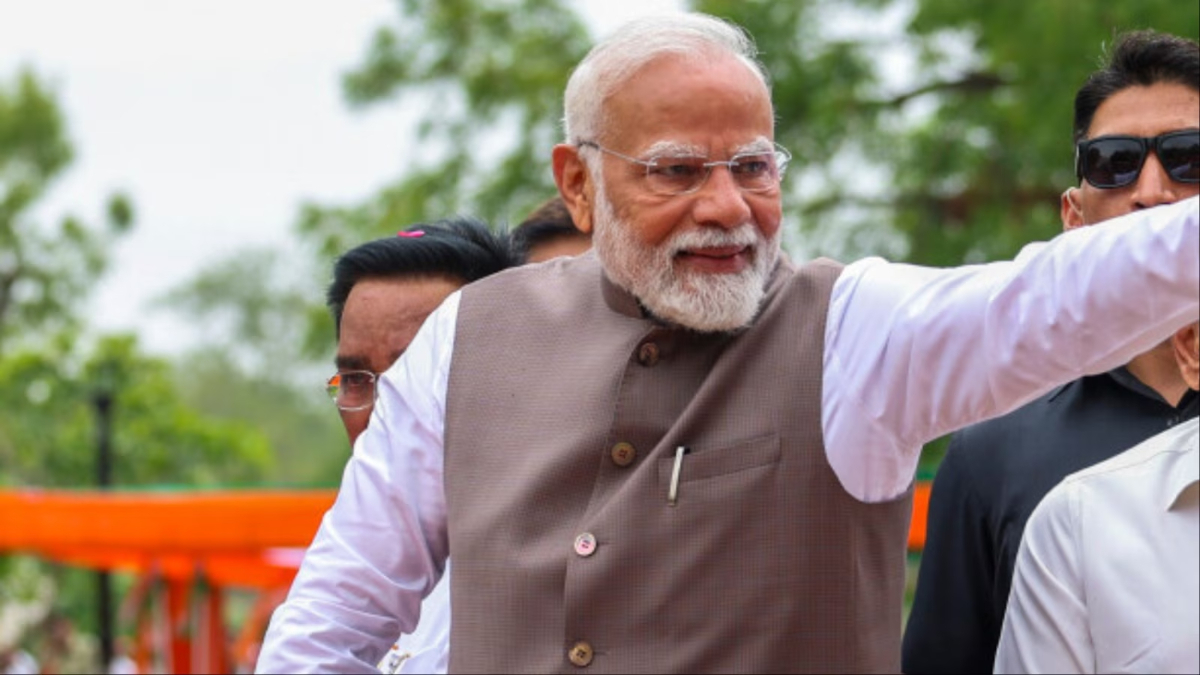
April 28, 2026: In a move that has captured the nation’s attention and sent political analysts into a frenzy, Prime Minister Narendra Modi traded his signature formal attire for track pants and football spikes this Tuesday morning. The venue was the picturesque city of Gangtok, Sikkim, but the echoes of this “sporting” event are resonating clearly across the plains of West Bengal, where the political temperature is reaching a boiling point.
As the Prime Minister dribbled past young players and took a shot at the goal under the clear Himalayan sky, the symbolism was hard to miss. While the event was officially a light-hearted engagement with the youth of Sikkim to mark the state’s 50th Statehood Day celebrations, the underlying message appeared to be a masterclass in political optics aimed directly at the neighbouring state of West Bengal.
The Pitch and the Politics
Football is not merely a sport in West Bengal; it is the heartbeat of the state’s cultural identity. It is ingrained in the socio-political fabric, a point famously punctuated during the 2021 assembly elections when Chief Minister Mamata Banerjee famously utilized a wheelchair and a football as a rallying cry, chanting the now-iconic slogan, “Khela Hobe” (The game is on).
By choosing to take the field in Sikkim—a region where football is equally revered and where the “Sikkimese Sniper” Bhaichung Bhutia has long been a household name—the Prime Minister seems to have executed a calculated maneuver to reclaim the narrative.
“Nothing like playing some football with my young friends in Sikkim on a lovely Gangtok morning!” the Prime Minister wrote on his social media handles, sharing snapshots of his energetic session.
The images of a 75-year-old Prime Minister showing agility on the pitch have sparked an avalanche of social media engagement. One viral comment perhaps best summarized the general perception: “Playing in Sikkim, scoring in Bengal.”
A Change of Scenery, Same Strategic Intent
This unexpected football interlude comes just a day after Mr. Modi concluded a high-intensity, multi-day campaign trail in West Bengal. During his final rallies, his rhetoric remained sharp, criticizing the Trinamool Congress (TMC) and accusing the state government of fostering an atmosphere of fear, while promising a “golden opportunity” for development and safety under a “double engine” government.
The transition from the sweltering heat of the Bengal campaign trail to the cool, crisp air of Gangtok provided the Prime Minister with a platform to soften his image. The visuals of him laughing with youngsters, warming up, and taking shots on goal offered a sharp contrast to the aggressive, confrontational nature of election-season political speeches.
It is a classic political tactic: when the discourse gets too toxic, a shift in environment and a display of relatability can act as a powerful reset button. By projecting an aura of energy and vitality in Sikkim, the BJP leadership appears to be attempting to counter any narratives about the Prime Minister’s stamina while simultaneously asserting dominance in the region’s cultural vernacular.
The “Khela Hobe” Counter-Offensive?
For years, the TMC has held the copyright on the football metaphor in Bengal politics. The slogan “Khela Hobe” became more than just a phrase; it became an anthem of defiance and political strength. By stepping onto the pitch himself, even if hundreds of kilometers away, PM Modi has attempted to disrupt this ownership.
Critics, however, argue that this is merely a diversionary tactic. As the second phase of elections approaches, the opposition has questioned the BJP’s focus, suggesting that such “staged” events are designed to distract from substantive issues like economic policies, unemployment, and inflation. Despite this, the political messaging of the move remains undeniable. It is a signal to the voters of Bengal that the BJP is prepared to play the game on their terms, embracing the state’s passion for the sport to bridge the “outsider” perception that has often hampered the party’s growth in the region.
Sikkim’s Role in the Narrative
While the focus is undeniably on Bengal, the significance of the Sikkim visit cannot be downplayed. The Prime Minister’s presence in Gangtok was tied to the closing ceremony of the state’s 50th Statehood Day. The unveiling of development projects worth ₹4,000 crore served as a reminder of the central government’s commitment to the Northeast.
This duality—developmental governance in the Northeast and aggressive political campaigning in the East—is the cornerstone of the BJP’s strategy in the region. By weaving together the celebration of statehood with the optics of a personal, humanizing event, the party aims to project a sense of stability and connectivity that contrasts with the localized, often volatile, political climate of West Bengal.
The Road Ahead
As the nation waits for the election results on May 4, the “Gangtok Goal” will be analyzed through a dozen different prisms. Was it a genuine moment of relaxation, or a carefully curated piece of political theater? In the high-stakes arena of Indian politics, the line between the two is almost always blurred.
The Prime Minister’s “Beckham-esque” moment in Sikkim has certainly grabbed eyeballs. Whether it will translate into actual votes in Bengal remains the billion-dollar question. What is certain, however, is that in the high-voltage “game” of Indian elections, the players are always looking for new ways to catch the other side off-guard.
For now, the ball is firmly in the court of the Bengal electorate. As they head to the polls, they will have to decide whether this symbolic kick in the mountains is enough to change the game on the ground.