

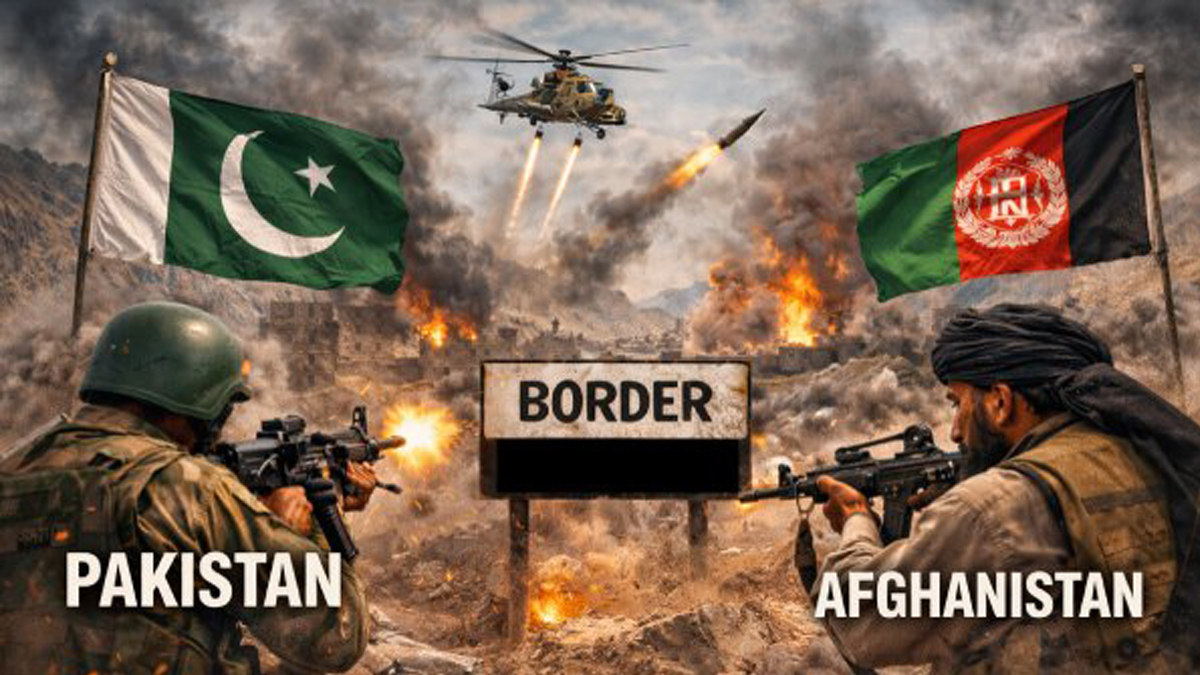
February 28, 2026: The long-simmering friction between Pakistan and the Taliban-led government of Afghanistan has reached a dangerous tipping point. Following a week of unprecedented military escalation, Islamabad’s Defence Minister Khawaja Asif declared on Friday that the two nations are now in a state of “open war.”
The conflict, which has transitioned from localized border skirmishes to deep-set aerial bombardments, has sent shockwaves across South and Central Asia. As both nations trade lethal blows, the eyes of global superpowers—China, Russia, and the United States—are fixed on a region that serves as a critical geostrategic crossroads.
The Spark: Operation Ghazab-lil-Haq
The current crisis ignited in late February 2026. Pakistan, citing a surge in domestic terrorism and the failure of the Taliban to curb militant safe havens, launched Operation Ghazab-lil-Haq (Operation Righteous Fury).
- Pakistani Airstrikes: On February 27, the Pakistan Air Force (PAF) conducted strikes deep within Afghan territory, hitting targets in the capital, Kabul, as well as Kandahar, the spiritual and political heart of the Taliban leadership.
- Taliban Retaliation: The Afghan Ministry of Defence responded with its own offensive, claiming to have captured several Pakistani border posts and utilized drone units to strike military targets within Pakistan, including areas near Islamabad and Nowshera.
- Casualties: While figures are difficult to verify independently, Pakistan claims to have killed over 270 Taliban officials and militants, while Kabul reports significant civilian casualties and the deaths of dozens of Pakistani soldiers.
Deep-Rooted Friction: The TTP and the Durand Line
At the heart of this “open war” are two structural issues that have plagued bilateral relations for decades:
- The TTP Menace: Pakistan alleges that the Tehreek-e-Taliban Pakistan (TTP) operates with impunity from Afghan soil. Despite the Taliban’s repeated denials, Islamabad views the group as a direct proxy or, at the very least, a protected ally of the Afghan government.
- The Durand Line Dispute: The 2,600-kilometer border between the two countries remains unrecognized by any Afghan administration, including the Taliban. This lack of a formal boundary leads to constant friction over border fencing and military outposts.
“Our patience has reached its limit,” stated Minister Khawaja Asif. “We will no longer tolerate the export of terrorism from Afghan soil under the guise of ‘neighborhood’ ties.”
The Superpower Lens: Geopolitics and Global Stakes
The prospect of a full-scale war in the Hindu Kush is a nightmare scenario for global powers, each with competing interests in the region.
| Power | Primary Concern | Strategic Interest |
| China | Regional Stability | Protecting the $62 billion CPEC projects and preventing militant spillover into Xinjiang. |
| United States | Counter-Terrorism | Monitoring Al-Qaeda and ISIS-K remnants while managing the fallout of the U.S.-Iran crisis. |
| Russia | Central Asian Security | Preventing the destabilization of Tajikistan and Uzbekistan via northern Afghan borders. |
China has already signaled its willingness to mediate, fearing that a protracted conflict will derail its “Belt and Road” ambitions. Meanwhile, regional actors like Saudi Arabia and Qatar are reportedly working behind the scenes to establish a ceasefire, similar to the fragile truce reached in October 2025.
A Region on the Edge
The economic stakes are equally high. Central Asian nations, particularly Uzbekistan, have invested heavily in trans-Afghan corridors like the Termez–Peshawar railway. A war would effectively bury these dreams of regional connectivity, further isolating the already fragile Afghan economy and straining Pakistan’s precarious financial situation.
As UN Secretary-General António Guterres expresses “deep concern” over the escalation, the world waits to see if the rhetoric of “open war” will transition into a full-scale invasion or if diplomatic pressure can pull these two neighbors back from the abyss.