

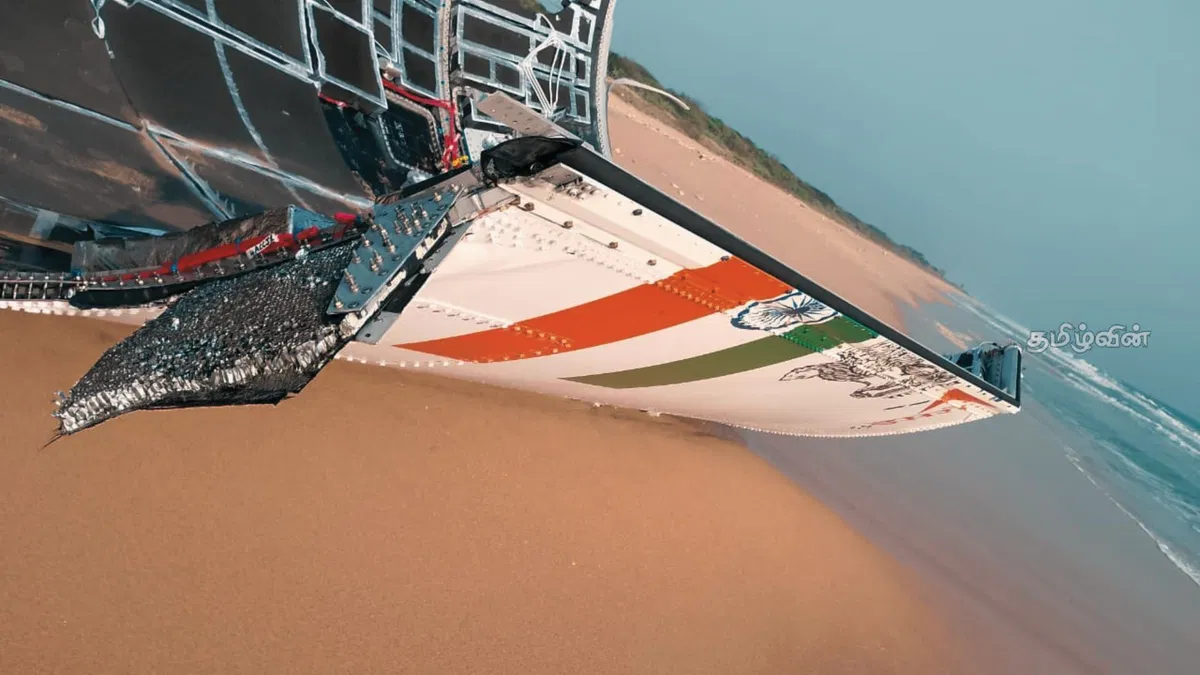
New Delhi, December 30, 2025: A large, mysterious metallic object discovered on a remote beach in Sri Lanka has been identified as debris from India’s heavy-lift LVM3-M6 rocket. The find, which occurred on the evening of December 28, 2025, has drawn crowds of curious locals and prompted a swift response from Sri Lankan security forces.
The Discovery at Sampur
The debris was first spotted by local fishermen along the Malai Munthal sea stretch near Trincomalee, specifically in the coastal town of Sampur. Strong ocean currents likely pushed the massive, curved component onto the sand.
Initial photos from the scene show a large, white metallic structure with visible charred markings, consistent with the intense heat experienced during a rocket’s ascent. Based on its shape and size, space experts and preliminary naval assessments suggest the object is a payload fairing (also known as a “nose cone”).
What is a Payload Fairing?
A payload fairing is a protective shell that covers the satellite during the early stages of a rocket launch. Its primary jobs are:
- Protection: Shielding the delicate satellite from high-pressure winds and atmospheric heating.
- Aerodynamics: Helping the rocket slice through the air more efficiently.
Once the rocket reaches a certain altitude where the atmosphere is thin enough, the fairing is no longer needed. It splits into two halves and is jettisoned, falling back toward Earth. While these parts are typically aimed at “drop zones” in the open ocean, weather conditions and ocean currents can occasionally carry them far from their intended splashdown site.
The LVM3-M6 Mission
The debris is linked to the LVM3-M6 mission, which launched on December 24, 2025, from the Satish Dhawan Space Centre in Sriharikota, India. Nicknamed the “Baahubali” rocket for its immense power, the LVM3 successfully placed the BlueBird Block-2 satellite into orbit—the heaviest payload ever launched from Indian soil.
Security and Safety Measures
Following the discovery, the Sampur Police and the Sri Lankan Navy cordoned off the area to prevent public access. While space debris can look intimidating, authorities have conducted preliminary checks and found:
- No Radiation Risk: The object does not appear to be radioactive.
- No Explosive Hazard: It is a hollow structural component rather than a fuel tank.
Technical teams are expected to coordinate with the Indian Space Research Organisation (ISRO) for the formal identification and eventual recovery of the hardware.
This incident highlights the shared maritime and space environment of the Indian Ocean region. Similar fragments have been found in the past in the Maldives and Australia, serving as a grounded reminder of the high-altitude achievements happening just above the horizon.