

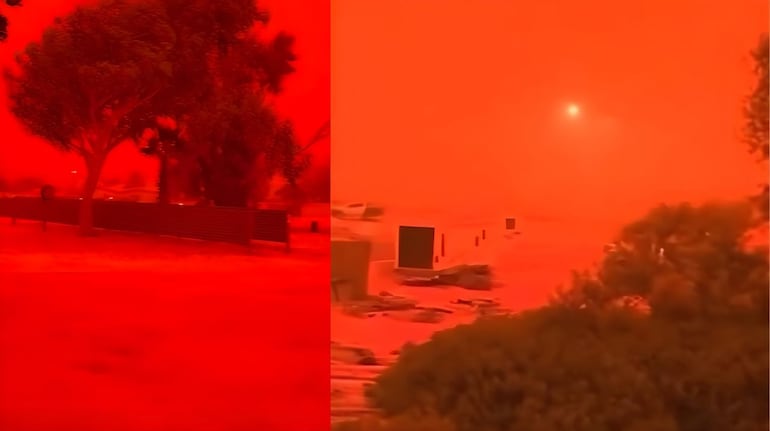
New Delhi, March 30, 2026: An apocalyptic scene unfolded across the coast of Western Australia this past weekend as residents woke up to a sky turned a deep, blood-red hue. The phenomenon, which was captured in numerous viral videos on March 27, 2026, transformed the day into an eerie dusk, leaving many to wonder if they were witnessing a digital filter or a scene from a science fiction movie. The most dramatic footage emerged from the Gascoyne and Pilbara regions, particularly in towns like Shark Bay and Denham, where visibility was reduced to near zero.
The “truth” behind the crimson glow is rooted in the arrival of Tropical Cyclone Narelle, a powerful weather system that has taken an unusual “triple-strike” path across Australia. As the cyclone intensified to a Category 3-4 storm off the Western Australian coast, its high-velocity winds—reaching gusts of up to 250 km/h—vacuumed up massive quantities of iron-rich dust from the arid outback. This mineral-heavy dust was suspended in the atmosphere, creating a dense haze that completely altered the way sunlight reached the ground.
The Physics of Mie Scattering and Iron Oxide
The dramatic color shift is explained by the scientific principle known as light scattering. While the sky is normally blue due to Rayleigh scattering (the scattering of light by small gas molecules), the presence of much larger dust particles triggered a process called “Mie scattering.” It is noted by meteorologists that the soil in the Australian interior is particularly high in iron oxide, also known as hematite, which naturally reflects red and orange light while absorbing shorter blue and green wavelengths.
As the sun’s rays passed through the thick layers of suspended iron dust, the shorter wavelengths were filtered out, allowing only the long, red wavelengths to dominate the horizon. This effect was further intensified by the timing of the storm’s approach, as the low angle of the sun during the late afternoon forced light to travel through even more of the dust-laden atmosphere. The result was a vivid, blood-red appearance that many residents described as “frightening yet fascinating.”
Also Read: Mother at Burj Khalifa Wins Millions of Hearts
Impact of Cyclone Narelle and Environmental Risks
Beyond the visual spectacle, Tropical Cyclone Narelle has brought significant structural challenges to the region. It is reported that the storm’s destructive winds have caused power outages and ripped roofs off several buildings in Exmouth and Coral Bay. The massive dust storm that preceded the rain also posed health risks, with local authorities issuing warnings for individuals with respiratory conditions due to the high concentration of airborne particulates.
As of March 30, 2026, the cyclone has weakened into a subtropical low, but the environmental impact of the event is still being studied. Scientists are particularly interested in how the iron-rich dust settling into the Indian Ocean might trigger nutrient cycles that affect marine life. While the “Blood-Red Sky” has faded, the incident serves as a stark reminder of the intense and unpredictable relationship between Australia’s unique geology and its extreme weather patterns.