

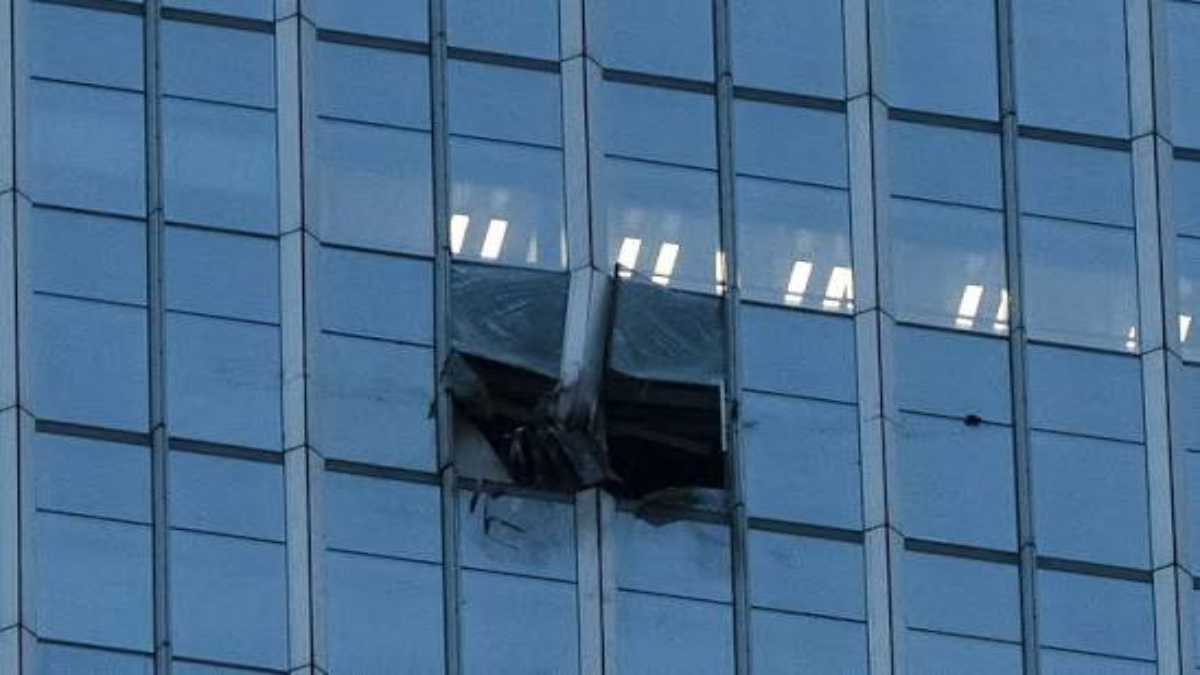
New Delhi, June 27, 2026 — A light sport aircraft crashed into Beijing’s tallest building, the iconic CITIC Tower, on Friday afternoon, June 26, 2026. The collision sent metal debris and shattered glass raining down into the streets of the capital’s busy Central Business District (CBD). The extraordinary incident triggered an immediate, massive emergency response, leading to the full evacuation of the 109-story skyscraper and a tight security lockdown across several city blocks.
The aircraft involved has been identified as a Sunward SA 60L Aurora, a light, two-seater Chinese-made sport aircraft roughly the size of a car. Operating under registration code B-12PP, the aircraft reportedly struck the upper floors of the skyscraper—with some reports pinpointing the impact area around the 65th floor—leaving a visible gash and fracturing multiple large glass panels on the building’s distinct curved exterior.
CITIC Tower, also known as China Zun, the tallest building in Beijing.. Source: gionnixxx / Getty Image.
The Sunward SA 60L Aurora, the same model of light sport aircraft involved in the collision.. Source: Wikipedia / Sunward SA 60L Aurora – Wikipedia
“Louder Than Fireworks”: Eyewitnesses Recount Moment of Impact
The collision occurred during the late Friday afternoon rush hour, a time when the surrounding financial hub is heavily populated. Eyewitnesses described a sudden, booming sound that reverberated through the district.
“It was incredibly loud—way louder than fireworks,” a courier working near the building told reporters. The worker stated that he rushed toward the CITIC Tower after hearing the blast at around 6:00 PM local time. He managed to capture initial cell phone video showing the aircraft fuselage protruding from the side of the skyscraper before emergency personnel instructed bystanders to clear the area.
Another worker inside the building recalled the harrowing scramble to safety after alarms began blaring. “I was told to evacuate immediately via the stairs and strictly warned not to use the elevators,” she noted, breathless after rushing down dozens of flights of stairs. “When I reached the ground and looked back, I could see debris scattered across the pavement. It clearly looked like pieces of an airplane.”
Videos quickly uploaded to social media platforms before being systematically removed by internet filters showed dramatic scenes of twisted metal and glass falling from the sky. On the streets below, a section of what appeared to be the aircraft’s tail assembly crushed the rear window of a parked taxi. Near the base of the tower, firefighters were captured on camera deploying water hoses to extinguish small fires burning on an exterior ground-floor outcropping where burning debris had landed.
The Flight Profile: A Dangerous Deviation
Preliminary flight-tracking data indicates that the light aircraft had taken off from Shifosi Airport, located on the outskirts of Beijing, approximately 30 minutes before the disaster. The flight was reportedly operated by a local general aviation company that typically utilizes the Sunward SA 60L Aurora for pilot training, recreational flights, and aerial photography.
According to flight records, the pilot—who is believed to have been the sole occupant on board—was preparing to return to Shifosi Airport for a standard landing sequence around 5:40 PM. However, shortly before its scheduled arrival, the aircraft dramatically deviated from its authorized flight path.
Radar data tracked the plane moving deep into restricted airspace toward the East Fifth Ring Road before the tracking signal suddenly cut out entirely. Minutes later, the plane slammed directly into the side of the 528-meter (1,732-foot) skyscraper
Strict Airspace Controls and Immediate Information Blackout
An incident of this nature is exceptionally rare and highly sensitive in Beijing, where the central government enforces some of the tightest low-altitude airspace restrictions in the world. The capital’s skies are heavily monitored, and unauthorized flights are virtually non-existent. Notably, on May 1, authorities implemented sweeping new rules that transformed nearly the entire metropolitan area into a strictly regulated zone, explicitly banning the unapproved purchase, rental, or operation of even small consumer drones.
Because the crash pierced through these intense security layers, the official state response on the ground and online was instantaneous. Dozens of police cruisers, ambulances, and fire engines rapidly cordoned off the roads feeding into the Central Business District.
Journalists and international news agencies at the scene observed a heavy police presence. Officers actively intercepted passersby, strictly blocking anyone attempting to photograph or film the damaged facade of the tower. Multiple witnesses reported that security personnel forced them to delete photos and videos from their smartphones before ushering them away from the perimeter.
Concurrently, a massive digital cleanup swept through Chinese social media. Videos of the falling debris, images of the plane’s wing lying on the asphalt, and early discussions regarding the crash were scrubbed from platforms like Weibo and WeChat within hours of appearing.
Uncertain Casualties and Next Steps in the Investigation
As night fell over Beijing, the municipal government and local aviation regulatory bodies maintained a strict silence, issuing no immediate official statements regarding the cause of the crash or the status of those involved.
While unverified reports indicate that the pilot was the only person inside the plane, it remains unclear what injuries or fatalities may have occurred either on board the aircraft or among the thousands of office workers inside the tower and pedestrians on the streets below. Structural engineering teams are expected to join aviation inspectors to evaluate the integrity of the skyscraper’s upper floors, though the building’s reinforced design appears to have absorbed the impact without suffering catastrophic structural failure.
Investigators will focus heavily on determining whether the catastrophic flight path deviation was caused by a sudden mechanical failure, pilot incapacitation, or intentional action. Given the tower’s role as the prominent headquarters of the state-owned conglomerate CITIC Group, the investigation is being treated with the highest level of national security oversight.
The video report linked below from Republic World provides detailed visual coverage of the incident, including footage of the falling debris and the heavy emergency response surrounding the CITIC Tower.