

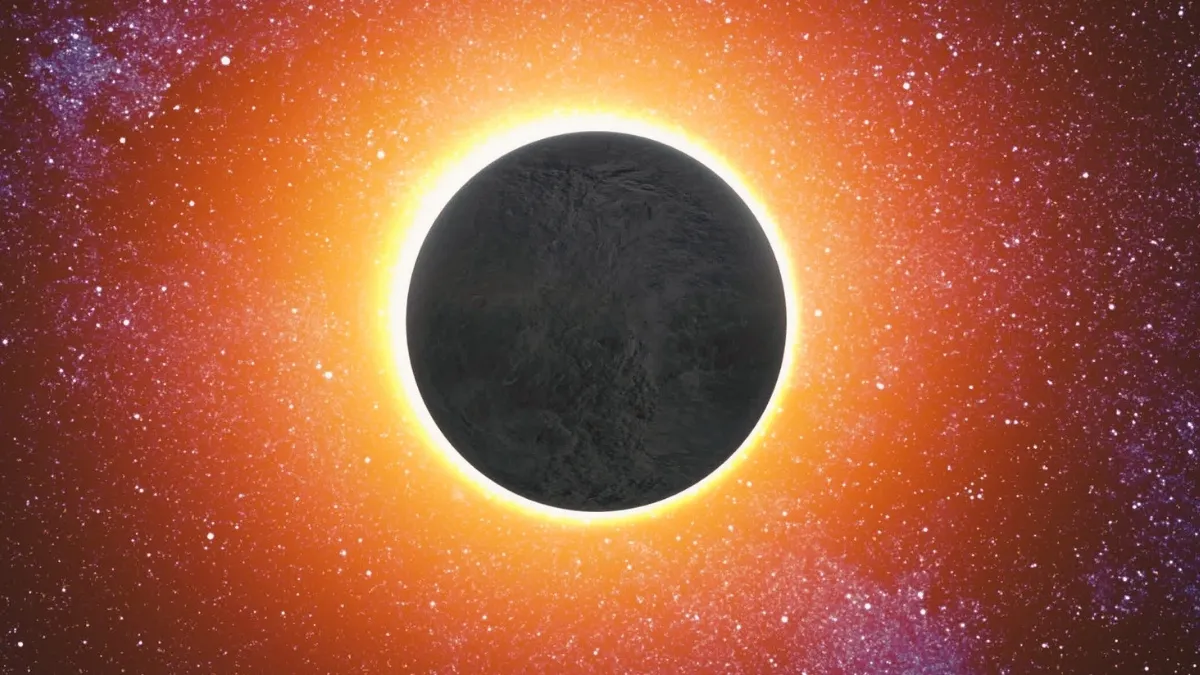
New Delhi, February 17, 2026: The year 2026 is set to be a landmark period for amateur astronomers and seasoned eclipse chasers alike. Leading the charge is the February 17, 2026, Annular Solar Eclipse, a stunning celestial event that will transform the sun into a glowing “Ring of Fire.”
While the world often focuses on total solar eclipses, the annular variety offers a unique aesthetic that is equally haunting and beautiful. Here is everything you need to know about the first major solar event of 2026.
What is a ‘Ring of Fire’ Eclipse?
An annular solar eclipse occurs when the Moon passes directly between the Earth and the Sun but is at or near its farthest point from Earth (apogee). Because the Moon appears slightly smaller in the sky than the Sun, it cannot completely cover the solar disk.
The result is a brilliant, narrow ring of sunlight—the annulus—that remains visible around the dark silhouette of the Moon. This creates the iconic “Ring of Fire” effect. Unlike a total eclipse, the sky does not go completely dark, and at no point is it safe to look at the Sun without specialized eye protection.
Visibility: Where to See the 2026 Annular Eclipse
The path of annularity for the February 17 eclipse is quite exclusive, primarily favoring the most remote regions of the globe.
- The Path of Annularity: The full “Ring of Fire” will be visible along a track crossing Antarctica and the surrounding Southern Ocean. Research stations and the occasional expedition vessel will be the only witnesses to the maximum phase.
- Partial Visibility: A partial solar eclipse will be visible across much broader regions, including:
- Southern Africa: South Africa (Cape Town, Durban), Namibia, and Zimbabwe.
- South America: The southern tips of Chile and Argentina.
- Island Nations: Madagascar, Mauritius, and Reunion.
- Excluded Regions: Much of the Northern Hemisphere, including India, North America, and Europe, will not be able to view this specific event.
Looking Ahead: The Total Solar Eclipse of August 2026
If you miss the February event, 2026 has a second, even more dramatic act in store. On August 12, 2026, a Total Solar Eclipse will grace the Northern Hemisphere. This event will be visible from:
- Greenland and Iceland
- Northern Spain and Portugal
- The Arctic Ocean
This will be Europe’s first total solar eclipse in over two decades, making it one of the most anticipated travel events of the year.
How to Watch Safely
Whether you are viewing the “Ring of Fire” or a partial phase, safety is paramount. The Sun’s rays are powerful enough to cause permanent retinal damage in seconds.
- ISO-Certified Glasses: Always use eclipse glasses that meet the ISO 12312-2 international safety standard.
- Solar Filters: If using a telescope, binoculars, or a camera, you must use a professional-grade solar filter on the front of the lens.
- Pinhole Projectors: If you don’t have glasses, you can create a simple pinhole projector to watch the shadow of the eclipse on the ground.
- Live Streams: For those outside the visibility zone, major space agencies like NASA often provide high-definition live streams from the path of annularity.
The Scientific & Cultural Significance
For scientists, these events are more than just a light show; they allow for the study of the Earth’s ionosphere and the Sun’s outer atmosphere. Culturally, eclipses remain a time of reflection and wonder, reminding us of the precise “celestial clockwork” that governs our solar system.